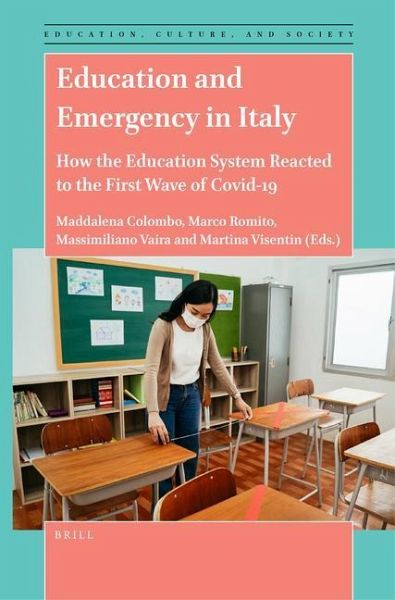
The nine chapters in this book explore how the Italian education system responded to distance learning during the first wave of the pandemic. The impact of the hard lockdown on both teaching and learning revealed the inherent weaknesses of a system in which digital technology had only recently been introduced and highlighted the relevant inequalities in their access and use. While students, teachers and families adapted (albeit with difficulty) to the new learning and teaching routines, the institutions faced the challenge of ensuring quality and equality. By including various case studies and…mehr
The nine chapters in this book explore how the Italian education system responded to distance learning during the first wave of the pandemic. The impact of the hard lockdown on both teaching and learning revealed the inherent weaknesses of a system in which digital technology had only recently been introduced and highlighted the relevant inequalities in their access and use. While students, teachers and families adapted (albeit with difficulty) to the new learning and teaching routines, the institutions faced the challenge of ensuring quality and equality. By including various case studies and unedited sets of data collected in different areas of the country, the book offers up-to-date insights on the impact of the pandemic on the Italian school system and provides a broad introduction to the educational emergency from a sociological perspective. The volume ends with a post-commentary comparing the Italian case with the similar situation of school closure as it occurred in the United Kingdom. Contributors are: Paolo Barabanti, Eduardo Barberis, Nico Bazzoli, Rita Bertozzi, Stefania Capogna, Gianna Cappello, Domenico Carbone, Maddalena Colombo, Joselle Dagnes, Maria Chiara De Angelis, Maurizio Merico, Diego Mesa, Flaminia Musella, Francesco Ramella, Marco Romito, Michele Rostan, Mariagrazia Santagati, Tatiana Saruis, Fausta Scardigno, Spyros Themelis, Massimiliano Vaira and Martina Visentin.
Maddalena Colombo is Full Professor in Sociology of Cultural and Communicative Processes at Università Cattolica del Sacro Cuore, Milan. She coordinated the Italian Sociological Association's Sociology of Education section (AIS-EDU) from 2018 to 2021. Her research interest are educational inequalities, training and socialization processes and supply, education systems, impacts of migration in schools and the curriculum, social changes in teachers' role, and intercultural competences. Marco Romito is Assistant Professor at the Department of Sociology and Social Research at the University of Milano-Bicocca. He is member of the Scientific Committee of the Italian Sociological Association's Sociology of Education section (AIS-EDU) and member of the editorial board of the journal Scuola democratica. He researches educational inequalities in schools and higher education, on educational transitions and on the digitalization of education. Massimiliano Vaira is Associate Professor of Sociology of Economy at the University of Pavia. He is member of the Consortium of Higher Education Researchers (CHER) and of the Scientific Committee of the journal Scuola democratica. His research interests are comparative analysis of higher education systems, the academic profession and work conditions, university and industry relationships, the Third Mission of universities and public engagement. He was a member of the Scientific Committee of the Italian Sociological Association's Sociology of Education section (AIS-EDU) from 2018 to 2021. Martina Visentin is Assistant Professor at the University of Padua, where she teaches Sociology and Social Policies. Her academic research focuses on social innovation, youth studies and cultural transformation. She has collaborated as a researcher and as a consultant for several services and universities. She was a member of the Scientific Committee of the Italian Sociological Association's Sociology of Education section (AIS-EDU) from 2018 to 2021.
Es gelten unsere Allgemeinen Geschäftsbedingungen: www.buecher.de/agb
Impressum
www.buecher.de ist ein Internetauftritt der buecher.de internetstores GmbH
Geschäftsführung: Monica Sawhney | Roland Kölbl | Günter Hilger
Sitz der Gesellschaft: Batheyer Straße 115 - 117, 58099 Hagen
Postanschrift: Bürgermeister-Wegele-Str. 12, 86167 Augsburg
Amtsgericht Hagen HRB 13257
Steuernummer: 321/5800/1497
USt-IdNr: DE450055826