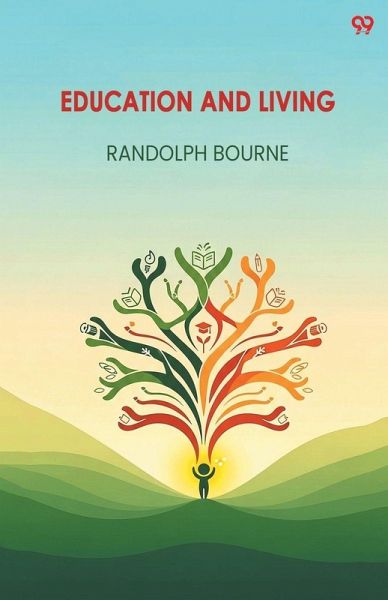
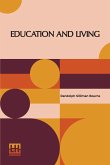
Education and living is a collection of essays on educational reform that challenges the rigid structures of traditional schooling and promotes a model where learning is interwoven with the rhythms of daily life. Drawing on progressive philosophies, particularly those aligned with experiential learning, the essays critique conventional institutions that reduce education to mechanical drills and conformity. Instead, the work advocates for an approach that fosters curiosity, creativity, and meaningful participation. The essays argue that education should reflect the real needs of children and…mehr
Education and living is a collection of essays on educational reform that challenges the rigid structures of traditional schooling and promotes a model where learning is interwoven with the rhythms of daily life. Drawing on progressive philosophies, particularly those aligned with experiential learning, the essays critique conventional institutions that reduce education to mechanical drills and conformity. Instead, the work advocates for an approach that fosters curiosity, creativity, and meaningful participation. The essays argue that education should reflect the real needs of children and encourage personal growth through exploration rather than submission to imposed standards. The early chapters focus on the misalignment between institutional goals and the developmental needs of young minds, framing schools as spaces that often hinder rather than help genuine learning. The author urges educators to cultivate environments where play, imagination, and inquiry lead the way, transforming education into a dynamic part of everyday living. Through reflective criticism and visionary proposals, the work makes a compelling case for reshaping how society views knowledge, childhood, and the purpose of teaching.
Randolph Silliman Bourne was a writer and public thinker active in the early 20th century. Known for his sharp critiques and original ideas, Bourne contributed extensively to discussions around education, war, and social reform. A graduate of Columbia University, Bourne was deeply influenced by progressive educational theories and sought to challenge traditional norms through his essays. His writing appeared in influential journals of the time, where he voiced concerns about the mechanization of schooling and the moral consequences of war. His work often reflected a belief in diversity, individual development, and democratic engagement. Despite a short life, Bourne left behind a legacy of intellectual courage and commitment to reshaping modern thought. His essays continue to be referenced in conversations around reform, particularly in the areas of education and cultural identity. Bourne's perspective was not bound by convention; instead, it was grounded in a desire to foster more humane, inclusive institutions. Through his critical analysis and forward-thinking approach, he remains a notable figure in American intellectual history. His parents were Rachael Silliman and Charles Bourne.
Es gelten unsere Allgemeinen Geschäftsbedingungen: www.buecher.de/agb
Impressum
www.buecher.de ist ein Internetauftritt der buecher.de internetstores GmbH
Geschäftsführung: Monica Sawhney | Roland Kölbl | Günter Hilger
Sitz der Gesellschaft: Batheyer Straße 115 - 117, 58099 Hagen
Postanschrift: Bürgermeister-Wegele-Str. 12, 86167 Augsburg
Amtsgericht Hagen HRB 13257
Steuernummer: 321/5800/1497
USt-IdNr: DE450055826