While Europe is certainly one of the richest and most educated areas of the world, some of the challenges faced by the old continent are staggering: low economic growth, structural difficulties in the labour market, and increasing international competition. Politicians and policymakers may advocate different means of overcoming the potential economic decline of Europe, but most agree that Europe needs to strengthen human capital, its ultimate competitive advantage in the world economy. This book looks at the accumulation of human capital from two perspectives, first through formal education…mehr
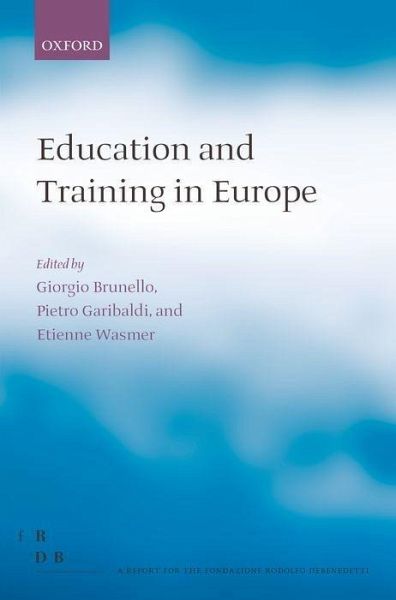
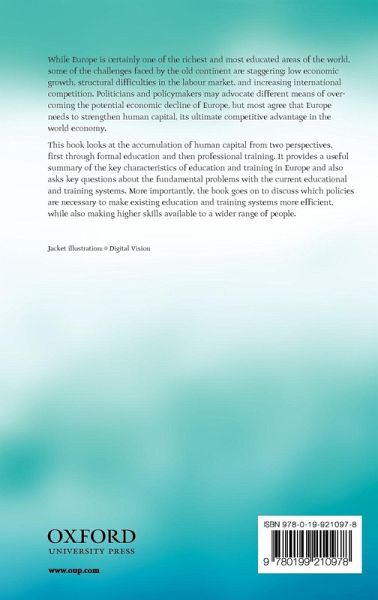
While Europe is certainly one of the richest and most educated areas of the world, some of the challenges faced by the old continent are staggering: low economic growth, structural difficulties in the labour market, and increasing international competition. Politicians and policymakers may advocate different means of overcoming the potential economic decline of Europe, but most agree that Europe needs to strengthen human capital, its ultimate competitive advantage in the world economy. This book looks at the accumulation of human capital from two perspectives, first through formal education and then professional training. It provides a useful summary of the key characteristics of education and training in Europe and also asks key questions about the fundamental problems with the current educational and training systems. More importantly, the book goes on to discuss which policies are necessary to make existing education and training systems more efficient, while also making higher skills available to a wider range of people.
Giorgio Brunello holds a MsC in Economics from the LSE and a PhD in Economics from Osaka University, Japan. He has taught at Osaka, Venice, and is currently Professor of Economics in Padova. He is a Research Fellow at IZA (Bonn) and CESifo (Munich). Pietro Garibaldi is Professor of Economics at the University of Turin, and acts as Economic Counselor of the Italian Ministry of Finance. He is also head of Labor Studies for the Fondazione Debenedetti and research fellow at IGIER, CEPR, and IZA. He holds a PhD in Economics from the London School of Economics. He was previously an economist in the IMF Research Department and an associate professor of Economics at Bocconi University. Etienne Wasmer is Professor of Economics at Sciences Po. Paris and at Université du Québec à Montréal. He is also a Research Fellow in both the Labour Program and the International Macro Program of CEPR. Etienne received a Ph.D. in Economics from the London School of Economics. He is also associate editor of the French think tank on-line telos, and been a consultant for the European Commission for the Socio-Economic Impact of the Cohesion Fund and the Ministry of Finance in Québec. He is currently External Member of the Council of Economic Advisors of the French Prime Minister.
Inhaltsangabe
Introduction Part I The Macroeconomics of Education 1: Theory and Facts Part A- Education Priorities: Growth vs. Cohesion 2: Cohesion and the Supply of General Skills in Europe 3: Higher Education, Innovation, and Growth Part B- The Margins of Improvement in Education Institutions: Skill Mismatch, Skill Portability, and Mobility 4: Internal Mobility, Skills, and Education 5: Skill Mismatch and Over-qualification in the Enlarged Europe 6: Specificity of Skills and Reallocation 7: Policy Implications Part II Workplace Training in Europe 8: Introduction 9: An Overview of the Theoretical Framework 10: Stylised Facts About Workplace Training 11: Training and Labour Market Institutions 12: The Costs and Benefits of Workplace Training 13: Is There Scope for Policy? Final Remarks
Es gelten unsere Allgemeinen Geschäftsbedingungen: www.buecher.de/agb
Impressum
www.buecher.de ist ein Internetauftritt der buecher.de internetstores GmbH
Geschäftsführung: Monica Sawhney | Roland Kölbl | Günter Hilger
Sitz der Gesellschaft: Batheyer Straße 115 - 117, 58099 Hagen
Postanschrift: Bürgermeister-Wegele-Str. 12, 86167 Augsburg
Amtsgericht Hagen HRB 13257
Steuernummer: 321/5800/1497
USt-IdNr: DE450055826