
Andere Kunden interessierten sich auch für
 AUTISM IN HIGHER EDUCATION29,99 €
 The prospect of access to higher education40,99 €
 Social Networks and Learning in Distance Education27,99 €
 School Environments for Basic and Secondary Education for Educational Institutions in Colombia36,99 €
 Pedagogical themes Written from the School Floor36,99 €
 Other techniques for compensatory corrective treatment56,99 €
 PEDAGOGICAL EXPERIENCE AND SUPPORT FOR STUDENTS IN HIGHER EDUCATION27,99 €
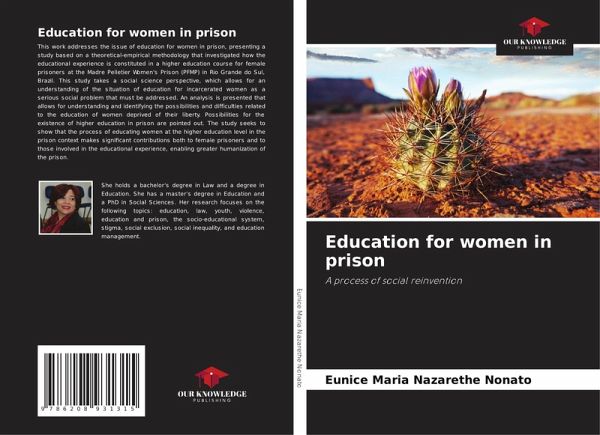
This work addresses the issue of education for women in prison, presenting a study based on a theoretical-empirical methodology that investigated how the educational experience is constituted in a higher education course for female prisoners at the Madre Pelletier Women's Prison (PFMP) in Rio Grande do Sul, Brazil. This study takes a social science perspective, which allows for an understanding of the situation of education for incarcerated women as a serious social problem that must be addressed. An analysis is presented that allows for understanding and identifying the possibilities and difficulties related to the education of women deprived of their liberty. Possibilities for the existence of higher education in prison are pointed out. The study seeks to show that the process of educating women at the higher education level in the prison context makes significant contributions both to female prisoners and to those involved in the educational experience, enabling greater humanization of the prison.