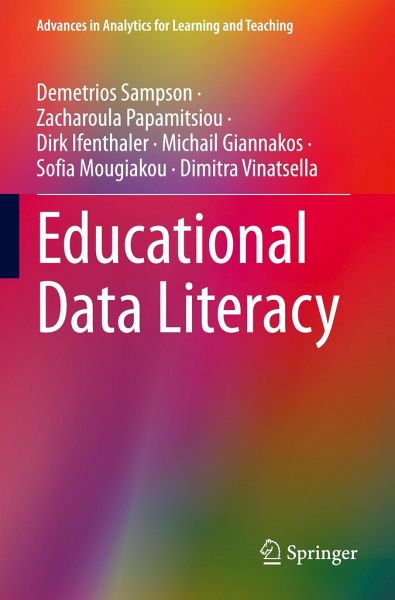
Digital Education is recognised as a key transformative innovation for K-12 school and university teaching and learning, as well as, for professional development and vocational training. As a result, blended and online courses are nowadays widely deployed to meet the needs of K-12, higher education and vocational training students, as well as, the needs for professional development of in-service professionals. In this context, important professional roles in digital education and training, such as, the Instructional Designers, who design and develop online and blended courses, and the Trainers…mehr
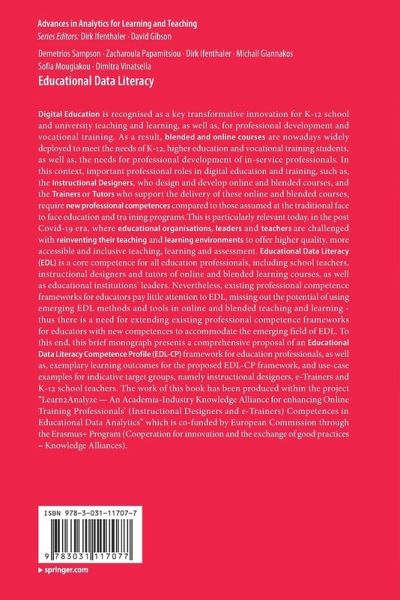
Digital Education is recognised as a key transformative innovation for K-12 school and university teaching and learning, as well as, for professional development and vocational training. As a result, blended and online courses are nowadays widely deployed to meet the needs of K-12, higher education and vocational training students, as well as, the needs for professional development of in-service professionals. In this context, important professional roles in digital education and training, such as, the Instructional Designers, who design and develop online and blended courses, and the Trainers or Tutors who support the delivery of these online and blended courses, require new professional competences compared to those assumed at the traditional face to face education and tra ining programs.This is particularly relevant today, in the post Covid-19 era, where educational organisations, leaders and teachers are challenged with reinventing their teaching and learning environmentsto offer higher quality, more accessible and inclusive teaching, learning and assessment. Educational Data Literacy (EDL) is a core competence for all education professionals, including school teachers, instructional designers and tutors of online and blended learning courses, as well as educational institutions' leaders. Nevertheless, existing professional competence frameworks for educators pay little attention to EDL, missing out the potential of using emerging EDL methods and tools in online and blended teaching and learning - thus there is a need for extending existing professional competence frameworks for educators with new competences to accommodate the emerging field of EDL. To this end, this brief monograph presents a comprehensive proposal of an Educational Data Literacy Competence Profile (EDL-CP) framework for education professionals, as well as, exemplary learning outcomes for the proposed EDL-CP framework, and use-case examples for indicative target groups, namely instructional designers, e-Trainers and K-12 school teachers. The work of this book has been produced within the project "Learn2Analyze - An Academia-Industry Knowledge Alliance for enhancing Online Training Professionals' (Instructional Designers and e-Trainers) Competences in Educational Data Analytics" which is co-funded by European Commission through the Erasmus+ Program (Cooperation for innovation and the exchange of good practices - Knowledge Alliances).
Sofia Mougiakou is a Computer Science teacher in secondary education since 1996. She holds a B.Sc. in "Informatics and Telecommunications" (November 1994) from the Department of Informatics and Telecommunications of the National and Kapodistrian University of Athens, Greece, a M.Sc. in "Electronic Automation" (June 1998) from the Department of Informatics and Telecommunications, National and Kapodistrian University of Athens, Greece, as well as a M.Sc. with distinction in e-Learning from the Department of Digital Systems, University of Piraeus, Greece (June 2020). She has two years of administrative experience as a high school principal and 10 years as Head of the Center of Informatics and New Technologies of the Directorate of Secondary Education of Piraeus. She has 15 years of teaching experience as a computer science teacher in secondary education. She participated as a member of the Education Committee in two co-funded European projects for teachers' professional development, as well as in the Learn2Analyze project (Erasmus+ Knowledge Alliance Program). She has several conference publications regarding the exploiting of blended learning using the Moodle Learning Platform at the high-school level. Currently, she is a Ph.D. Candidate at the Department of Digital Systems, University of Piraeus, Greece. Dimitra Vinatsella holds a B.Sc. in "Informatics & Telecommunications" (2003) and a M.Sc. in "Communication Systems and Networks" (2007) from National and Kapodistrian University of Athens. She started to work as a Product Development Manager in Vodafone Greece responsible to act as an overall project manager for the planning, development, roll out and post launch monitoring of retail commercial Value Added Services and Products. In 2007, she joined the Greek Ministry of Education, Research and Religious Affairs, as Computer Science Teacher and since 2012 she has been working in a cross-functional team in the Center of Informatics and New Technologies of the Directorate of Secondary Education of Piraeus. She has a long experience in e-Learning utilizing innovative technologies and learning management systems and she has participated successfully in several scientific research European programmes, including the Learn2Analyze project. Currently, she is a Ph.D. Candidate at the Department of Digital Systems, University of Piraeus, Greece. Demetrios Sampson is a Professor of Digital Systems for Teaching and Learning at the Department of Digital Systems, University of Piraeus, Greece since 2003. He has been a Professor of Learning Technologies and Director of Research at the School of Education, Curtin University, Australia (2015-2017) and Senior Research (1999-2003) at the Information Technologies Institute of the Center for Research and Technology - Hellas (CERTH).He is the co-author of 350 articles in scientific books, journals and conferences, and the editor of 90+ books, special issues in academic journals and international conference proceedings books. He has received 10 times Best Paper Award in International Conferences on Learning Technologies. He has been a Keynote/Invited Speaker/Lecturer in 100+ International/National Conferences and/or Postgraduate Programs around the world; project director, principle investigator and/or research consultant in 70 Research and Innovation projects with external funding at the range of 16 MillionEUR. He has supervised 180+ honours and postgraduate students to successful completion since 2003. He has developed and delivers the first Massive Online Open Course (MOOC) on the use of Educational Data Analytics by School Teachers (Analytics for the Classroom Teacher), offered by the edX platform (a Harvard and MIT led global initiative) which has attracted more than 25.000 participants from 180 countries around the world since October 2016. He lead an international University-Industry Consortium (Learn2Analyse) that promotesd professional development in EducationalData
Inhaltsangabe
Introduction.- State of the Art in Educational Data Literacy (brief environment scan).- Towards an Educational Data Literacy Competence Model (the Learn2Analyse proposal).- Educational Data Literacy Competence Model: From theory to practice (exemplify how the EDL-CP can be put into practice).- Conclusions and Future Direction.
Introduction.- State of the Art in Educational Data Literacy (brief environment scan).- Towards an Educational Data Literacy Competence Model (the Learn2Analyse proposal).- Educational Data Literacy Competence Model: From theory to practice (exemplify how the EDL-CP can be put into practice).- Conclusions and Future Direction.
Es gelten unsere Allgemeinen Geschäftsbedingungen: www.buecher.de/agb
Impressum
www.buecher.de ist ein Internetauftritt der buecher.de internetstores GmbH
Geschäftsführung: Monica Sawhney | Roland Kölbl | Günter Hilger
Sitz der Gesellschaft: Batheyer Straße 115 - 117, 58099 Hagen
Postanschrift: Bürgermeister-Wegele-Str. 12, 86167 Augsburg
Amtsgericht Hagen HRB 13257
Steuernummer: 321/5800/1497
USt-IdNr: DE450055826