
Andere Kunden interessierten sich auch für
 Relocating to Algeria14,99 €
 Revolutionary Emotions in Cold War Egypt40,99 €
 Sketches in Egypt17,99 €
 Mecca of Revolution46,99 €
 How the Church Under Pius XII Addressed Decolonization38,99 €
 The Tunisian Exception39,99 €
 Sudan's Blood Memory29,99 €







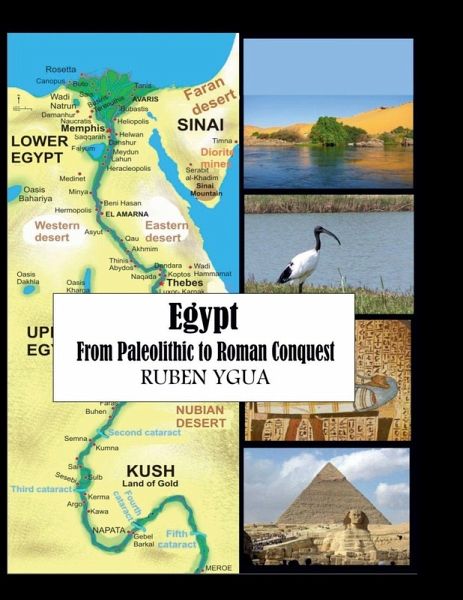
The primitive name of Egypt was KEMET, which means "black earth" due to the fertile black silt deposited by the rising of the Nile. This differentiated the territory from the desert, which was known as "Red Earth". In the future Coptic language, the country was known as KIMI, and its Near Eastern neighbors knew it as KHEMIA. In the pre-pharaonic period, Lower Egypt was called TAMEHEW, land of the north, and Upper Egypt was TASHEMEAW, the land of sedge, an aromatic plant. The ancient Mycenaean called it HAKPHTAH, "home of Ptah", which was the name of Memphis, the capital of the unified country. Over time this term was altered, until AÍGYPTAH arose, from which it derives its modern name, Egypt. PREHISTORY Between 500,000 and 35,000- In the Kerma region, Upper Nubia: the earliest evidence of settlement at Kaddanarti and Kabrinarti, north of Dongola. The most spectacular deposit is on the summit of an ancient volcano, 40 km from the Nile. Settlements were also discovered on Mograt Island, the largest island in the Nile and located in Abu Hamed Reach. Several sites with Mousterian technology were found in the area of the second cataract. 50,000- Four Khormusian sites, located on the eastern bank of the Nile along the Khor Musa branch. 19,500- At the end of the last Pleistocene Ice Age, which was also the harshest, a climatic change marked by an alternation of temperate and cold phases begins. These alterations allowed the extension of forest masses, but also provoked the formation of wide steppe and/or semi-desert strips around the tropics. As a consequence of these changes, the large mammals that had formed the basis of the diet of Upper Paleolithic humans became extinct or migrated: the woolly mammoth and the woolly rhinoceros, among others, disappeared, and animals such as reindeer and bison migrated northward. On the other hand, animals with less gregarious habits prospered, whose hunting was more complex: deer, wild boar, roe deer, rabbits, etc. To hunt them, man probably used dogs, the first animal he had domesticated as early as the end of the Upper Paleolithic. In Africa, on Lake Edward, near the source of the Nile River: Ishango bone, with marks suggesting understanding and mathematical calculations. Halfian culture in the upper Nile, Sudan: stone industry with Levallois technique. 19,400... ...