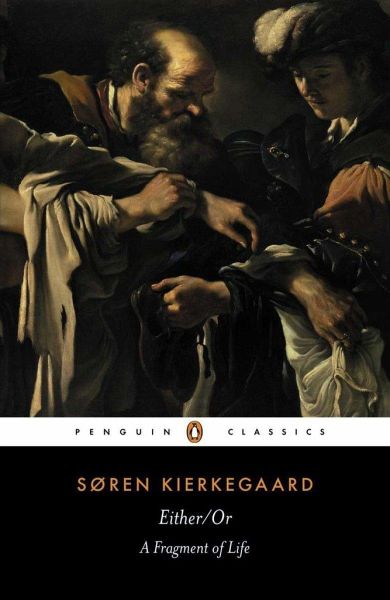
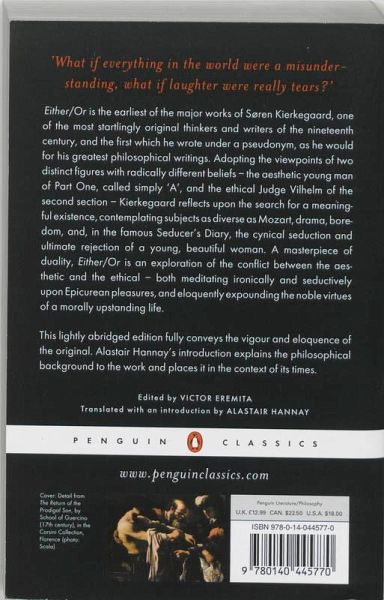
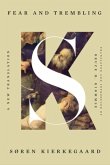
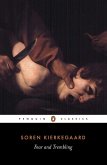
Published in 1843, this is one of the earliest of Kierkegaard's major works. The author plays devil's advocate putting forward two opposing points of view challenging the reader to question the different alternatives. This book is written to provoke philosophical debate.
Published in 1843, this is one of the earliest of Kierkegaard's major works. The author plays devil's advocate putting forward two opposing points of view challenging the reader to question the different alternatives. This book is written to provoke philosophical debate.
Kierkegaard (1813-55) was born in Copenhagen, the youngest of seven children. His childhood was unhappy, clouded by the religious fervour of his father, and the death of his mother, his sisters and two brothers. Educated at the School of Civic Virtue, he went on study theology, liberal arts and science at university, gaining a reputation for his academic brilliance and extravagant social life. He began to criticize Christianity, and in 1841 broke off his engagement to concentrate on his writing. Over the next ten years he produced a flood of works, in particular twelve major philosophical essays, many written under noms de plume. By the end of his life he had become an object of public ridicule, but he is now enjoying increasing acclaim. Alastair Hannay was educated at the Edinburgh Academy, the University of Edinburgh and University College London. In 1961 he became a resident of Norway and is now Emeritus Professor of Philosophy at the University of Oslo.
Inhaltsangabe
Either/Or Translator's Note Introduction Part One: Containing the Papers of A Preface 1. Diapsalmata 2. The Immediate Erotic Stages or the Musical Erotic 3. Ancient Tragedy's Reflection in the Modern 4. Shadowgraphs 5. The Unhappiest One 6. Crop Rotation 7. The Seducer's Diary Part Two: Containing the Papers of B: Letters to A 1. The Aesthetic Validity of Marriage 2. Equilibrium between the Aesthetic and the Ethical in the Development of Personality 3. Last Word 4. The Edifying in the Thought that Against God We Are Always in the Wrong Notes
Either/Or Translator's Note Introduction Part One: Containing the Papers of A Preface 1. Diapsalmata 2. The Immediate Erotic Stages or the Musical Erotic 3. Ancient Tragedy's Reflection in the Modern 4. Shadowgraphs 5. The Unhappiest One 6. Crop Rotation 7. The Seducer's Diary Part Two: Containing the Papers of B: Letters to A 1. The Aesthetic Validity of Marriage 2. Equilibrium between the Aesthetic and the Ethical in the Development of Personality 3. Last Word 4. The Edifying in the Thought that Against God We Are Always in the Wrong Notes
Es gelten unsere Allgemeinen Geschäftsbedingungen: www.buecher.de/agb
Impressum
www.buecher.de ist ein Internetauftritt der buecher.de internetstores GmbH
Geschäftsführung: Monica Sawhney | Roland Kölbl | Günter Hilger
Sitz der Gesellschaft: Batheyer Straße 115 - 117, 58099 Hagen
Postanschrift: Bürgermeister-Wegele-Str. 12, 86167 Augsburg
Amtsgericht Hagen HRB 13257
Steuernummer: 321/5800/1497
USt-IdNr: DE450055826