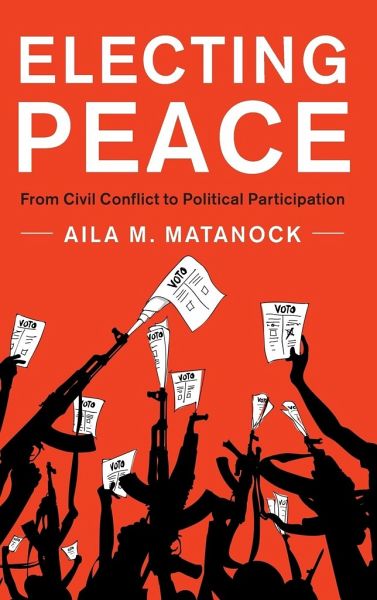
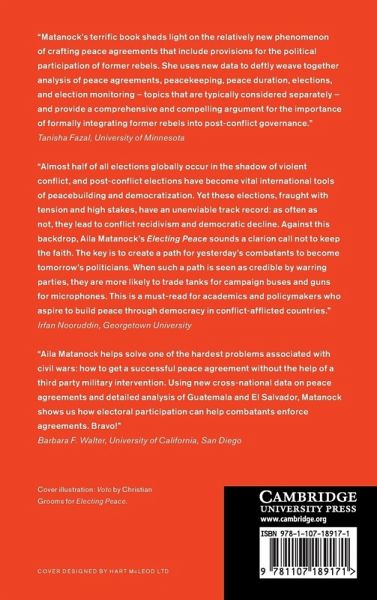
This book examines the causes and consequences of post-conflict elections in securing and stabilizing peace agreements without the need to send troops.
This book examines the causes and consequences of post-conflict elections in securing and stabilizing peace agreements without the need to send troops.
Aila M. Matanock is Assistant Professor of Political Science at the University of California, Berkeley. Her research addresses international intervention, civil conflict, and weak states. Her Stanford University dissertation, on which this book is based, won the 2013 Helen Dwight Reid Award from the American Political Science Association for the best dissertation from the previous two years in international relations, law, and politics.
Inhaltsangabe
Part I. Introduction and Theory: 1. Credible transitions from civil conflict: provisions for combatant participation in post-conflict elections; 2. Electoral participation provisions: a theory of external engagement; 3. International involvement over time: changes with the end of the Cold War and patterns there-after; Part II. Causes of Electoral Participation Provisions: 4. Trading bullets for ballots: examining the inclusion of electoral participation provisions; 5. Shifting expectations of engagement: paving a path for peace agreements based on electoral participation provisions; Part III. Consequences of Electoral Participation Provisions: 6. Participating for peace: examining the effect of electoral participation provisions on peace; 7. Engaging through elections: external observation and incentives around elections during implementation; Part IV. Conclusion: 8. Securing peace: conclusions about electoral participation and external engagement in post-conflict states.
Part I. Introduction and Theory: 1. Credible transitions from civil conflict: provisions for combatant participation in post-conflict elections; 2. Electoral participation provisions: a theory of external engagement; 3. International involvement over time: changes with the end of the Cold War and patterns there-after; Part II. Causes of Electoral Participation Provisions: 4. Trading bullets for ballots: examining the inclusion of electoral participation provisions; 5. Shifting expectations of engagement: paving a path for peace agreements based on electoral participation provisions; Part III. Consequences of Electoral Participation Provisions: 6. Participating for peace: examining the effect of electoral participation provisions on peace; 7. Engaging through elections: external observation and incentives around elections during implementation; Part IV. Conclusion: 8. Securing peace: conclusions about electoral participation and external engagement in post-conflict states.
Es gelten unsere Allgemeinen Geschäftsbedingungen: www.buecher.de/agb
Impressum
www.buecher.de ist ein Internetauftritt der buecher.de internetstores GmbH
Geschäftsführung: Monica Sawhney | Roland Kölbl | Günter Hilger
Sitz der Gesellschaft: Batheyer Straße 115 - 117, 58099 Hagen
Postanschrift: Bürgermeister-Wegele-Str. 12, 86167 Augsburg
Amtsgericht Hagen HRB 13257
Steuernummer: 321/5800/1497
USt-IdNr: DE450055826