
Andere Kunden interessierten sich auch für
 Kinetic Study of the Electrocoagulation Process24,99 €
") Organic Polymer Extracted from the Cactus (Cereus jamacaru)24,99 €
Organic Polymer Extracted from the Cactus (Cereus jamacaru)24,99 € Advanced Technologies of Water and Wastewater Treatment113,99 €
 Antimicrobial & Coagulation Performance of Chrysophyllum Albidum Seeds58,99 €
") Urban and Industrial Wastewater Disinfection and Decontamination by Advanced Oxidation Processes (AOPs)66,99 €
Urban and Industrial Wastewater Disinfection and Decontamination by Advanced Oxidation Processes (AOPs)66,99 € Eletrocoagulação no tratamento da água23,99 €
 Elettrocoagulazione nel trattamento dell'acqua23,99 €
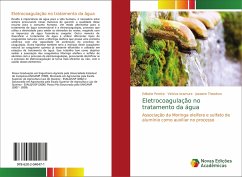
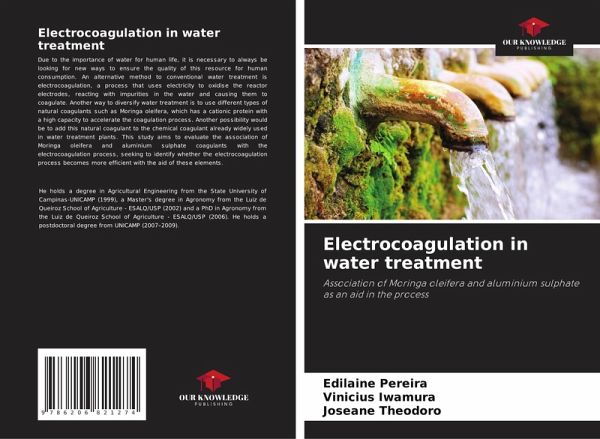
Due to the importance of water for human life, it is necessary to always be looking for new ways to ensure the quality of this resource for human consumption. An alternative method to conventional water treatment is electrocoagulation, a process that uses electricity to oxidise the reactor electrodes, reacting with impurities in the water and causing them to coagulate. Another way to diversify water treatment is to use different types of natural coagulants such as Moringa oleifera, which has a cationic protein with a high capacity to accelerate the coagulation process. Another possibility would be to add this natural coagulant to the chemical coagulant already widely used in water treatment plants. This study aims to evaluate the association of Moringa oleifera and aluminium sulphate coagulants with the electrocoagulation process, seeking to identify whether the electrocoagulation process becomes more efficient with the aid of these elements.