
Andere Kunden interessierten sich auch für
 Electromagnetic Radiation of Electrons in Periodic Structures113,99 €
 Beam-Wave Interaction in Periodic and Quasi-Periodic Structures76,99 €
 Progress in Nanophotonics 176,99 €
 Longitudinally Polarised Terahertz Radiation for Relativistic Particle Acceleration76,99 €
 Exciton Polaritons in Microcavities136,99 €
 Detection of Trapped Antihydrogen76,99 €
 Polarized Electrons77,99 €



This book offers state-of-the-art findings on both theoretical and applied research on achieving supply chain coordination under uncertainty. It examines supply chain coordination challenges with a focal point on discovering innovative measures.
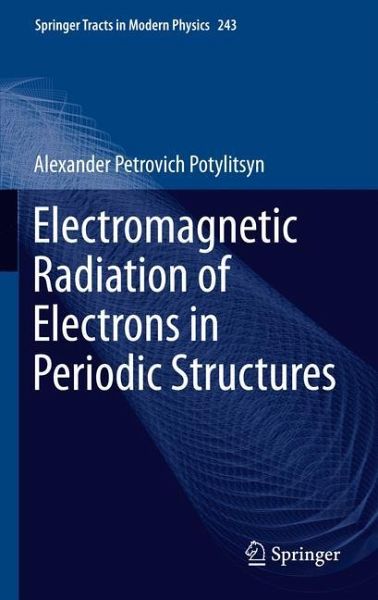
Periodic magnetic structures (undulators) are widely used in accelerators to generate monochromatic undulator radiation (UR) in the range from far infrared to the hard X-ray region. Another periodic crystalline structure is used to produce quasimonochromatic polarized photon beams via the coherent bremsstrahlung mechanism (CBS). Due to such characteristics as monochromaticity, polarization and adjustability, these types of radiation is of large interest for applied and basic research of accelerator-emitted radiation. The book provides a detailed overview of the fundamental principles behind electromagnetic radiation emitted from accelerated charged particles (e.g. UR, CBS, radiation of fast electrons in Laser flash fields) as well as a unified description of relatively new radiation mechanisms which attracted great interest in recent years. This are the so-called polarization radiation excited by the Coulomb field of incident particles in periodic structures, parametric X-rays, resonant transition radiation and the Smith-Purcell effect. Characteristics of such radiation sources and perspectives of their usage are discussed. The recent experimental results as well as their interpretation are presented.
Periodic magnetic structures (undulators) are widely used in accelerators to generate monochromatic undulator radiation (UR) in the range from far infrared to the hard X-ray region. Another periodic crystalline structure is used to produce quasimonochromatic polarized photon beams via the coherent bremsstrahlung mechanism (CBS). Due to such characteristics as monochromaticity, polarization and adjustability, these types of radiation is of large interest for applied and basic research of accelerator-emitted radiation. The book provides a detailed overview of the fundamental principles behind electromagnetic radiation emitted from accelerated charged particles (e.g. UR, CBS, radiation of fast electrons in Laser flash fields) as well as a unified description of relatively new radiation mechanisms which attracted great interest in recent years. This are the so-called polarization radiation excited by the Coulomb field of incident particles in periodic structures, parametric X-rays, resonant transition radiation and the Smith-Purcell effect. Characteristics of such radiation sources and perspectives of their usage are discussed. The recent experimental results as well as their interpretation are presented.
From the reviews:
"This monograph covers seven different techniques for producing quasimonochromatic radiation from high energy electron beams passing through or near periodic structures. ... It begins with a thorough but concise theoretical derivation of the technique, and ends with experimental results comparing the theory to reality. ... the material is presented very concisely but is thoroughly referenced so these sources can be readily consulted for additional information." (Albert C. Claus, Optics & Photonics News, May, 2012)
"This monograph covers seven different techniques for producing quasimonochromatic radiation from high energy electron beams passing through or near periodic structures. ... It begins with a thorough but concise theoretical derivation of the technique, and ends with experimental results comparing the theory to reality. ... the material is presented very concisely but is thoroughly referenced so these sources can be readily consulted for additional information." (Albert C. Claus, Optics & Photonics News, May, 2012)