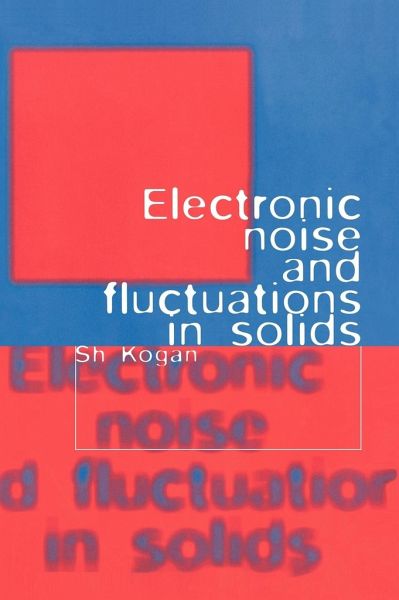
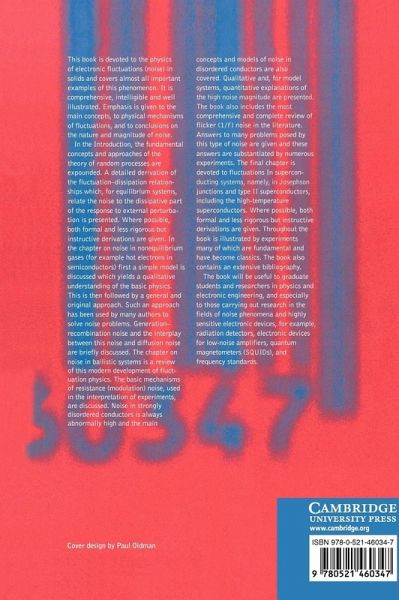
This book is devoted to the physics of electronic fluctuations (noise) in solids and covers almost all important examples of this phenomenon. It is comprehensive, intelligible and well illustrated. Emphasis is given to the main concepts, supported by many fundamental experiments which have become classics, to physical mechanisms of fluctuations, and to conclusions on the nature and magnitude of noise. The book also includes a comprehensive and complete review of flicker (1/f) noise in the literature. It will be useful to graduate students and researchers in physics and electronic engineering,…mehr
This book is devoted to the physics of electronic fluctuations (noise) in solids and covers almost all important examples of this phenomenon. It is comprehensive, intelligible and well illustrated. Emphasis is given to the main concepts, supported by many fundamental experiments which have become classics, to physical mechanisms of fluctuations, and to conclusions on the nature and magnitude of noise. The book also includes a comprehensive and complete review of flicker (1/f) noise in the literature. It will be useful to graduate students and researchers in physics and electronic engineering, and especially those carrying out research in the fields of noise phenomena and highly sensitive electronic devices, for example radiation detectors, electronic devices for low-noise amplifiers and quantum magnetometers (SQUIDS).
Preface Part I. Introduction. Some Basic Concepts of the Theory of Random Processes: 1. Probability density functions. Moments. Stationary processes 2. Correlation function 3. Spectral density of noise 4. Ergodicity and nonergodicity of random processes 5. Random pulses and shot noise 6. Markov processes. General theory 7. Discrete Markov processes. Random telegraph noise 8. Quasicontinuous (Diffusion-like) Markov processes 9. Brownian motion 10. Langevin approach to the kinetics of fluctuations Part II. Fluctuation-Dissipation Relations in Equilibrium Systems: 11. Derivation of fluctuation-dissipation relations 12. Equilibrium noise in quasistationary circuits. Nyquist theorem 13. Fluctuations of electromagnetic fields in continuous media Part III. Fluctuations in Nonequilibrium Gases: 14. Some basic concepts of hot-electrons' physics 15. Simple model of current fluctuations in a semiconductor with hot electrons 16. General kinetic theory of quasiclassical fluctuations in a gas of particles. The Boltzmann-Langevin equation 17. Current fluctuations and noise temperature 18. Current fluctuations and diffusion in a gas of hot electrons 19. One-time correlation in nonequilibrium gases 20. Intervalley noise in multivalley semiconductors 21. Noise of hot electrons emitting optical phonons in the streaming regime 22. Noise in a semiconductor with a postbreakdown stable current filament Part IV. Generation-recombination noise: 23. G-R noise in uniform unipolar semiconductors 24. Noise produced by recombination and diffusion Part V. Noise in quantum ballistic systems: 25. Introduction 26. Equilibrium noise and shot noise in quantum conductors 27. Modulation noise in quantum point contacts 28. Transition from a ballistic conductor to a macroscopic one 29. Noise in tunnel junctions Part VI. Resistance noise in metals: 30. Incoherent scattering of electrons by mobile defects 31. Effect of mobile scattering centers on the electron interference pattern 32. Fluctuations of the number of diffusing scattering centers 33. Temperature fluctuations and the corresponding noise Part VII. Noise in strongly disordered conductors: 34. Basic ideas of the percolation theory 35. Resistance fluctuations in percolation systems. 36. Experiments Part VIII. Low-frequency noise with an 1/f-type spectrum and random telegraph noise: 37. Introduction 38. Some general properties of 1/f noise 39. Basic models of 1/f noise 40./f noise in metals 41. Low-frequency noise in semiconductors 42. Magnetic noise in spin glasses and some other magnetic systems 43. Temperature fluctuations as a possible source of 1/f noise 44. Random telegraph noise 45. Fluctuations with 1/f spectrum in other systems 46. General conclusions on 1/f noise Part IX. Noise in Superconductors and Superconducting Structures: 47. Noise in Josephson junctions 48. Noise in type II superconductors References Subject index.
Preface Part I. Introduction. Some Basic Concepts of the Theory of Random Processes: 1. Probability density functions. Moments. Stationary processes 2. Correlation function 3. Spectral density of noise 4. Ergodicity and nonergodicity of random processes 5. Random pulses and shot noise 6. Markov processes. General theory 7. Discrete Markov processes. Random telegraph noise 8. Quasicontinuous (Diffusion-like) Markov processes 9. Brownian motion 10. Langevin approach to the kinetics of fluctuations Part II. Fluctuation-Dissipation Relations in Equilibrium Systems: 11. Derivation of fluctuation-dissipation relations 12. Equilibrium noise in quasistationary circuits. Nyquist theorem 13. Fluctuations of electromagnetic fields in continuous media Part III. Fluctuations in Nonequilibrium Gases: 14. Some basic concepts of hot-electrons' physics 15. Simple model of current fluctuations in a semiconductor with hot electrons 16. General kinetic theory of quasiclassical fluctuations in a gas of particles. The Boltzmann-Langevin equation 17. Current fluctuations and noise temperature 18. Current fluctuations and diffusion in a gas of hot electrons 19. One-time correlation in nonequilibrium gases 20. Intervalley noise in multivalley semiconductors 21. Noise of hot electrons emitting optical phonons in the streaming regime 22. Noise in a semiconductor with a postbreakdown stable current filament Part IV. Generation-recombination noise: 23. G-R noise in uniform unipolar semiconductors 24. Noise produced by recombination and diffusion Part V. Noise in quantum ballistic systems: 25. Introduction 26. Equilibrium noise and shot noise in quantum conductors 27. Modulation noise in quantum point contacts 28. Transition from a ballistic conductor to a macroscopic one 29. Noise in tunnel junctions Part VI. Resistance noise in metals: 30. Incoherent scattering of electrons by mobile defects 31. Effect of mobile scattering centers on the electron interference pattern 32. Fluctuations of the number of diffusing scattering centers 33. Temperature fluctuations and the corresponding noise Part VII. Noise in strongly disordered conductors: 34. Basic ideas of the percolation theory 35. Resistance fluctuations in percolation systems. 36. Experiments Part VIII. Low-frequency noise with an 1/f-type spectrum and random telegraph noise: 37. Introduction 38. Some general properties of 1/f noise 39. Basic models of 1/f noise 40./f noise in metals 41. Low-frequency noise in semiconductors 42. Magnetic noise in spin glasses and some other magnetic systems 43. Temperature fluctuations as a possible source of 1/f noise 44. Random telegraph noise 45. Fluctuations with 1/f spectrum in other systems 46. General conclusions on 1/f noise Part IX. Noise in Superconductors and Superconducting Structures: 47. Noise in Josephson junctions 48. Noise in type II superconductors References Subject index.
Es gelten unsere Allgemeinen Geschäftsbedingungen: www.buecher.de/agb
Impressum
www.buecher.de ist ein Internetauftritt der buecher.de internetstores GmbH
Geschäftsführung: Monica Sawhney | Roland Kölbl | Günter Hilger
Sitz der Gesellschaft: Batheyer Straße 115 - 117, 58099 Hagen
Postanschrift: Bürgermeister-Wegele-Str. 12, 86167 Augsburg
Amtsgericht Hagen HRB 13257
Steuernummer: 321/5800/1497
USt-IdNr: DE450055826