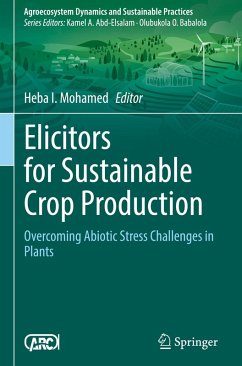
This book offers an approach to overcoming the challenges of abiotic stress in agriculture. By focusing on the role of plant elicitors, it provides a comprehensive exploration of how these compounds can activate a plant's immune system, leading to increased resistance against stressors such as salt, heavy metals, and temperature fluctuations. The chapters delve into a range of topics, including the cellular and molecular mechanisms modulated by elicitors, the protocols for their application, and their potential to reduce oxidative damage in plants. The book also addresses the critical…mehr
This book offers an approach to overcoming the challenges of abiotic stress in agriculture. By focusing on the role of plant elicitors, it provides a comprehensive exploration of how these compounds can activate a plant's immune system, leading to increased resistance against stressors such as salt, heavy metals, and temperature fluctuations. The chapters delve into a range of topics, including the cellular and molecular mechanisms modulated by elicitors, the protocols for their application, and their potential to reduce oxidative damage in plants. The book also addresses the critical questions such as the efficacy of plant elicitors in promoting sustainable agriculture. It also provides information on how physical and chemical treatments can activate plant defense systems and the role of elicitors in achieving a healthier, more productive harvest.
Designed for researchers, agricultural professionals, and farmers, this book offers innovative solutions to the challengesof abiotic stress in crops. It provides practical strategies for safeguarding crops and enhancing productivity, making it an invaluable resource for anyone interested in advancing sustainable agricultural practices.
Heba I. Mohamed is a professor of plant physiology at Ain Shams University, Egypt. She holds an M.Sc. and PhD in plant physiology from Ain Shams University. Dr. Heba’s research interests include biotic and abiotic stress responses, plant biochemistry, eco-friendly stress alleviation compounds, plant secondary metabolites, and genetic differences between genotypes. She has edited 5 books with Springer Nature, published 40+ book chapters, 6+ review articles, and over 120 research articles. Listed among the top 2% of the world's most influential scientists by Stanford University, Dr. Heba continues to contribute significantly to her field.
Inhaltsangabe
.- Chapter 1: Genotype × environment interaction in breeding programs: wide vs. specific adaptation .- Chapter 2: Impact of genotype-by-environment interaction on grain yield and related traits in multi-environment trials .- Chapter 3: QTL × environmental interactions underlying phenotypic stability or plasticity in crops: Which one to utilize .- Chapter 4: Contribution of yield related traits to G×E interaction for grain yield .- Chapter 5: Does Modern Plant Breeding Techniques Increase Crop Stability Performance .- Chapter 6: Does breeding for abiotic stress tolerance mitigate G×E interactions under a changing climate .- Chapter 7: Impact of biotic stresses influence on wheat G×E interactions and yield performance .- Chapter 8: Do soil properties significantly influence the G×E interaction of crop varieties? .- Chapter 9: Efficiency of multivariate statistical models in analysis of G×E interactions .- Chapter 10:A comparative study among multivariate statistical methods for analysing G×E interaction .- Chapter 11:Does drought tolerance enhance crop stability performance? .- Chapter 12:Genomic selection role to mitigate G×E interaction in plant breeding .- Chapter 13:Can selection in segregating population reduce the effects of G×E interactions in breeding programs? .- Chapter 14:A comparative study among parametric and non-parametric univariate stability statistics for stability analysis .- Chapter 15:An introductory guide to the usage of statistical softwares for investigating G×E interaction: from theory to application.
.- Chapter 1: Genotype × environment interaction in breeding programs: wide vs. specific adaptation .- Chapter 2: Impact of genotype-by-environment interaction on grain yield and related traits in multi-environment trials .- Chapter 3: QTL × environmental interactions underlying phenotypic stability or plasticity in crops: Which one to utilize .- Chapter 4: Contribution of yield related traits to G×E interaction for grain yield .- Chapter 5: Does Modern Plant Breeding Techniques Increase Crop Stability Performance .- Chapter 6: Does breeding for abiotic stress tolerance mitigate G×E interactions under a changing climate .- Chapter 7: Impact of biotic stresses influence on wheat G×E interactions and yield performance .- Chapter 8: Do soil properties significantly influence the G×E interaction of crop varieties? .- Chapter 9: Efficiency of multivariate statistical models in analysis of G×E interactions .- Chapter 10:A comparative study among multivariate statistical methods for analysing G×E interaction .- Chapter 11:Does drought tolerance enhance crop stability performance? .- Chapter 12:Genomic selection role to mitigate G×E interaction in plant breeding .- Chapter 13:Can selection in segregating population reduce the effects of G×E interactions in breeding programs? .- Chapter 14:A comparative study among parametric and non-parametric univariate stability statistics for stability analysis .- Chapter 15:An introductory guide to the usage of statistical softwares for investigating G×E interaction: from theory to application.
Es gelten unsere Allgemeinen Geschäftsbedingungen: www.buecher.de/agb
Impressum
www.buecher.de ist ein Internetauftritt der buecher.de internetstores GmbH
Geschäftsführung: Monica Sawhney | Roland Kölbl | Günter Hilger
Sitz der Gesellschaft: Batheyer Straße 115 - 117, 58099 Hagen
Postanschrift: Bürgermeister-Wegele-Str. 12, 86167 Augsburg
Amtsgericht Hagen HRB 13257
Steuernummer: 321/5800/1497
USt-IdNr: DE450055826