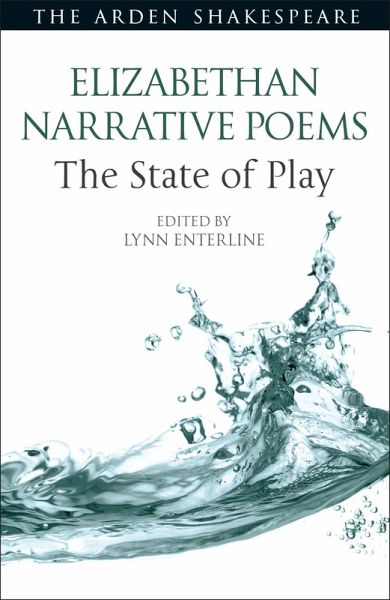
Tracing the development of narrative verse in London's literary circles during the 1590s, this volume puts Shakespeare's Venus and Adonis and The Rape of Lucrece into conversation with poems by a wide variety of contemporary writers, including Thomas Lodge, Francis Beaumont, Christopher Marlowe, Thomas Heywood, Thomas Campion and Edmund Spenser. Chapters investigate the complexities of this literary conversation and contribute for the current, vigorous reassessment of humanism's intended consequences by drawing attention to the highly diverse forms of early modern classicism as well as the…mehr
Tracing the development of narrative verse in London's literary circles during the 1590s, this volume puts Shakespeare's Venus and Adonis and The Rape of Lucrece into conversation with poems by a wide variety of contemporary writers, including Thomas Lodge, Francis Beaumont, Christopher Marlowe, Thomas Heywood, Thomas Campion and Edmund Spenser. Chapters investigate the complexities of this literary conversation and contribute for the current, vigorous reassessment of humanism's intended consequences by drawing attention to the highly diverse forms of early modern classicism as well as the complex connection between Latin pedagogy and vernacular poetic invention. Key themes and topics include: -Epyllia, masculinity and sexuality -Classicism and commerce -Genre and mimesis -Rhetoric and aesthetics
Lynn Enterline is Nancy Perot Mulford Professor of English at Vanderbilt University. She is author of The Rhetoric of the Body from Ovid to Shakespeare and The Tears of Narcissus: Melancholia and Masculinity in Early Modern Writing.
Inhaltsangabe
Series Preface Notes on Contributors Lynn Enterline, Introduction: On 'Schoolmen's Cunning Notes' Part One. Reckoning with Rhetoric 1. Jenny C. Mann, 'Reck'ning' with Shakespeare's Orpheus in The Rape of Lucrece 2. Rachel Eisendrath, Poetry at the Limits of Rhetoric in Shakespeare's The Rape of Lucrece Part Two. Debating Mimesis 3. Joseph M. Ortiz, Epic Oenone, Pastoral Paris: Undoing the Virgilian rota in Thomas Heywood's Oenone and Paris 4. Andrew Fleck, 'Arte with her contending, doth aspire T'excell the naturall': Contending for Representation in the Elizabethan Epyllion 5. Catherine Nicholson, Learning to Read with Lucrece Part Three. Epyllia, Masculinity and Sexuality 6. Jessica Winston, From Discontent to Disdain: Thomas Lodge's Scillaes Metamorphosis and Inns of Court 7. John S. Garrison, Love Will Tear Us Apart: Campion's Umbra and Shakespeare's Venus and Adonis 8. Stephen Guy-Bray, Love Loves: Venus and Adonis, Venus and Anchises Part Four. Classicism and Mercantile Capital 9. Jane Raisch, Crossing the Hellespont: The Erotics of the Everyday in Marlowe's Hero and Leander 10. Barbara Correll, 'Unthriftie waste': Epyllia, Idleness, and General Economy Appendix Notes Index
Es gelten unsere Allgemeinen Geschäftsbedingungen: www.buecher.de/agb
Impressum
www.buecher.de ist ein Internetauftritt der buecher.de internetstores GmbH
Geschäftsführung: Monica Sawhney | Roland Kölbl | Günter Hilger
Sitz der Gesellschaft: Batheyer Straße 115 - 117, 58099 Hagen
Postanschrift: Bürgermeister-Wegele-Str. 12, 86167 Augsburg
Amtsgericht Hagen HRB 13257
Steuernummer: 321/5800/1497
USt-IdNr: DE450055826