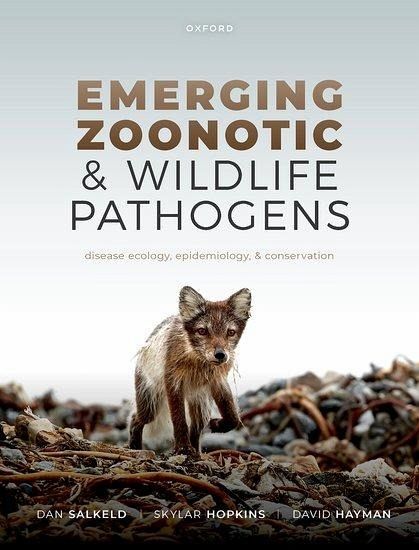
The first textbook to describe the ecology and epidemiology of wildlife and zoonotic (animal-to-human) infectious diseases and the applications to conservation biology and public health. Examples of disease agents enliven the text and illustrate many of the theories presented.
The first textbook to describe the ecology and epidemiology of wildlife and zoonotic (animal-to-human) infectious diseases and the applications to conservation biology and public health. Examples of disease agents enliven the text and illustrate many of the theories presented.
Dan Salkeld is an ecologist & epidemiologist at Colorado State University, USA, whose vagabond field research has included a suspected case of bubonic plague in Colorado, USA, a probable case of Bolivian histoplasmosis, and confirmed tick-bites in other exotic places (both geographically and physically, but mostly in California, USA). Salkeld has taught university classes on 'Ecology of Infectious Disease' and 'One Health' which have occasionally received lukewarm praise. His current research focuses on conservation and emerging infectious diseases. Skylar Hopkins is an Assistant Professor at N.C. State University, where she researches how global change affects parasites, people, and wildlife. She has a Ph.D. in Biological Sciences from Virginia Tech, where she specialized in getting stung by bees and examining snail gonads for parasites. Though much of her research involves mathematical and statistical models, she can also be found rappelling into caves to survey white-nose syndrome in bats or wrangling wild snakes to pick trematodes out of their mouths. She has only had one zoonotic disease (Lyme disease), and that was more than enough. David Hayman is a Professor at Massey University, New Zealand. Dave's research focuses on the intersection of disease ecology, conservation, and public health. He has studied emerging and neglected diseases and has had unpleasant personal experience with salmonellosis, myiasis, scabies, and malaria, among the many undiagnosed febrile, pruritic and gastrointestinal illnesses while working throughout the world. To the surprise of many he has three degrees from UK universities: Edinburgh, Kent, and Cambridge.
Inhaltsangabe
1: Spillover and emerging infectious diseases 2: The anatomy of disease 3: Descriptive epidemiology of disease outbreaks 4: Surveillance 5: Making simple predictions using models 6: The environment as a pathogen reservoir 7: Reservoir hosts 8: Identifying animal reservoirs during an epidemic 9: Emerging infectious diseases and globalization-travel, trade, and invasive species 10: Climate change and emerging infectious diseases 11: Land use change and emerging infectious diseases 12: Impacts of emerging infectious diseases on wildlife populations 13: Infectious diseases in ecosystems 14: Infectious disease control 15: COVID-19, One Health, and pandemic prevention
1: Spillover and emerging infectious diseases 2: The anatomy of disease 3: Descriptive epidemiology of disease outbreaks 4: Surveillance 5: Making simple predictions using models 6: The environment as a pathogen reservoir 7: Reservoir hosts 8: Identifying animal reservoirs during an epidemic 9: Emerging infectious diseases and globalization-travel, trade, and invasive species 10: Climate change and emerging infectious diseases 11: Land use change and emerging infectious diseases 12: Impacts of emerging infectious diseases on wildlife populations 13: Infectious diseases in ecosystems 14: Infectious disease control 15: COVID-19, One Health, and pandemic prevention
Es gelten unsere Allgemeinen Geschäftsbedingungen: www.buecher.de/agb
Impressum
www.buecher.de ist ein Internetauftritt der buecher.de internetstores GmbH
Geschäftsführung: Monica Sawhney | Roland Kölbl | Günter Hilger
Sitz der Gesellschaft: Batheyer Straße 115 - 117, 58099 Hagen
Postanschrift: Bürgermeister-Wegele-Str. 12, 86167 Augsburg
Amtsgericht Hagen HRB 13257
Steuernummer: 321/5800/1497
USt-IdNr: DE450055826