While previous collections of Emerson essays have tended to be a sort of 'stock-taking' or 'retrospective' look at Emerson scholarship, the present collection, divided into four sections, follows a more 'prospective' trajectory for Emerson studies based on the recent increase in global perspectives in nearly all fields of humanistic studies. The first section of essays is about the author's transatlantic and wider connections and the circulation of his influence to thinkers such as Nietzsche. The next two sections register Emerson's encounters with the global worlds of science and philosophy,…mehr
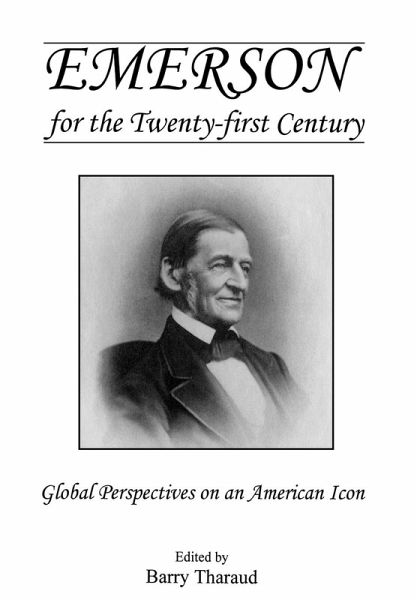
While previous collections of Emerson essays have tended to be a sort of 'stock-taking' or 'retrospective' look at Emerson scholarship, the present collection, divided into four sections, follows a more 'prospective' trajectory for Emerson studies based on the recent increase in global perspectives in nearly all fields of humanistic studies. The first section of essays is about the author's transatlantic and wider connections and the circulation of his influence to thinkers such as Nietzsche. The next two sections register Emerson's encounters with the global worlds of science and philosophy, from his early encounters with science in France to his meeting with the leading scientists of the day like Faraday during his English lecture tour of 1848. Finally, in the extremely rich concluding section, Emerson's engaging with the major social problem of his time entitles him to be considered as not just 'cosmopolitan,' but even 'militant' in his embrace of the violent abolitionist John Brown, which resonates with violent protesters like George Jackson during the civil rights and Vietnam War era in U.S. history.
Barry Tharaud is chair of the Department of English at Fatih University, Istanbul.
Inhaltsangabe
Acknowledgments Introduction: Emerson for the Twenty-first Century: Global Perspectives on an American Icon - Barry Tharaud I. Emerson, Europe, and Beyond Emerson, Literary Globalism, and the Circularity of Influence - Barry Tharaud The Theme of Mind in Emerson's English Traits - Stephen L. Tanner Beauty Meets Beast: Emerson's English Traits - T. S. McMillin A Tale of Three Cities: Emerson, Louis-Philippe, and Transatlantic Uses of Great Men - Wesley T. Mott East of Emerson - Susan L. Dunston Transcendental Brahmin: Emerson's "Hindu" Sentiments - Steven Adisasmito-Smith "We want men ... who can open their eyes wider than to a nationality:" Ralph Waldo Emerson's Vision of an American World Literature - Jan Stievermann II. Emerson and Science Paths to Nature: Emerson's Early Natural History Lectures - Michael P. Branch Nocturnal Outings: Emerson on Dreams - Branka Arsic British Science, the London Lectures, and Emerson's Philosophical Reorientation - David M. Robinson "Every truth tends to become a power:" Emerson, Faraday, and the Minding of Matter - Laura Dassow Walls III. Emerson Thinking Emerson on Nature and the Rhetoric of Thought - Gayle L. Smith Seeing Metaphors - David LaRocca Emerson's Autobiographical Philosophy - John Ronan Death, Love, and Emerson's Poetry - John Michael Emerson and Postmodernism - George J. Stack and Mary DiMaria IV. Emerson and Activism Transcendentalism, Transnationalism, and Antislavery Violence: Concord's Embrace of John Brown - David S. Reynolds "Only justice satisfies all:" Emerson's Militant Transcendentalism - Len Gougeon Simular Man: Emerson and Cosmopolitan Identity - T. Gregory Garvey The Guano of History - Eduardo Cadava Abstracts Notes on Contributors Index
Es gelten unsere Allgemeinen Geschäftsbedingungen: www.buecher.de/agb
Impressum
www.buecher.de ist ein Internetauftritt der buecher.de internetstores GmbH
Geschäftsführung: Monica Sawhney | Roland Kölbl | Günter Hilger
Sitz der Gesellschaft: Batheyer Straße 115 - 117, 58099 Hagen
Postanschrift: Bürgermeister-Wegele-Str. 12, 86167 Augsburg
Amtsgericht Hagen HRB 13257
Steuernummer: 321/5800/1497
USt-IdNr: DE450055826