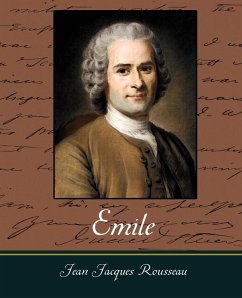
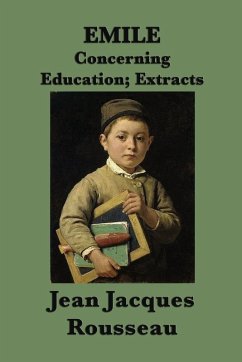
Jean-Jacques Rousseau was a French philosopher, novelist and essayist whose ideas in the areas of science, art, nature, morality, among many others, greatly influenced the late eighteenth century's Romantic Naturalism movement. His philosophies explored the virtue of human beings as being good by nature, the corruption of civil society, individual freedom, and in the case of his 1762 treatise on education, "Emile", allowing children to develop naturally and without the constraint of social conditions. Emile is an imaginary student put forth by Rousseau to illustrate his idea of "negative…mehr
Jean-Jacques Rousseau was a French philosopher, novelist and essayist whose ideas in the areas of science, art, nature, morality, among many others, greatly influenced the late eighteenth century's Romantic Naturalism movement. His philosophies explored the virtue of human beings as being good by nature, the corruption of civil society, individual freedom, and in the case of his 1762 treatise on education, "Emile", allowing children to develop naturally and without the constraint of social conditions. Emile is an imaginary student put forth by Rousseau to illustrate his idea of "negative education", in other words, education in harmony with a child's natural capacity through a process of autonomous discovery. Rousseau removes the authoritative, domineering teacher figure, and instead wants mothers to encourage children's natural tendencies, without coddling or spoiling them. The work was controversial in its own time, but later inspired a new national system of education during the French Revolution, and to some has earned Rousseau the title of "father of modern education". This edition is printed on premium acid-free paper and follows the translation of Barbara Foxley.
Jean-Jacques Rousseau, born on June 28, 1712, in Geneva, was a philosopher, writer, and composer who shaped Enlightenment thought and modern political theory. Raised by his father and aunt after his mother's death, Rousseau's early life was marked by wanderings and diverse experiences. At 15, he left Geneva, converted to Catholicism, and worked various jobs while exploring his intellectual interests.In Paris, Rousseau befriended Denis Diderot and contributed to the Encyclopédie, gaining recognition with his 1750 essay, Discourse on the Arts and Sciences. He argued that advancements in the arts and sciences had led to moral decay, introducing his critical stance on societal progress. His later works, including The Social Contract and Discourse on Inequality, challenged traditional authority and championed the idea of popular sovereignty.Rousseau's novel Émile presented groundbreaking views on education, emphasizing natural development and experiential learning. His radical ideas often brought him into conflict with authorities, resulting in bans and exile. Despite these challenges, Rousseau's philosophy inspired the French Revolution and continues to influence modern political and educational thought.
Es gelten unsere Allgemeinen Geschäftsbedingungen: www.buecher.de/agb
Impressum
www.buecher.de ist ein Internetauftritt der buecher.de internetstores GmbH
Geschäftsführung: Monica Sawhney | Roland Kölbl | Günter Hilger
Sitz der Gesellschaft: Batheyer Straße 115 - 117, 58099 Hagen
Postanschrift: Bürgermeister-Wegele-Str. 12, 86167 Augsburg
Amtsgericht Hagen HRB 13257
Steuernummer: 321/5800/1497
USt-IdNr: DE450055826