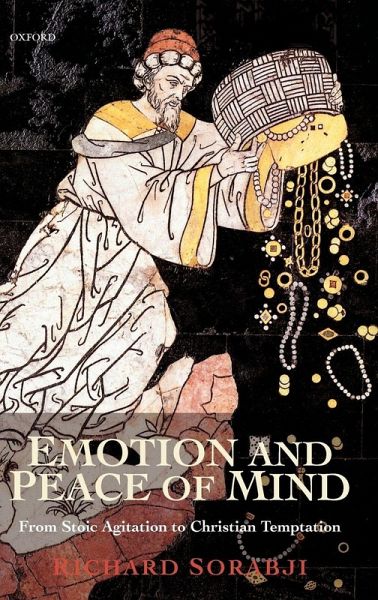
Richard Sorabji presents a ground-breaking study of ancient Greek views of the emotions and their influence on subsequent theories and attitudes, pagan and Christian. The key questions are ones that concern everyone: what is emotion, and how does one cope with one's own emotions and establish peace of mind? The central focus of the book is the Stoics, but Sorabji draws on a vast range of texts to give a rich historical survey of how Western thinking about this central aspect of human nature developed. The result is a magisterial work of scholarship which will be fascinating for anyone with an…mehr
Richard Sorabji presents a ground-breaking study of ancient Greek views of the emotions and their influence on subsequent theories and attitudes, pagan and Christian. The key questions are ones that concern everyone: what is emotion, and how does one cope with one's own emotions and establish peace of mind? The central focus of the book is the Stoics, but Sorabji draws on a vast range of texts to give a rich historical survey of how Western thinking about this central aspect of human nature developed. The result is a magisterial work of scholarship which will be fascinating for anyone with an interest in the emotions from a historical or contemporary perspective.
Richard Sorabji, CBE, is Research Professor of Philosophy at King's College London, and a Fellow of Wolfson College Oxford; he was previously Director of the Institute of Classical Studies, London. He is a Fellow of the British Academy and an Honorary Member of the American Academy of Arts and Sciences.
Inhaltsangabe
* Introduction * Emotions as Judgements Versus Irrational Forces * 2: The Emotions as Value Judgements in Chrysippus * 3: Seneca's Defence: Third Movements as Harmonizing Chrysippus and Zeno * 4: Seneca's Defence: First Movements as Answering Posidonius * 5: The Arts: First Movements and Controversies on Drama and Music. Aristotle, Philodemus, and the Stoics * 6: Posidonius on the Irrational Forces in Emotion: Galen's Report * 7: Posidonius: Judgements Insufficient for Emotion. Exhaustion and Lack of Imagination * 8: Posidonius: Judgements Not Necessary for Emotion. Disowned Judgements, Animals, and Music * 9: Aspasius and Other Objections to Chrysippus * 10: What is Missing from the Judgemental Analysis? Brain Research and Limitations on Stoic Cognitive Therapy * Value of the Emotions, Cognitive Therapy, and the Role of Philosophy * 12: Stoic Indifference: A Barrier to Therapy? * 13: The Case for and against Eradication of Emotion * 14: The Traditions of Moderation and Eradication * 15: How the Ancient Exercises Work * 16: Exercises Concerned with Time and the Self * 17: Physiology and the Non-Cognitive: Galen's Alternative Approach to Emotion * 18: Sex, Love, and Marriage in Pagan Philosophy and the Use of Catharsis * 19: Catharsis and the Classification of Therapies * Emotional Conflict and Structure of the Mind * 21: The Concept of Will * From Stoic Agitations to Christian Temptations * 23: From First Movements to the Seven Cardinal Sins: Evagrius * 24: First Movements in Augustine: Adaptation and Misunderstanding * 25: Christians on Moderation versus Eradication * 26: Augustine on Lust and the Will * Bibliography of Secondary Sources Mentioned * Index of Ancient Thinkers * Index Locorum * Subject and Name Index
* Introduction * Emotions as Judgements Versus Irrational Forces * 2: The Emotions as Value Judgements in Chrysippus * 3: Seneca's Defence: Third Movements as Harmonizing Chrysippus and Zeno * 4: Seneca's Defence: First Movements as Answering Posidonius * 5: The Arts: First Movements and Controversies on Drama and Music. Aristotle, Philodemus, and the Stoics * 6: Posidonius on the Irrational Forces in Emotion: Galen's Report * 7: Posidonius: Judgements Insufficient for Emotion. Exhaustion and Lack of Imagination * 8: Posidonius: Judgements Not Necessary for Emotion. Disowned Judgements, Animals, and Music * 9: Aspasius and Other Objections to Chrysippus * 10: What is Missing from the Judgemental Analysis? Brain Research and Limitations on Stoic Cognitive Therapy * Value of the Emotions, Cognitive Therapy, and the Role of Philosophy * 12: Stoic Indifference: A Barrier to Therapy? * 13: The Case for and against Eradication of Emotion * 14: The Traditions of Moderation and Eradication * 15: How the Ancient Exercises Work * 16: Exercises Concerned with Time and the Self * 17: Physiology and the Non-Cognitive: Galen's Alternative Approach to Emotion * 18: Sex, Love, and Marriage in Pagan Philosophy and the Use of Catharsis * 19: Catharsis and the Classification of Therapies * Emotional Conflict and Structure of the Mind * 21: The Concept of Will * From Stoic Agitations to Christian Temptations * 23: From First Movements to the Seven Cardinal Sins: Evagrius * 24: First Movements in Augustine: Adaptation and Misunderstanding * 25: Christians on Moderation versus Eradication * 26: Augustine on Lust and the Will * Bibliography of Secondary Sources Mentioned * Index of Ancient Thinkers * Index Locorum * Subject and Name Index
Es gelten unsere Allgemeinen Geschäftsbedingungen: www.buecher.de/agb
Impressum
www.buecher.de ist ein Internetauftritt der buecher.de internetstores GmbH
Geschäftsführung: Monica Sawhney | Roland Kölbl | Günter Hilger
Sitz der Gesellschaft: Batheyer Straße 115 - 117, 58099 Hagen
Postanschrift: Bürgermeister-Wegele-Str. 12, 86167 Augsburg
Amtsgericht Hagen HRB 13257
Steuernummer: 321/5800/1497
USt-IdNr: DE450055826