
Andere Kunden interessierten sich auch für
 Developing academic writing skills with the help of blogs54,99 €
 Academic Writing and Research across Disciplines in Africa. From Students to Experts47,70 €
") Credibility, Honesty, Ethics & Politeness in Academic and Journalistic Writing (Band 14)44,90 €
Credibility, Honesty, Ethics & Politeness in Academic and Journalistic Writing (Band 14)44,90 € Multiple Translation Communities in Contemporary Japan55,99 €
 Multiple Translation Communities in Contemporary Japan199,99 €
 Multiple Exponence173,99 €
 Stories and Social Media186,99 €
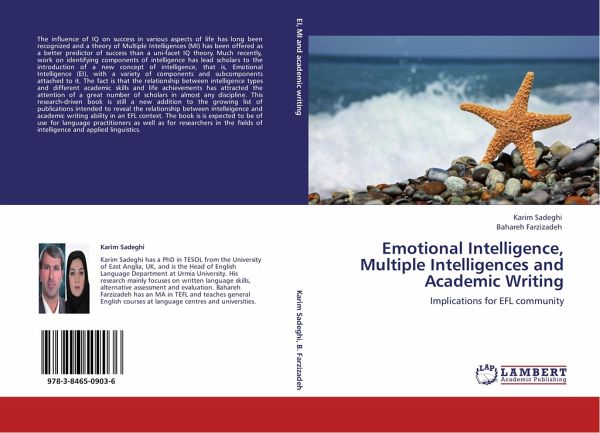
The influence of IQ on success in various aspects of life has long been recognized and a theory of Multiple Intelligences (MI) has been offered as a better predictor of success than a uni-facet IQ theory. Much recently, work on identifying components of intelligence has lead scholars to the introduction of a new concept of intelligence, that is, Emotional Intelligence (EI), with a variety of components and subcomponents attached to it. The fact is that the relationship between intelligence types and different academic skills and life achievements has attracted the attention of a great number of scholars in almost any discipline. This research-driven book is still a new addition to the growing list of publications intended to reveal the relationship between intelleigence and academic writing ability in an EFL context. The book is is expected to be of use for language practitioners as well as for researchers in the fields of intelligence and applied linguistics.