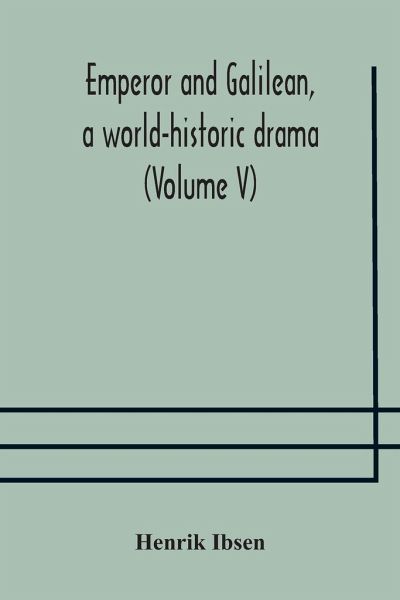
When faith collides with empire, destinies are remade. Henrik Ibsen's Emperor and Galilean, A World-Historic Drama (Volume V) stands as a monumental classic theatre piece, exploring the late Roman Empire's shifting sands of belief, power, and identity. In this sweeping historical drama play, Ibsen delves into the conflict between faith and power, following the philosophical journey of Emperor Julian as he seeks meaning between ancient gods and the rising tide of Christianity. The result is a profound meditation on religious transformation and the cost of conviction. For theatre enthusiasts and…mehr
When faith collides with empire, destinies are remade. Henrik Ibsen's Emperor and Galilean, A World-Historic Drama (Volume V) stands as a monumental classic theatre piece, exploring the late Roman Empire's shifting sands of belief, power, and identity. In this sweeping historical drama play, Ibsen delves into the conflict between faith and power, following the philosophical journey of Emperor Julian as he seeks meaning between ancient gods and the rising tide of Christianity. The result is a profound meditation on religious transformation and the cost of conviction. For theatre enthusiasts and those drawn to the drama of world-changing moments, Ibsen's work is both gripping and intellectually rich. Its layered narrative invites historical literary analysis, while its timeless questions resonate with anyone fascinated by the crossroads of politics, faith, and personal destiny. Set against the grandeur of the late Roman Empire and the echoes of ancient Norway, this world-historic drama offers a rare glimpse into the ambitions and doubts that shaped civilisations. Republished by Alpha Editions in a careful modern edition, this volume preserves the spirit of the original while making it effortless to enjoy today - a heritage title prepared for readers and collectors alike. Whether for academic study or personal reflection, Emperor and Galilean endures as a cornerstone of Ibsen's dramatic works and a cultural treasure for every classic literature collection.
Henrik Johan Ibsen (20 March 1828 - 23 May 1906) was a Norwegian playwright, theatre director, and poet. As one of the founders of modernism in theatre, Ibsen is often referred to as "the father of realism" and one of the most influential playwrights of his time.[2] His major works include Brand, Peer Gynt, An Enemy of the People, Emperor and Galilean, A Doll's House, Hedda Gabler, Ghosts, The Wild Duck, When We Dead Awaken, Pillars of Society, The Lady from the Sea, Rosmersholm, The Master Builder, and John Gabriel Borkman. He is the most frequently performed dramatist in the world after Shakespeare,and by the early 20th century A Doll's House became the world's most performed play. Several of his later dramas were considered scandalous to many of his era, when European theatre was expected to model strict morals of family life and propriety. Ibsen's later work examined the realities that lay behind the facades, revealing much that was disquieting to a number of his contemporaries. He had a critical eye and conducted a free inquiry into the conditions of life and issues of morality. His early poetic and cinematic play Peer Gynt, however, has also strong surreal elements.[6] Ibsen is often ranked as one of the most distinguished playwrights in the European tradition.[7] Richard Hornby describes him as "a profound poetic dramatist-the best since Shakespeare".[8] He is widely regarded as the foremost playwright of the nineteenth century.[7][9] He influenced other playwrights and novelists such as George Bernard Shaw, Oscar Wilde, Arthur Miller, James Joyce, Eugene O'Neill, and Miroslav Krle¿a. Ibsen was nominated for the Nobel Prize in Literature in 1902, 1903, and 1904.[10] Ibsen wrote his plays in Danish (the common written language of Denmark and Norway during his lifetime)[11] and they were published by the Danish publisher Gyldendal. Although most of his plays are set in Norway-often in places reminiscent of Skien, the port town where he grew up-Ibsen lived for 27 years in Italy and Germany, and rarely visited Norway during his most productive years. Born into a merchant family connected to the patriciate of Skien, Ibsen shaped his dramas according to his family background. He was the father of Prime Minister Sigurd Ibsen. Ibsen's dramas have a strong influence upon contemporary culture.
Es gelten unsere Allgemeinen Geschäftsbedingungen: www.buecher.de/agb
Impressum
www.buecher.de ist ein Internetauftritt der buecher.de internetstores GmbH
Geschäftsführung: Monica Sawhney | Roland Kölbl | Günter Hilger
Sitz der Gesellschaft: Batheyer Straße 115 - 117, 58099 Hagen
Postanschrift: Bürgermeister-Wegele-Str. 12, 86167 Augsburg
Amtsgericht Hagen HRB 13257
Steuernummer: 321/5800/1497
USt-IdNr: DE450055826