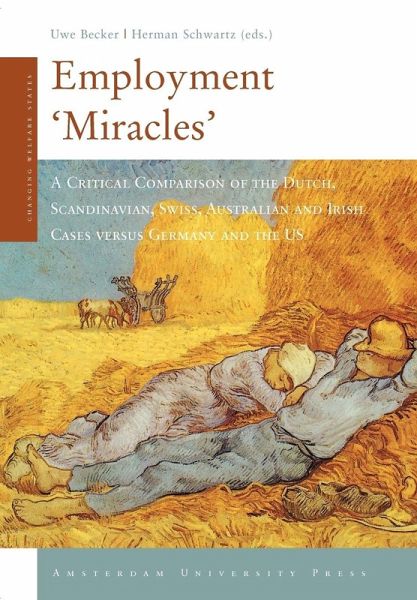
A Critical Comparison of the Dutch, Scandinavian, Swiss, Australian and Irish Cases Versus Germany and the Us Herausgeber: Schwartz, Herman; Becker, Uwe
A Critical Comparison of the Dutch, Scandinavian, Swiss, Australian and Irish Cases Versus Germany and the Us Herausgeber: Schwartz, Herman; Becker, Uwe
Why did some economies experience a boom in the 1990s? Employment 'Miracles' comparatively analyses select miracle economies. The contributors to the volume critically analyze how the small size and institutional structure of seven countries like the Netherlands, Denmark and Ireland accounted for their success and status as economic models. Comparisons with the American and German markets reveal how differing policies - liberal versus corporatist/social democratic - determine job growth and levels of income inequality and poverty. The book also stresses the explanatory relevance of lucky…mehr
Why did some economies experience a boom in the 1990s? Employment 'Miracles' comparatively analyses select miracle economies. The contributors to the volume critically analyze how the small size and institutional structure of seven countries like the Netherlands, Denmark and Ireland accounted for their success and status as economic models. Comparisons with the American and German markets reveal how differing policies - liberal versus corporatist/social democratic - determine job growth and levels of income inequality and poverty. The book also stresses the explanatory relevance of lucky circumstances such as the housing price bubble. Employment 'Miracles' is an important resource for political scientists and economists in their study of employment development. A critical scrutiny of the 'miracle economies' of the 1990s, analysing the role of the relatively small size of the national economies in question, and of accidental external circumstances which contributed to favourable developments.
Uwe Becker is Associate Professor of Political Science at the University of Amsterdam and co-ordinator of an international research project on the socio-economic develop[1]ment of European corporatist countries. Herman Schwartz is Professor of Political Science at the University of Virginia, Charlottesville and director of the Graduate Studies Department of Politics.
Inhaltsangabe
Preface 1 Introduction: Miracles Mirages and Markets Introduction Luck pluck and stuck in the employment miracles Globalisation and the miracles A specific (corporatist) variety of capitalism? What the chapters say 2 The Dutch Model: Magic in a Flat Landscape? Introduction 40 Labour market performance Economic performance Social outcomes Policies the model and the results Conclusion: luck pluck or stuck? 3 Employment and Unemployment in Denmark and Sweden: Success or Failure for the Universal Welfare Model? Introduction Employment and unemployment: what happened? Unemployment and employment policies Policies and outcome - Is there a link? Conclusions 4 The Evolution of the Finnish Model in the 1990s : From Depression to High-Tech Boom Introduction The background of the Finnish miracle: the economic crisis of the 1990s Political response to the crisis 94 The recovery and the Finnish 'miracle' Structural issues: welfare state and labour market institutions The Nordic welfare state: Good to economic growth? Labour market institutions and corporatism Conclusion 5 The Swiss Miracle: Low growth and high employment Introduction Corporatism in a fragmented polity A coordinated market economy? Recent developments Economic and labour market development Disentangling the Swiss 'miracle' An expanding welfare system Conclusion 6 Recasting the Story of Ireland's Miracle: Policy Politics or Profit? The constituents of economic growth and development Possible explanations The costs: sustainability? The significance of the Irish case 7 The Australian Miracle: Luck Pluck or Being Stuck Down Under? Introduction Exports and the current account balance 166 Employment and collective bargaining Fiscal balance Conclusion 8 Last Year's Model? Reflections on the American Model of Employment Growth Introduction An American success story The American model Limits to the liberal market economy model Conclusion 9 The German Contrast. On Bad Comparisons Special Circumstances Luck and Policies That Turned Out to Be Wrong 'Germany isn't working' The German economy in comparison A bad employment record because of labour market and welfare rigidities? Accidental circumstances: housing bubble versus unification On strong German regions Prospects and possible lessons from the 'model cases' 10 Conclusion: The Importance of Lucky Circumstances and Still the Liberal-Social Democratic Divide In sum Recent developments and prospects What is to be learned? 'Competitive Corporatism'? Still the liberal-social democratic divide Contributors Index Bibliography.
Preface 1 Introduction: Miracles Mirages and Markets Introduction Luck pluck and stuck in the employment miracles Globalisation and the miracles A specific (corporatist) variety of capitalism? What the chapters say 2 The Dutch Model: Magic in a Flat Landscape? Introduction 40 Labour market performance Economic performance Social outcomes Policies the model and the results Conclusion: luck pluck or stuck? 3 Employment and Unemployment in Denmark and Sweden: Success or Failure for the Universal Welfare Model? Introduction Employment and unemployment: what happened? Unemployment and employment policies Policies and outcome - Is there a link? Conclusions 4 The Evolution of the Finnish Model in the 1990s : From Depression to High-Tech Boom Introduction The background of the Finnish miracle: the economic crisis of the 1990s Political response to the crisis 94 The recovery and the Finnish 'miracle' Structural issues: welfare state and labour market institutions The Nordic welfare state: Good to economic growth? Labour market institutions and corporatism Conclusion 5 The Swiss Miracle: Low growth and high employment Introduction Corporatism in a fragmented polity A coordinated market economy? Recent developments Economic and labour market development Disentangling the Swiss 'miracle' An expanding welfare system Conclusion 6 Recasting the Story of Ireland's Miracle: Policy Politics or Profit? The constituents of economic growth and development Possible explanations The costs: sustainability? The significance of the Irish case 7 The Australian Miracle: Luck Pluck or Being Stuck Down Under? Introduction Exports and the current account balance 166 Employment and collective bargaining Fiscal balance Conclusion 8 Last Year's Model? Reflections on the American Model of Employment Growth Introduction An American success story The American model Limits to the liberal market economy model Conclusion 9 The German Contrast. On Bad Comparisons Special Circumstances Luck and Policies That Turned Out to Be Wrong 'Germany isn't working' The German economy in comparison A bad employment record because of labour market and welfare rigidities? Accidental circumstances: housing bubble versus unification On strong German regions Prospects and possible lessons from the 'model cases' 10 Conclusion: The Importance of Lucky Circumstances and Still the Liberal-Social Democratic Divide In sum Recent developments and prospects What is to be learned? 'Competitive Corporatism'? Still the liberal-social democratic divide Contributors Index Bibliography.
Es gelten unsere Allgemeinen Geschäftsbedingungen: www.buecher.de/agb
Impressum
www.buecher.de ist ein Internetauftritt der buecher.de internetstores GmbH
Geschäftsführung: Monica Sawhney | Roland Kölbl | Günter Hilger
Sitz der Gesellschaft: Batheyer Straße 115 - 117, 58099 Hagen
Postanschrift: Bürgermeister-Wegele-Str. 12, 86167 Augsburg
Amtsgericht Hagen HRB 13257
Steuernummer: 321/5800/1497
USt-IdNr: DE450055826