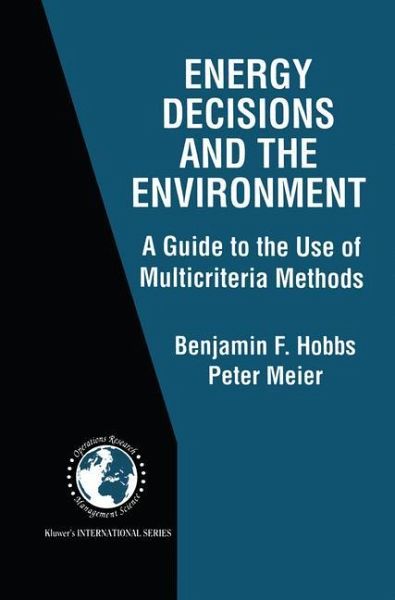
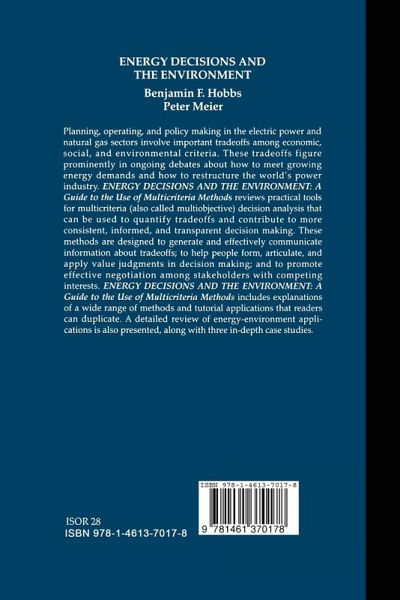
Planning, operating, and policy making in the electric utility and natural gas sectors involves important trade-offs among economic, social, and environmental criteria. These trade-offs figure prominently in ongoing debates about how to meet growing energy demands and how to restructure the world's power industry. Energy Decisions and the Environment: A Guide to the Use of Multicriteria Methods reviews practical tools for multicriteria (also called multiobjective) decision analysis that can be used to quantify trade-offs and contribute to more consistent, informed, and transparent decision…mehr
Planning, operating, and policy making in the electric utility and natural gas sectors involves important trade-offs among economic, social, and environmental criteria. These trade-offs figure prominently in ongoing debates about how to meet growing energy demands and how to restructure the world's power industry. EnergyDecisions and the Environment: A Guide to the Use of MulticriteriaMethods reviews practical tools for multicriteria (also called multiobjective) decision analysis that can be used to quantify trade-offs and contribute to more consistent, informed, and transparent decision making. These methods are designed to generate and effectively communicate information about trade-offs; to help people form, articulate, and apply value judgments in decision making; and to promote effective negotiation among stakeholders with competing interests. Energy Decisions and the Environment: A Guide to the Use ofMulticriteria Methods includes explanations of a wide range of methods, tutorial applications that readers can duplicate, a detailed review of energy-environment applications, and three in-depth case studies.
Produktdetails
Produktdetails
International Series in Operations Research & Management Science 28
Steven A. Gabriel received his M.A. and Ph.D. degrees in Mathematical Sciences from Johns Hopkins University in 1989 and 1992, respectively, and his M.S. in Operations Research from Stanford University in 1984. He is currently Associate Professor, Civil Systems Program, Department of Civil and Environmental Engineering, University of Maryland. Antonio J. Conejo received the M.S. degree from Massachusetts Institute of Technology, Cambridge, MA, in 1987 and the Ph.D. degree from the Royal Institute of Technology, Stockholm, Sweden, in 1990. He is currently Professor of Electrical Engineering at the Universidad de Castilla - La Mancha, Ciudad Real, Spain. J. David Fuller received his Ph.D. in Interdisciplinary Studies from the University of British Columbia in 1980. His research interests focus on Energy Economics and Operations Research; Mathematical Programming Models of Economic Equilibrium with Applications to Energy Markets Forecasting and Electricity Market Design; and Decomposition of Linear, Nonlinear and Equilibrium Programs. He is currently a Professor of Management Sciences, in the Faculty of Engineering at the University of Waterloo, in Waterloo, Ontario, Canada. Benjamin F. Hobbs received his Ph.D. in Environmental Systems Engineering from Cornell University in 1983; his MS in Resource Management and Policy from Syracuse University in 1978, and his BS in Mathematics and Environmental Sciences from North Dakota State University in 1976. He has served as Chair of the JHU President's Climate Change Task Force since 2008. Carlos Ruiz is currently a Ph.D. candidate under Dr. Conejo at the University de Castilla.
Inhaltsangabe
1 Introduction.- 1.1 Tradeoffs in Utility Operations, Planning, and Policy Decisions.- 1.2 How Can Multicriteria Decision-Making Methods Help?.- 1.3 Why Not Monetize All Criteria?.- 1.4 Scope of the Book.- 2 The Application of MCDM Methods.- 2.1 Attribute Selection and Definition (Step 1).- 2.2 Define Options (Step 2).- 2.3 Quantify Impacts (Step 3).- Annex 2.1 An Example of an MCDM Method for Evaluating Proposals.- Annex 2.2 Defining Attributes: Biodiversity in Sri Lanka.- Annex 2.1 An Example of an MCDM Method for Evaluating Proposals.- 3 Screening and Tradeoff Analysis.- 3.1 Screening (Step 4).- 3.2 Analyzing Tradeoff Plots (Step 5).- 3.3 Dominance Analysis (Step 6).- Annex 3.1 Generating Tradeoff Curves.- Annex 3.2 Other Tradeoff Display Methods.- Annex 3.3 Screening Resources at BC Hydro by Dominance Analysis.- Annex 3.4 Tradeoff analysis for the Three-Dimensional Case.- 4 Scaling, Weighting, and Amalgamation.- 4.1 Value Scaling (Step 7).- 4.2 Weighting Methods (Step 8).- 4.3 Amalgamation Methods (Step 9).- 5 Resolving Differences (Step 10).- 5.1 Resolving Differences Among Methods.- 5.2 Resolving Differences Among Individuals.- 6 An Illustrative Numerical Example.- 6.1 Exclusionary Screening (Step 4).- 6.2 Dominance Analysis (Step 6).- 6.3 Scaling, Weighting, and Amalgamation (Steps 7-9).- 6.4 Indifference Tradeoff Weighting (Step 8).- 6.5 AHP Weighting (Step 8).- 6.6 Goal Programming Amalgamation (Step 9).- 6.7 Single and Multiattribute Utility Functions (Steps 7-9).- 6.8 Amalgamation by ELECTRE (Step 9).- 6.9 Successive Elimination (Step 9).- 7 A Review of MCDM Applications in Energy Planning and Policy.- 7.1 MCDM Methods in Environmental Impact Assessment.- 7.2 MCDM Methods in Resource Bidding Systems.- 7.3 MCDM Methods in Transmission and DistributionSystem Planning.- 7.4 MCDM Methods in Supply Capacity Planning.- 7.5 MCDM Methods in Resource Planning.- 7.6 MCDM Applications in Generation System Operations.- 7.7 Using MCDM to Measure Corporate Environmental Performance.- 7.8 MCDM Methods in National Energy Policy.- 7.9 Power Sector Applications of MCDM Methods in Developing Countries.- 8 MCDM at BC Hydro: The 1995 Plan.- 8.1 Structuring the Process.- 8.2 Objectives and Attributes (Step 1).- 8.3 Defining the Alternatives (Step 2).- 8.4 Portfolio Analysis.- 8.5 Tradeoff Display (Step 5) and Evaluation of Portfolios (Steps 8,9).- 8.6 Getting to Consensus (Step 10).- 9 Multi-Method MCDM at BC Gas.- 9.1 Designing a Multi-method MCDM-Based Process.- 9.2 Using MCDM Methods to Screen DSM Programs.- 9.3 Application.- 9.4 Stakeholder Evaluation of the Process and Conclusion.- 10 MCDM Experiments at Seattle City Light.- 10.1 Introduction.- 10.2 Questions Addressed.- 10.3 Resource Planning at Seattle City Light.- 10.4 Results of Method Comparisons.- 10.5 Conclusions.- 11 Closing Remarks.- References.
1 Introduction.- 1.1 Tradeoffs in Utility Operations, Planning, and Policy Decisions.- 1.2 How Can Multicriteria Decision-Making Methods Help?.- 1.3 Why Not Monetize All Criteria?.- 1.4 Scope of the Book.- 2 The Application of MCDM Methods.- 2.1 Attribute Selection and Definition (Step 1).- 2.2 Define Options (Step 2).- 2.3 Quantify Impacts (Step 3).- Annex 2.1 An Example of an MCDM Method for Evaluating Proposals.- Annex 2.2 Defining Attributes: Biodiversity in Sri Lanka.- Annex 2.1 An Example of an MCDM Method for Evaluating Proposals.- 3 Screening and Tradeoff Analysis.- 3.1 Screening (Step 4).- 3.2 Analyzing Tradeoff Plots (Step 5).- 3.3 Dominance Analysis (Step 6).- Annex 3.1 Generating Tradeoff Curves.- Annex 3.2 Other Tradeoff Display Methods.- Annex 3.3 Screening Resources at BC Hydro by Dominance Analysis.- Annex 3.4 Tradeoff analysis for the Three-Dimensional Case.- 4 Scaling, Weighting, and Amalgamation.- 4.1 Value Scaling (Step 7).- 4.2 Weighting Methods (Step 8).- 4.3 Amalgamation Methods (Step 9).- 5 Resolving Differences (Step 10).- 5.1 Resolving Differences Among Methods.- 5.2 Resolving Differences Among Individuals.- 6 An Illustrative Numerical Example.- 6.1 Exclusionary Screening (Step 4).- 6.2 Dominance Analysis (Step 6).- 6.3 Scaling, Weighting, and Amalgamation (Steps 7-9).- 6.4 Indifference Tradeoff Weighting (Step 8).- 6.5 AHP Weighting (Step 8).- 6.6 Goal Programming Amalgamation (Step 9).- 6.7 Single and Multiattribute Utility Functions (Steps 7-9).- 6.8 Amalgamation by ELECTRE (Step 9).- 6.9 Successive Elimination (Step 9).- 7 A Review of MCDM Applications in Energy Planning and Policy.- 7.1 MCDM Methods in Environmental Impact Assessment.- 7.2 MCDM Methods in Resource Bidding Systems.- 7.3 MCDM Methods in Transmission and DistributionSystem Planning.- 7.4 MCDM Methods in Supply Capacity Planning.- 7.5 MCDM Methods in Resource Planning.- 7.6 MCDM Applications in Generation System Operations.- 7.7 Using MCDM to Measure Corporate Environmental Performance.- 7.8 MCDM Methods in National Energy Policy.- 7.9 Power Sector Applications of MCDM Methods in Developing Countries.- 8 MCDM at BC Hydro: The 1995 Plan.- 8.1 Structuring the Process.- 8.2 Objectives and Attributes (Step 1).- 8.3 Defining the Alternatives (Step 2).- 8.4 Portfolio Analysis.- 8.5 Tradeoff Display (Step 5) and Evaluation of Portfolios (Steps 8,9).- 8.6 Getting to Consensus (Step 10).- 9 Multi-Method MCDM at BC Gas.- 9.1 Designing a Multi-method MCDM-Based Process.- 9.2 Using MCDM Methods to Screen DSM Programs.- 9.3 Application.- 9.4 Stakeholder Evaluation of the Process and Conclusion.- 10 MCDM Experiments at Seattle City Light.- 10.1 Introduction.- 10.2 Questions Addressed.- 10.3 Resource Planning at Seattle City Light.- 10.4 Results of Method Comparisons.- 10.5 Conclusions.- 11 Closing Remarks.- References.
Es gelten unsere Allgemeinen Geschäftsbedingungen: www.buecher.de/agb
Impressum
www.buecher.de ist ein Internetauftritt der buecher.de internetstores GmbH
Geschäftsführung: Monica Sawhney | Roland Kölbl | Günter Hilger
Sitz der Gesellschaft: Batheyer Straße 115 - 117, 58099 Hagen
Postanschrift: Bürgermeister-Wegele-Str. 12, 86167 Augsburg
Amtsgericht Hagen HRB 13257
Steuernummer: 321/5800/1497
USt-IdNr: DE450055826