
Andere Kunden interessierten sich auch für
 Vascular, Oxidative and Inflammatory Dysregulation in Neurodegenerative Diseases82,99 €
 Learning to Live with Huntington's Disease27,99 €
 Morphology, Physiology, Gap junctions Energy Proceses in Human Beings36,99 €
 The Mystery of the Dancing Plague: Unveiling the Science Behind Huntington's Disease26,49 €
 Dual Energy X-Ray Absorptiometry84,99 €
 Role of Electronics and Computer Sciences on Energy Medicine36,99 €
 Molecular Biology of Long Non-coding RNAs113,99 €



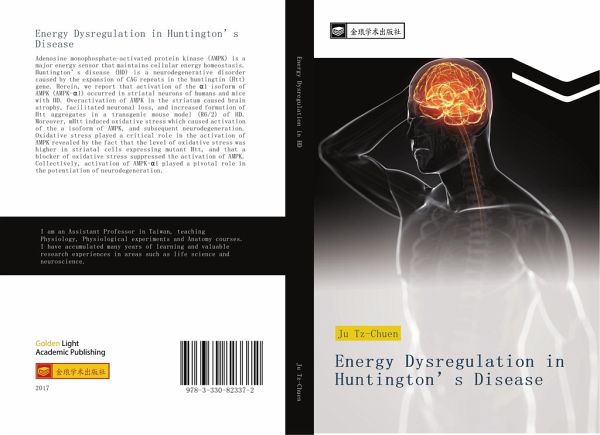
Adenosine monophosphate-activated protein kinase (AMPK) is a major energy sensor that maintains cellular energy homeostasis. Huntington's disease (HD) is a neurodegenerative disorder caused by the expansion of CAG repeats in the huntingtin (Htt) gene. Herein, we report that activation of the ¿1 isoform of AMPK (AMPK-¿1) occurred in striatal neurons of humans and mice with HD. Overactivation of AMPK in the striatum caused brain atrophy, facilitated neuronal loss, and increased formation of Htt aggregates in a transgenic mouse model (R6/2) of HD. Moreover, mHtt induced oxidative stress which caused activation of the a isoform of AMPK, and subsequent neurodegeneration. Oxidative stress played a critical role in the activation of AMPK revealed by the fact that the level of oxidative stress was higher in striatal cells expressing mutant Htt, and that a blocker of oxidative stress suppressed the activation of AMPK. Collectively, activation of AMPK-¿1 played a pivotal role in the potentiation of neurodegeneration.