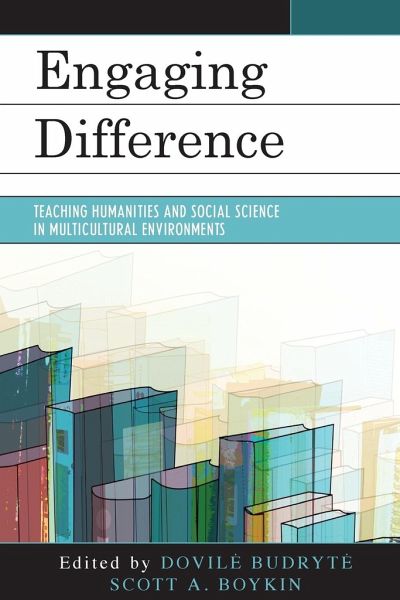
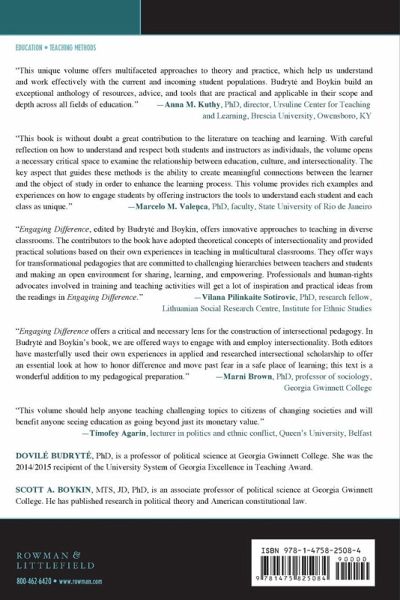
Engaging Difference discusses how to develop strategies to engage difference that work for both students and professors in multicultural classrooms. The contributions to this volume discuss specific pedagogical techniques and the ways in which these have been applied in the classroom and in related educational activities.
Engaging Difference discusses how to develop strategies to engage difference that work for both students and professors in multicultural classrooms. The contributions to this volume discuss specific pedagogical techniques and the ways in which these have been applied in the classroom and in related educational activities.
Dovile Budryte, Ph.D. is a Professor of Political Science at Georgia Gwinnett College. Her publications include articles about the Baltic states and three books, Taming Nationalism? Political Community Building in the Post-Soviet Baltic States (2005), Feminist Conversations: Women, Trauma and Empowerment in Post-Transitional Societies (co-edited with Lisa M. Vaughn and Natalya T. Riegg, 2009), and Memory and Trauma in International Relations: Theories, Cases and Debates (co-edited with Erica Resende, 2013). In 2014/15, she was the recipient of the University System of Georgia Excellence in Teaching Award. Her current research interests include intersectionality, memory politics, and trauma education. Scott A. Boykin, M.T.S., J.D., Ph.D. is an Associate Professor of Political Science at Georgia Gwinnett College. Before joining Georgia Gwinnett College, Dr. Boykin practiced law in Alabama and Texas and served as a judicial clerk to Judge Patrick E. Higginbotham on the United States Court of Appeals for the Fifth Circuit. Boykin has published research in political theory and American constitutional law.
Inhaltsangabe
Preface. Engaging Difference, Overcoming the Fear of Otherness: How to Teach Effectively in Diverse Classrooms? Dovile Budryte and Scott A. Boykin Chapter 1. "Intersectionality" and Popular Empowerment in International Relations. Natalya T. Riegg Chapter 2. "Intersectionality" and the Spoken Word: Toward a Pedagogy Understanding of Culture. Richard S. Rawls and Janita L. Rawls Chapter 3.The Law as the Language of Civil Rights: Using Supreme Court Cases to Facilitate an Inclusive Classroom Dialogue on Difference and Equality.Michael A. Lewkowitz Chapter 4. Applying Insights from the Literature on "Intersectionality" to Teaching Political Science. Dovile Budryte Chapter 5. Lessons from the Salad Bowl: Contextualized Foreign Language Instruction in a Diverse Institution. Kristina Watkins Mormino Chapter 6. Beyond the Accent: "Intersectionality" in a Foreign-Trained Instructor Classroom. Josephine J. Dawuni Chapter 7. Lie to Me: Learning about Manipulation Using Social Media through Operation Design. Ignas Kalpokas Chapter 8. Touchy Subjects: Utilizing Handedness as a Precursor to Discussing Privilege and Diversity in the Classroom. Bryan L. Dawson Chapter 9. Favorite Place Mapmaking and the Decolonization of Teaching. Barbara Tedrow Chapter 10. Making Strangers of Ourselves: Role-Playing of the Immigrant Experience in a College Classroom. Ellen G. Rafshoon Chapter 11. Yellow Star of Courage: Teaching and Learning about the Holocaust. Louis Schmier Chapter 12. Postcard from Auschwitz? Chronicling the Challenges of a Holocaust Study Abroad Program. Natalie Bormann and Veronica Czastkiewicz Chapter 13. Speech, Diversity and Higher Education: Balancing Civil Liberties and Freedom from Discrimination in Classrooms and Campus Life. Scott A. Boykin Appendix References About the Authors
Preface. Engaging Difference, Overcoming the Fear of Otherness: How to Teach Effectively in Diverse Classrooms? Dovile Budryte and Scott A. Boykin Chapter 1. "Intersectionality" and Popular Empowerment in International Relations. Natalya T. Riegg Chapter 2. "Intersectionality" and the Spoken Word: Toward a Pedagogy Understanding of Culture. Richard S. Rawls and Janita L. Rawls Chapter 3.The Law as the Language of Civil Rights: Using Supreme Court Cases to Facilitate an Inclusive Classroom Dialogue on Difference and Equality.Michael A. Lewkowitz Chapter 4. Applying Insights from the Literature on "Intersectionality" to Teaching Political Science. Dovile Budryte Chapter 5. Lessons from the Salad Bowl: Contextualized Foreign Language Instruction in a Diverse Institution. Kristina Watkins Mormino Chapter 6. Beyond the Accent: "Intersectionality" in a Foreign-Trained Instructor Classroom. Josephine J. Dawuni Chapter 7. Lie to Me: Learning about Manipulation Using Social Media through Operation Design. Ignas Kalpokas Chapter 8. Touchy Subjects: Utilizing Handedness as a Precursor to Discussing Privilege and Diversity in the Classroom. Bryan L. Dawson Chapter 9. Favorite Place Mapmaking and the Decolonization of Teaching. Barbara Tedrow Chapter 10. Making Strangers of Ourselves: Role-Playing of the Immigrant Experience in a College Classroom. Ellen G. Rafshoon Chapter 11. Yellow Star of Courage: Teaching and Learning about the Holocaust. Louis Schmier Chapter 12. Postcard from Auschwitz? Chronicling the Challenges of a Holocaust Study Abroad Program. Natalie Bormann and Veronica Czastkiewicz Chapter 13. Speech, Diversity and Higher Education: Balancing Civil Liberties and Freedom from Discrimination in Classrooms and Campus Life. Scott A. Boykin Appendix References About the Authors
Es gelten unsere Allgemeinen Geschäftsbedingungen: www.buecher.de/agb
Impressum
www.buecher.de ist ein Internetauftritt der buecher.de internetstores GmbH
Geschäftsführung: Monica Sawhney | Roland Kölbl | Günter Hilger
Sitz der Gesellschaft: Batheyer Straße 115 - 117, 58099 Hagen
Postanschrift: Bürgermeister-Wegele-Str. 12, 86167 Augsburg
Amtsgericht Hagen HRB 13257
Steuernummer: 321/5800/1497
USt-IdNr: DE450055826