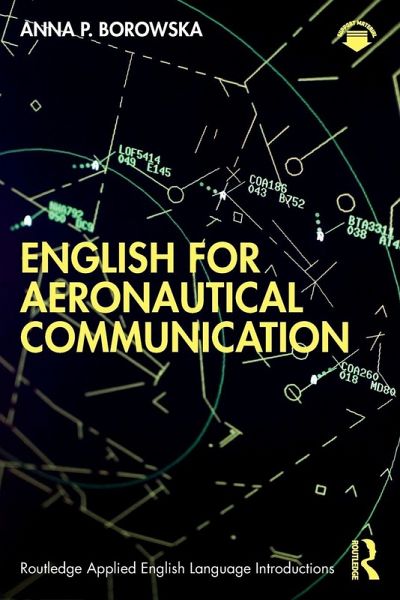
English for Aeronautical Communication is a comprehensive applied linguistics introduction of Aeronautical English tailored specifically for pilots, air traffic controllers, and aspiring trainees who aim to master radio communication for Instrument Flight Rules (IFR).
English for Aeronautical Communication is a comprehensive applied linguistics introduction of Aeronautical English tailored specifically for pilots, air traffic controllers, and aspiring trainees who aim to master radio communication for Instrument Flight Rules (IFR).
Anna P. Borowska is Professor at the Faculty of Applied Linguistics at the University of Warsaw, Poland, specialising in Aeronautical English research with more than 13 years of experience. She is an Aviation English instructor and assessor for an international audience. In 2017, she has developed the concept of avialinguistics, which aims to systematise the study of aviation communication. Her research focuses on improving aviation communication and understanding the linguistic challenges faced by operational personnel. Her contributions have paved the way for further exploration and understanding of how language functions within the aviation context.
Inhaltsangabe
PART I: Fundamentals for radiotelephony communications 1 International regulations for using English in aviation 2 Language testing for operational personnel 3 Features of aeronautical communication 4 Prescribed code for routine operations 5 Specialised language for non-routine operations 6 Airport layout, infrastructure and workers 7 Aircraft parts and their functions 8 Principles of flight and aerobatic manoeuvres 9 VFR vs. IFR flights 10 Meteorology and environmental hazards 11 Consolidation I PART II: Aeronautical communications 1 On the ground 2 Pre-flight operations 2.1 Departure information and route clearance 2.2 Start-up 2.3 Pushback 2.4 Taxiing 2.5 Line- up 3 Take-off and initial climb 3.1 Take-off 3.2 Initial climb 4 En route 4.1 Climb 4.2 Cruise 5 Descent, approach and landing 5.1 Descent 5.2 Approach 5.3 Landing 6 Emergency procedures 6.1 Fire 6.2 Medical issues 6.3 Bird strike 6.4 Unruly passengers 7 Consolidation II PART III: Aeronautical communication contributing factors 1 Situational awareness 1.1 Expectation bias 1.2 Code-switching 1.3 Intercultural competence 2 Native speakers of English on the frequency 3 Unexpected turn of events 4 Consolidation III
PART I: Fundamentals for radiotelephony communications 1 International regulations for using English in aviation 2 Language testing for operational personnel 3 Features of aeronautical communication 4 Prescribed code for routine operations 5 Specialised language for non-routine operations 6 Airport layout, infrastructure and workers 7 Aircraft parts and their functions 8 Principles of flight and aerobatic manoeuvres 9 VFR vs. IFR flights 10 Meteorology and environmental hazards 11 Consolidation I PART II: Aeronautical communications 1 On the ground 2 Pre-flight operations 2.1 Departure information and route clearance 2.2 Start-up 2.3 Pushback 2.4 Taxiing 2.5 Line- up 3 Take-off and initial climb 3.1 Take-off 3.2 Initial climb 4 En route 4.1 Climb 4.2 Cruise 5 Descent, approach and landing 5.1 Descent 5.2 Approach 5.3 Landing 6 Emergency procedures 6.1 Fire 6.2 Medical issues 6.3 Bird strike 6.4 Unruly passengers 7 Consolidation II PART III: Aeronautical communication contributing factors 1 Situational awareness 1.1 Expectation bias 1.2 Code-switching 1.3 Intercultural competence 2 Native speakers of English on the frequency 3 Unexpected turn of events 4 Consolidation III
Es gelten unsere Allgemeinen Geschäftsbedingungen: www.buecher.de/agb
Impressum
www.buecher.de ist ein Internetauftritt der buecher.de internetstores GmbH
Geschäftsführung: Monica Sawhney | Roland Kölbl | Günter Hilger
Sitz der Gesellschaft: Batheyer Straße 115 - 117, 58099 Hagen
Postanschrift: Bürgermeister-Wegele-Str. 12, 86167 Augsburg
Amtsgericht Hagen HRB 13257
Steuernummer: 321/5800/1497
USt-IdNr: DE450055826