
Christian Kay (University of Glasgow Professor of English Language, Kathryn L Allan (University College London Lecturer)
English Historical Semantics
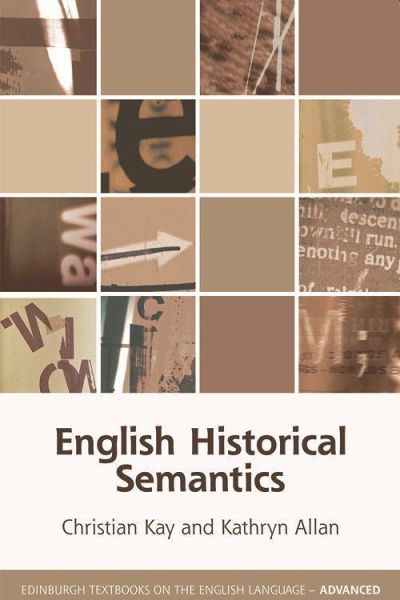
Christian Kay (University of Glasgow Professor of English Language, Kathryn L Allan (University College London Lecturer)
English Historical Semantics
- Broschiertes Buch
- Merkliste
- Auf die Merkliste
- Bewerten Bewerten
- Teilen
- Produkt teilen
- Produkterinnerung
- Produkterinnerung
This guide gives students a solid grounding in the basic methodology of how to analyse corpus data to study new words entering the language or language change. .
Andere Kunden interessierten sich auch für
 Yoad Winter (Technion Associate Professor)Elements of Formal Semantics38,99 €
 Patrick Griffiths (Professor of English, Beppu University, Japan)An Introduction to English Semantics and Pragmatics28,99 €
 Martin Hilpert (Univers Assistant Professor of English LinguisticsConstruction Grammar and Its Application to English33,99 €
 Alison Gibbons (Sheffield Hallam University Reader)Contemporary Stylistics33,99 €
 Chris Fox (University of Essex)Foundations of Intensional Semantics54,99 €
 Igor Mel'cuk (Universite de Montreal)An Advanced Introduction to Semantics45,99 €
 Dr Zeki Hamawand (Iraq University of Kirkuk)English Lexical Semantics37,99 €
-
-
-
This guide gives students a solid grounding in the basic methodology of how to analyse corpus data to study new words entering the language or language change. .
Produktdetails
- Produktdetails
- Edinburgh Textbooks on the English Language - Advanced
- Verlag: Edinburgh University Press
- Seitenzahl: 224
- Erscheinungstermin: 8. Oktober 2015
- Englisch
- Abmessung: 216mm x 139mm x 17mm
- Gewicht: 298g
- ISBN-13: 9780748644773
- ISBN-10: 0748644776
- Artikelnr.: 40509419
- Herstellerkennzeichnung
- Libri GmbH
- Europaallee 1
- 36244 Bad Hersfeld
- gpsr@libri.de
- Edinburgh Textbooks on the English Language - Advanced
- Verlag: Edinburgh University Press
- Seitenzahl: 224
- Erscheinungstermin: 8. Oktober 2015
- Englisch
- Abmessung: 216mm x 139mm x 17mm
- Gewicht: 298g
- ISBN-13: 9780748644773
- ISBN-10: 0748644776
- Artikelnr.: 40509419
- Herstellerkennzeichnung
- Libri GmbH
- Europaallee 1
- 36244 Bad Hersfeld
- gpsr@libri.de
Christian Kay is Professor Emeritus and Honorary Professorial Research Fellow in English Language at the University of Glasgow. She was an editor of the Historical Thesaurus of the Oxford English Dictionary, and A Thesaurus of Old English, and founded the Scottish Corpus of Texts and Speech. She has written on historical semantics and lexicography and contributed to projects on metaphor and semantic annotation based on the Historical Thesaurus of English dataset.
Chapter 1: Introduction
Chapter 2: A brief history of the English lexicon
2.1 Introduction
2.2 Old English (OE: 700-1150)
2.3 Middle English (ME: 1150-1500)
2.4 Early Modern English (EModE: 1500-1750)
2.5 Late Modern English (LModE: 1750 to present day)
2.6 Conclusion: The Present Day
Chapter 3: Categories of meaning
3.1. Introduction
3.2 Traditional approaches to Semantics
3.2.1 Reference
3.2.2 Sense
3.2.2.1 Sense relationships
3.2.3 Components, sets and fields
3.2.4 A note on homonymy
3.2.5 A memory aid
3.3 Categories and prototypes
3.3.1 Prototypes in action
3.3.2 Lexical prototypes
3.3.3 Homonymy revisited
3.4 Domains and frames
3.5. Conclusion
Chapter 4: Tracing the development of individual words
4.1 Introduction
4.2 Introducing the OED
4.2.1 OED1
4.2.2 OED2
4.2.3 OED3
4.3 What the OED tells us
4.3.1 manga2
4.3.2 monster
4.3.2.1 Formal history and etymology of monster
4.3.2.2 Semantic history
4.3.3 Overview
4.4 Some other historical dictionaries
4.4.1 Middle English Dictionary (MED)
4.4.2 Anglo-Norman Dictionary (AND)
4.4.3 Dictionary of the Scots Language (DSL)
4.4.4 Dictionary of Old English (DOE)
4.4.5 Other dictionaries
4.5 Historical corpora
Chapter 5: How and why words change meaning
5.1 Introduction
5.2 The significance of meaning change
5.3 Studying semantic change
5.4 The process of semantic change
5.5 Categories of meaning change
5.5.1 Widening (or broadening or generalisation) and narrowing (or specialisation)
5.5.2 Amelioration (or elevation) and pejoration (or deterioration or degeneration)
5.5.3 Metaphor and metonymy
5.6 Grammaticalisation
5.7 Why do words change meaning?
5.7.1 External factors
5.7.2 Internal factors: polysemy, homonymy, synonymy
5.7.3 Stylistic factors
5.8 Conclusion
Chapter 6: Larger categories
6.1 Introduction
6.2 A brief history of thesauruses
6.3 The structure of thesauruses
6.3.1 Basic level and other categories
6.3.2 Folk and expert categories
6.4 Using HTOED
6.4.1 The structure of HTOED
6.4.2 Inside HTOED categories
6.5 Conclusion
Chapter 7: English Colour Terms: A case study, C. P. Biggam
7.1 Introduction
7.2 How to describe colour
7.3 What are Basic Colour Terms?
7.4 The evolution of basic colour categories
7.5 The development of colour terms in English
7.5.1 Old English (OE: 700-1150)
7.5.2 Middle English (ME: 1150-1500)
7.5.3 Modern English (ModE 1500-)
7.6 The changing nature of a basic category: BLUE
7.7 Summary
7.8 Conclusion
Chapter 8: Language and culture
8.1 Introduction
8.2 Linguistics and anthropology
8.3 Pronouns of address
8.4 Kinship
8.4.1 Recent changes
8.5 Time
8.6 Conclusion
Chapter 9: Metaphor and metonymy
9.1 Introduction
9.2 Metaphor in language and thought
9.3 Another kind of mapping: metonymy
9.4 Metaphor and motivation
9.5 Metonymy and motivation
9.6 Conclusion
Chapter 10: The big picture and a look ahead
10.1 Introduction
10.2 The big picture
10.3 Green as an example
10. 4 Looking ahead
References
Glossary of key terms
Index
Chapter 2: A brief history of the English lexicon
2.1 Introduction
2.2 Old English (OE: 700-1150)
2.3 Middle English (ME: 1150-1500)
2.4 Early Modern English (EModE: 1500-1750)
2.5 Late Modern English (LModE: 1750 to present day)
2.6 Conclusion: The Present Day
Chapter 3: Categories of meaning
3.1. Introduction
3.2 Traditional approaches to Semantics
3.2.1 Reference
3.2.2 Sense
3.2.2.1 Sense relationships
3.2.3 Components, sets and fields
3.2.4 A note on homonymy
3.2.5 A memory aid
3.3 Categories and prototypes
3.3.1 Prototypes in action
3.3.2 Lexical prototypes
3.3.3 Homonymy revisited
3.4 Domains and frames
3.5. Conclusion
Chapter 4: Tracing the development of individual words
4.1 Introduction
4.2 Introducing the OED
4.2.1 OED1
4.2.2 OED2
4.2.3 OED3
4.3 What the OED tells us
4.3.1 manga2
4.3.2 monster
4.3.2.1 Formal history and etymology of monster
4.3.2.2 Semantic history
4.3.3 Overview
4.4 Some other historical dictionaries
4.4.1 Middle English Dictionary (MED)
4.4.2 Anglo-Norman Dictionary (AND)
4.4.3 Dictionary of the Scots Language (DSL)
4.4.4 Dictionary of Old English (DOE)
4.4.5 Other dictionaries
4.5 Historical corpora
Chapter 5: How and why words change meaning
5.1 Introduction
5.2 The significance of meaning change
5.3 Studying semantic change
5.4 The process of semantic change
5.5 Categories of meaning change
5.5.1 Widening (or broadening or generalisation) and narrowing (or specialisation)
5.5.2 Amelioration (or elevation) and pejoration (or deterioration or degeneration)
5.5.3 Metaphor and metonymy
5.6 Grammaticalisation
5.7 Why do words change meaning?
5.7.1 External factors
5.7.2 Internal factors: polysemy, homonymy, synonymy
5.7.3 Stylistic factors
5.8 Conclusion
Chapter 6: Larger categories
6.1 Introduction
6.2 A brief history of thesauruses
6.3 The structure of thesauruses
6.3.1 Basic level and other categories
6.3.2 Folk and expert categories
6.4 Using HTOED
6.4.1 The structure of HTOED
6.4.2 Inside HTOED categories
6.5 Conclusion
Chapter 7: English Colour Terms: A case study, C. P. Biggam
7.1 Introduction
7.2 How to describe colour
7.3 What are Basic Colour Terms?
7.4 The evolution of basic colour categories
7.5 The development of colour terms in English
7.5.1 Old English (OE: 700-1150)
7.5.2 Middle English (ME: 1150-1500)
7.5.3 Modern English (ModE 1500-)
7.6 The changing nature of a basic category: BLUE
7.7 Summary
7.8 Conclusion
Chapter 8: Language and culture
8.1 Introduction
8.2 Linguistics and anthropology
8.3 Pronouns of address
8.4 Kinship
8.4.1 Recent changes
8.5 Time
8.6 Conclusion
Chapter 9: Metaphor and metonymy
9.1 Introduction
9.2 Metaphor in language and thought
9.3 Another kind of mapping: metonymy
9.4 Metaphor and motivation
9.5 Metonymy and motivation
9.6 Conclusion
Chapter 10: The big picture and a look ahead
10.1 Introduction
10.2 The big picture
10.3 Green as an example
10. 4 Looking ahead
References
Glossary of key terms
Index
Chapter 1: Introduction
Chapter 2: A brief history of the English lexicon
2.1 Introduction
2.2 Old English (OE: 700-1150)
2.3 Middle English (ME: 1150-1500)
2.4 Early Modern English (EModE: 1500-1750)
2.5 Late Modern English (LModE: 1750 to present day)
2.6 Conclusion: The Present Day
Chapter 3: Categories of meaning
3.1. Introduction
3.2 Traditional approaches to Semantics
3.2.1 Reference
3.2.2 Sense
3.2.2.1 Sense relationships
3.2.3 Components, sets and fields
3.2.4 A note on homonymy
3.2.5 A memory aid
3.3 Categories and prototypes
3.3.1 Prototypes in action
3.3.2 Lexical prototypes
3.3.3 Homonymy revisited
3.4 Domains and frames
3.5. Conclusion
Chapter 4: Tracing the development of individual words
4.1 Introduction
4.2 Introducing the OED
4.2.1 OED1
4.2.2 OED2
4.2.3 OED3
4.3 What the OED tells us
4.3.1 manga2
4.3.2 monster
4.3.2.1 Formal history and etymology of monster
4.3.2.2 Semantic history
4.3.3 Overview
4.4 Some other historical dictionaries
4.4.1 Middle English Dictionary (MED)
4.4.2 Anglo-Norman Dictionary (AND)
4.4.3 Dictionary of the Scots Language (DSL)
4.4.4 Dictionary of Old English (DOE)
4.4.5 Other dictionaries
4.5 Historical corpora
Chapter 5: How and why words change meaning
5.1 Introduction
5.2 The significance of meaning change
5.3 Studying semantic change
5.4 The process of semantic change
5.5 Categories of meaning change
5.5.1 Widening (or broadening or generalisation) and narrowing (or specialisation)
5.5.2 Amelioration (or elevation) and pejoration (or deterioration or degeneration)
5.5.3 Metaphor and metonymy
5.6 Grammaticalisation
5.7 Why do words change meaning?
5.7.1 External factors
5.7.2 Internal factors: polysemy, homonymy, synonymy
5.7.3 Stylistic factors
5.8 Conclusion
Chapter 6: Larger categories
6.1 Introduction
6.2 A brief history of thesauruses
6.3 The structure of thesauruses
6.3.1 Basic level and other categories
6.3.2 Folk and expert categories
6.4 Using HTOED
6.4.1 The structure of HTOED
6.4.2 Inside HTOED categories
6.5 Conclusion
Chapter 7: English Colour Terms: A case study, C. P. Biggam
7.1 Introduction
7.2 How to describe colour
7.3 What are Basic Colour Terms?
7.4 The evolution of basic colour categories
7.5 The development of colour terms in English
7.5.1 Old English (OE: 700-1150)
7.5.2 Middle English (ME: 1150-1500)
7.5.3 Modern English (ModE 1500-)
7.6 The changing nature of a basic category: BLUE
7.7 Summary
7.8 Conclusion
Chapter 8: Language and culture
8.1 Introduction
8.2 Linguistics and anthropology
8.3 Pronouns of address
8.4 Kinship
8.4.1 Recent changes
8.5 Time
8.6 Conclusion
Chapter 9: Metaphor and metonymy
9.1 Introduction
9.2 Metaphor in language and thought
9.3 Another kind of mapping: metonymy
9.4 Metaphor and motivation
9.5 Metonymy and motivation
9.6 Conclusion
Chapter 10: The big picture and a look ahead
10.1 Introduction
10.2 The big picture
10.3 Green as an example
10. 4 Looking ahead
References
Glossary of key terms
Index
Chapter 2: A brief history of the English lexicon
2.1 Introduction
2.2 Old English (OE: 700-1150)
2.3 Middle English (ME: 1150-1500)
2.4 Early Modern English (EModE: 1500-1750)
2.5 Late Modern English (LModE: 1750 to present day)
2.6 Conclusion: The Present Day
Chapter 3: Categories of meaning
3.1. Introduction
3.2 Traditional approaches to Semantics
3.2.1 Reference
3.2.2 Sense
3.2.2.1 Sense relationships
3.2.3 Components, sets and fields
3.2.4 A note on homonymy
3.2.5 A memory aid
3.3 Categories and prototypes
3.3.1 Prototypes in action
3.3.2 Lexical prototypes
3.3.3 Homonymy revisited
3.4 Domains and frames
3.5. Conclusion
Chapter 4: Tracing the development of individual words
4.1 Introduction
4.2 Introducing the OED
4.2.1 OED1
4.2.2 OED2
4.2.3 OED3
4.3 What the OED tells us
4.3.1 manga2
4.3.2 monster
4.3.2.1 Formal history and etymology of monster
4.3.2.2 Semantic history
4.3.3 Overview
4.4 Some other historical dictionaries
4.4.1 Middle English Dictionary (MED)
4.4.2 Anglo-Norman Dictionary (AND)
4.4.3 Dictionary of the Scots Language (DSL)
4.4.4 Dictionary of Old English (DOE)
4.4.5 Other dictionaries
4.5 Historical corpora
Chapter 5: How and why words change meaning
5.1 Introduction
5.2 The significance of meaning change
5.3 Studying semantic change
5.4 The process of semantic change
5.5 Categories of meaning change
5.5.1 Widening (or broadening or generalisation) and narrowing (or specialisation)
5.5.2 Amelioration (or elevation) and pejoration (or deterioration or degeneration)
5.5.3 Metaphor and metonymy
5.6 Grammaticalisation
5.7 Why do words change meaning?
5.7.1 External factors
5.7.2 Internal factors: polysemy, homonymy, synonymy
5.7.3 Stylistic factors
5.8 Conclusion
Chapter 6: Larger categories
6.1 Introduction
6.2 A brief history of thesauruses
6.3 The structure of thesauruses
6.3.1 Basic level and other categories
6.3.2 Folk and expert categories
6.4 Using HTOED
6.4.1 The structure of HTOED
6.4.2 Inside HTOED categories
6.5 Conclusion
Chapter 7: English Colour Terms: A case study, C. P. Biggam
7.1 Introduction
7.2 How to describe colour
7.3 What are Basic Colour Terms?
7.4 The evolution of basic colour categories
7.5 The development of colour terms in English
7.5.1 Old English (OE: 700-1150)
7.5.2 Middle English (ME: 1150-1500)
7.5.3 Modern English (ModE 1500-)
7.6 The changing nature of a basic category: BLUE
7.7 Summary
7.8 Conclusion
Chapter 8: Language and culture
8.1 Introduction
8.2 Linguistics and anthropology
8.3 Pronouns of address
8.4 Kinship
8.4.1 Recent changes
8.5 Time
8.6 Conclusion
Chapter 9: Metaphor and metonymy
9.1 Introduction
9.2 Metaphor in language and thought
9.3 Another kind of mapping: metonymy
9.4 Metaphor and motivation
9.5 Metonymy and motivation
9.6 Conclusion
Chapter 10: The big picture and a look ahead
10.1 Introduction
10.2 The big picture
10.3 Green as an example
10. 4 Looking ahead
References
Glossary of key terms
Index