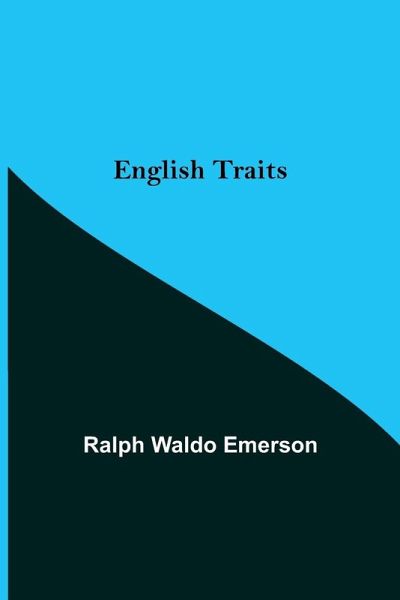
A brisk, lucid invitation to a world beyond the bustling modern mind. Emerson's English Traits surveys the moral weather of Victorian England with clarity, wit, and a humane curiosity that still resonates. This ambitious essay collection blends english character analysis with sharp British manners critique, weaving mid nineteenth century prose, cultural travel observations, and reflections on london and the countryside. It sits alongside american transcendentalist peers and companion transcendentalist writers, offering a rare cross-Atlantic dialogue on ideas, taste, and daily life. For readers…mehr
A brisk, lucid invitation to a world beyond the bustling modern mind. Emerson's English Traits surveys the moral weather of Victorian England with clarity, wit, and a humane curiosity that still resonates. This ambitious essay collection blends english character analysis with sharp British manners critique, weaving mid nineteenth century prose, cultural travel observations, and reflections on london and the countryside. It sits alongside american transcendentalist peers and companion transcendentalist writers, offering a rare cross-Atlantic dialogue on ideas, taste, and daily life. For readers and scholars, it reads as both an academic reading anthology and a window into the social fabric of its time-perfect for librarian classroom use and personal study alike. Alpha Editions is honoured to bring this long out-of-print work back into circulation. Restored for today's and future generations, it is more than a reprint: a collector's item and a cultural treasure. The notes of travel, the humour, the critique of social mores, and the clarity of Emerson's voice make it a vital purchase for casual readers exploring the English mind, and for classic-literature collectors seeking a richer sense of victorian england context. A genuine bridge between london and countryside, this volume honours the enduring spirit of inquiry that unites American and British thinkers.
Ralph Waldo Emerson was an American essayist, speaker, philosopher, abolitionist, and poet who lived from May 25, 1803 to April 27, 1882. He went by his middle name, Waldo. He led the transcendentalist movement in the middle of the 1800s. People looked up to him as a supporter of freedom and critical thinking, as well as a wise critic of how society and conformity can make people feel bad about themselves. He was called "the most gifted of the Americans" by Friedrich Nietzsche, and Walt Whitman called him his "master." Emerson slowly moved away from the religious and social beliefs of his time. In his 1836 essay "Nature," he formulated and explained the theory of transcendentalism. After this, in 1837, he gave a speech called "The American Scholar." Oliver Wendell Holmes Sr. thought it was America's "intellectual Declaration of Independence." Emerson was born on May 25, 1803, in Newbury, Massachusetts. His parents were Ruth Haskins and the Rev. William Emerson, who was a Unitarian preacher. He was named for Ralph, his mom brother, and Rebecca Waldo, his dad great-grandmother. William, Edward, Robert Bulkeley, and Charles were the other four sons who lived to adulthood. Ralph Waldo was the second of these boys to do so.
Es gelten unsere Allgemeinen Geschäftsbedingungen: www.buecher.de/agb
Impressum
www.buecher.de ist ein Internetauftritt der buecher.de internetstores GmbH
Geschäftsführung: Monica Sawhney | Roland Kölbl | Günter Hilger
Sitz der Gesellschaft: Batheyer Straße 115 - 117, 58099 Hagen
Postanschrift: Bürgermeister-Wegele-Str. 12, 86167 Augsburg
Amtsgericht Hagen HRB 13257
Steuernummer: 321/5800/1497
USt-IdNr: DE450055826