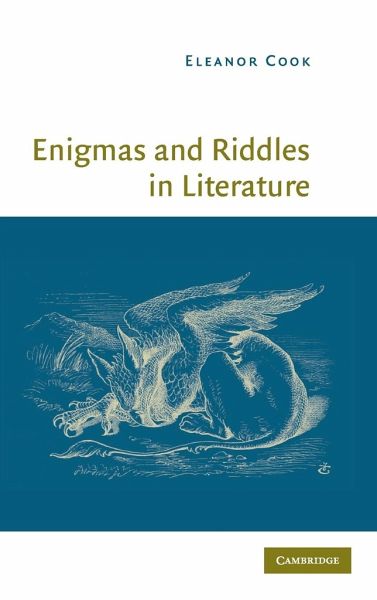
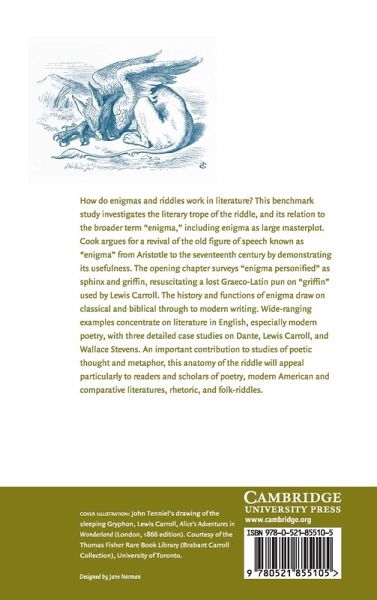
How do enigmas and riddles work in literature? This benchmark study investigates the literary trope of the riddle, and its relation to the broader term 'enigma', including enigma as large masterplot. Cook argues for a revival of the old figure of speech known as 'enigma' from Aristotle to the seventeenth century by demonstrating its usefulness. The opening chapter surveys 'enigma personified' as sphinx and griffin, resuscitating a lost Graeco-Latin pun on 'griffin' used by Lewis Carroll. The history and functions of enigma draw on classical and biblical through to modern writing. Wide-ranging…mehr
How do enigmas and riddles work in literature? This benchmark study investigates the literary trope of the riddle, and its relation to the broader term 'enigma', including enigma as large masterplot. Cook argues for a revival of the old figure of speech known as 'enigma' from Aristotle to the seventeenth century by demonstrating its usefulness. The opening chapter surveys 'enigma personified' as sphinx and griffin, resuscitating a lost Graeco-Latin pun on 'griffin' used by Lewis Carroll. The history and functions of enigma draw on classical and biblical through to modern writing. Wide-ranging examples concentrate on literature in English, especially modern poetry, with three detailed case studies on Dante, Lewis Carroll, and Wallace Stevens. An important contribution to studies of poetic thought and metaphor, this anatomy of the riddle will appeal particularly to readers and scholars of poetry, modern American and comparative literatures, rhetoric, and folk-riddles.
Eleanor Cook is Professor Emerita, Department of English, University of Toronto. She writes mainly on poetry and poetics, especially modern, as well as on questions of allusion, the English Bible and literature, and the riddle. Her books include studies of Robert Browning and Wallace Stevens, as well as a collection of essays, Against Coercion: Games Poets Play (1998). Her essays have appeared in many books and journals, including American Literature, Daedalus, ELH, Essays in Criticism, and Philosophy and Literature. She has served as President of the Association of Literary Scholars and Critics, and is a Guggenheim Fellow, a Senior Killam Research Fellow (Canada Council), and a Fellow of the Royal Society of Canada.
Inhaltsangabe
Introduction 1. Enigma personified: the riddling beasts, Sphinx and griffin 2. Enigma as trope: history, function, fortunes 3. What is the shape of the riddle? Enigma as masterplot 4. Case study I. Enigma in Dante's Eden (Purgatorio 27-33) 5. Questions of riddle and genre 6. Riddle as scheme: a case for a new griph-class 7. Case study II. Mapping riddles: Lewis Carroll and the Alice books 8. Figures for enigma 9. Case study III. The structure of reality: enigma in Wallace Steven's later work 10. From protection to innocent amusement: some other functions of enigma Afterword: enigma, the boundary figure Appendix: Enigma, riddle and friends among the lexicographers.
Introduction 1. Enigma personified: the riddling beasts, Sphinx and griffin 2. Enigma as trope: history, function, fortunes 3. What is the shape of the riddle? Enigma as masterplot 4. Case study I. Enigma in Dante's Eden (Purgatorio 27-33) 5. Questions of riddle and genre 6. Riddle as scheme: a case for a new griph-class 7. Case study II. Mapping riddles: Lewis Carroll and the Alice books 8. Figures for enigma 9. Case study III. The structure of reality: enigma in Wallace Steven's later work 10. From protection to innocent amusement: some other functions of enigma Afterword: enigma, the boundary figure Appendix: Enigma, riddle and friends among the lexicographers.
Es gelten unsere Allgemeinen Geschäftsbedingungen: www.buecher.de/agb
Impressum
www.buecher.de ist ein Internetauftritt der buecher.de internetstores GmbH
Geschäftsführung: Monica Sawhney | Roland Kölbl | Günter Hilger
Sitz der Gesellschaft: Batheyer Straße 115 - 117, 58099 Hagen
Postanschrift: Bürgermeister-Wegele-Str. 12, 86167 Augsburg
Amtsgericht Hagen HRB 13257
Steuernummer: 321/5800/1497
USt-IdNr: DE450055826