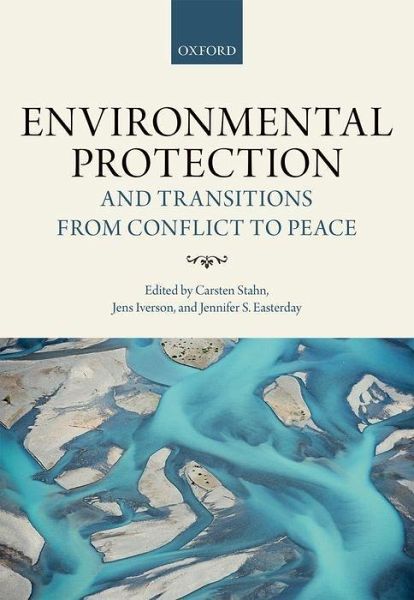
This is an open access title available under the terms of a CC BY-NC-ND 4.0 International licence. It is free to read at Oxford Scholarship Online and offered as a free PDF download from OUP and selected open access locations. Environmental protection is fundamental for the establishment of sustainable peace. Applying traditional legal approaches to protection raises particular challenges during the transition from conflict to peace. In the jus post bellum context, protection of the environment and natural resources needs to be considered in tandem with a broad range of simultaneously…mehr
This is an open access title available under the terms of a CC BY-NC-ND 4.0 International licence. It is free to read at Oxford Scholarship Online and offered as a free PDF download from OUP and selected open access locations. Environmental protection is fundamental for the establishment of sustainable peace. Applying traditional legal approaches to protection raises particular challenges during the transition from conflict to peace. In the jus post bellum context, protection of the environment and natural resources needs to be considered in tandem with a broad range of simultaneously applicable normative frameworks, such as human rights, transitional justice, arms control/disarmament, UN law and practice, development, and domestic law. While certain multilateral environment agreements, such as the Convention Concerning the Protection of the World Cultural and Natural Heritage protect the environment; international humanitarian law and international criminal law continue to treat environmental protection largely from an anthropocentric perspective. This book is the first targeted work in the legal literature that investigates environmental challenges in the aftermath of conflict. Addressing these challenges, it brings together academics, policy-makers, and practitioners from different disciplines to clarify policies and practices of environmental protection and key normative frameworks. It draws on experiences and practices in post-conflict settings to specify substantive principles and techniques to remedy and prevent harm.
Carsten Stahn is Professor of International Criminal Law and Global Justice at Leiden University and Assistant Professor at the Groitus Centre for International Legal Studies. He is the author of The Law and Practice of International Territorial Administration:Versailles to Iraq and Beyond. He has published articles on international criminal law and transitional justice in leading international journals (American Journal of International Law, European Journal of International Law, Journal of International Criminal Justice, Harvard International Law Journal), and edited several collections of essays in the field. Jens Iverson is a Researcher for the Jus Post Bellum project and an attorney specializing in public international law. A member of the California Bar, the Thurston Society, and the Order of the Coif, he received his Juris Doctor cum laude from the University of California, Hastings, and his Bachelor of Arts from Yale University. He has worked with the Cambodian Genocide Program, the Documentation Centre of Cambodia, and the Coalition for the International Criminal Court. As the co-founder of a human rights clinic, he helped represent the former Prime Minister of Haiti in a successful petition to the Inter-American Commission on Human Rights that ultimately resulted in a landmark ruling requiring Haitian prison reform. He has practiced at the International Criminal Tribunal for the former Yugoslavia on both the Popovic et al and Prlic et al cases. Jennifer Easterday is a Researcher for the Jus Post Bellum project. She is also an international justice consultant and a Trial Monitor for the Open Society Justice Initiative. She previously worked for International Criminal Law Services, an NGO based in The Hague, on a variety of international criminal law capacity-building projects in domestic jurisdictions in the former Yugoslavia and Africa. She has also worked as a Senior Researcher and Trial Monitor for the UC Berkeley War Crimes Studies Center, researching and monitoring the Special Court for Sierra Leone trial of Charles Taylor. She has experience at the ICTY and with other international criminal law and human rights NGOs in the United States and Latin America. She received her Juris Doctor from the University of California, Berkeley School of Law and is a member of the California State Bar.
Inhaltsangabe
* Introduction * Part I: Foundations * 1: Carl Bruch: Considerations in Framing the Environmental Dimensions of Jus Post Bellum * 2: Cymie R. Payne: Defining the Environment:Environmental Integrity * Part II: Legal Norms and Frameworks * 3: Britta Sjöstedt: The Ability of Environmental Treaties to Address Environmental Problems in Post-Conflict * 4: Kirsten Stefanik: The Environment and Armed Conflict: Employing General Principles to Protect the Environment * 5: Karen L. Hulme: Using a Framework of Human Rights and Transitional Justice for Post-Conflict Environmental Protection and Remediation * 6: Olivia Radics and Carl Bruch: The Law of Pillage, Conflict Resources, and Jus Post Bellum * 7: Daniëlla Dam-de Jong: Standard-setting Practices for the Management of Natural Resources in Conflict-Torn Stares: Constitutive Elements of Jus Post Bellum * 8: Ayse-Martina Böhringer and Thilo Marauhn: Environmental Implications of Disarmament: The Chemical Weapons Convention Case * 9: Dieter Flack: Legal Protection of the Environment: The Double Challenge of Non-International Armed Conflict and Post-Conflict Peacebuilding * 10: Matthew Gillett: Eco-Struggles: Using International Criminal Law to Protect the Environment During and After Non-International Armed Conflict * Part III: Tensions and Dilemmas * 11: Ilias Plakokefalos: Reparation for Environmental Damage in Jus Post Bellum: The Problem of Shared Responsibility * 12: Jennifer Easterday and Hana Ivanhoe: Conflict, Cash and Controversy: Protecting Environmental Rights in Post-Conflict Settings * 13: Onita Das and Aneaka Kellay: Private Security Companies and other Private Security Service Providers (PSCs) and Environmental Protection in Jus Post Bellum: Policy and Regulatory Challenges * Part IV: Remedying and Preventing Damage and Harm * 14: Cymie R. Payne: Developments in the Law of Environmental Reparations: A Case Study of the UN Compensation Commission * 15: Merryl Lawry-White: Victims of Environmental Harm During Conflict: The Potential for 'Justice' * 16: Ursign Hofmann and Pascal Rapillard: Post-Conflict Mine Action: Environment and Law * 17: Anne Dienelt: 'After the War is Before the War': The Environment, Preventive Measures under International Humanitarian Law, and their Post-Conflict Impact * 18: Doug Weir: Reframing the Remnants of War: The Role of the International Law Commission, Governments, and Civil Society
* Introduction * Part I: Foundations * 1: Carl Bruch: Considerations in Framing the Environmental Dimensions of Jus Post Bellum * 2: Cymie R. Payne: Defining the Environment:Environmental Integrity * Part II: Legal Norms and Frameworks * 3: Britta Sjöstedt: The Ability of Environmental Treaties to Address Environmental Problems in Post-Conflict * 4: Kirsten Stefanik: The Environment and Armed Conflict: Employing General Principles to Protect the Environment * 5: Karen L. Hulme: Using a Framework of Human Rights and Transitional Justice for Post-Conflict Environmental Protection and Remediation * 6: Olivia Radics and Carl Bruch: The Law of Pillage, Conflict Resources, and Jus Post Bellum * 7: Daniëlla Dam-de Jong: Standard-setting Practices for the Management of Natural Resources in Conflict-Torn Stares: Constitutive Elements of Jus Post Bellum * 8: Ayse-Martina Böhringer and Thilo Marauhn: Environmental Implications of Disarmament: The Chemical Weapons Convention Case * 9: Dieter Flack: Legal Protection of the Environment: The Double Challenge of Non-International Armed Conflict and Post-Conflict Peacebuilding * 10: Matthew Gillett: Eco-Struggles: Using International Criminal Law to Protect the Environment During and After Non-International Armed Conflict * Part III: Tensions and Dilemmas * 11: Ilias Plakokefalos: Reparation for Environmental Damage in Jus Post Bellum: The Problem of Shared Responsibility * 12: Jennifer Easterday and Hana Ivanhoe: Conflict, Cash and Controversy: Protecting Environmental Rights in Post-Conflict Settings * 13: Onita Das and Aneaka Kellay: Private Security Companies and other Private Security Service Providers (PSCs) and Environmental Protection in Jus Post Bellum: Policy and Regulatory Challenges * Part IV: Remedying and Preventing Damage and Harm * 14: Cymie R. Payne: Developments in the Law of Environmental Reparations: A Case Study of the UN Compensation Commission * 15: Merryl Lawry-White: Victims of Environmental Harm During Conflict: The Potential for 'Justice' * 16: Ursign Hofmann and Pascal Rapillard: Post-Conflict Mine Action: Environment and Law * 17: Anne Dienelt: 'After the War is Before the War': The Environment, Preventive Measures under International Humanitarian Law, and their Post-Conflict Impact * 18: Doug Weir: Reframing the Remnants of War: The Role of the International Law Commission, Governments, and Civil Society
Es gelten unsere Allgemeinen Geschäftsbedingungen: www.buecher.de/agb
Impressum
www.buecher.de ist ein Internetauftritt der buecher.de internetstores GmbH
Geschäftsführung: Monica Sawhney | Roland Kölbl | Günter Hilger
Sitz der Gesellschaft: Batheyer Straße 115 - 117, 58099 Hagen
Postanschrift: Bürgermeister-Wegele-Str. 12, 86167 Augsburg
Amtsgericht Hagen HRB 13257
Steuernummer: 321/5800/1497
USt-IdNr: DE450055826