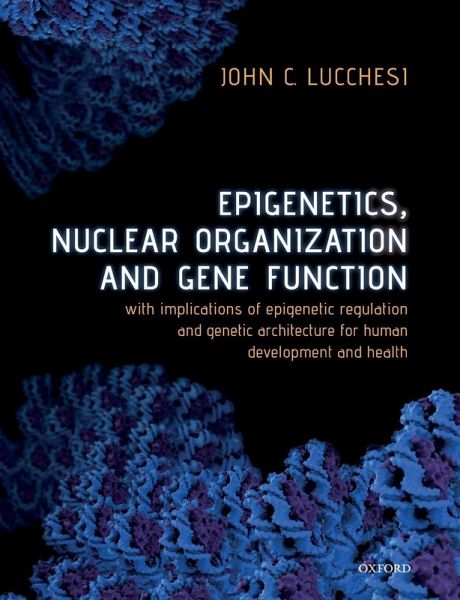
Epigenetics is the study of heritable changes in gene function that do not involve changes in the DNA sequence. These changes, consisting principally of DNA methylation, histone modifications, and non-coding RNAs, maintain or modulate the initial impact of regulatory factors that recognize and associate with particular genomic sequences. Epigenetic modifications are manifest in all aspects of normal cellular differentiation and function, but they can also have damaging effects that result in pathologies such as cancer. Research is continuously uncovering the role of epigenetics in a variety of…mehr
Epigenetics is the study of heritable changes in gene function that do not involve changes in the DNA sequence. These changes, consisting principally of DNA methylation, histone modifications, and non-coding RNAs, maintain or modulate the initial impact of regulatory factors that recognize and associate with particular genomic sequences. Epigenetic modifications are manifest in all aspects of normal cellular differentiation and function, but they can also have damaging effects that result in pathologies such as cancer. Research is continuously uncovering the role of epigenetics in a variety of human disorders, providing new avenues for therapeutic interventions and advances in regenerative medicine. This book's primary goal is to establish a framework that can be used to understand the basis of epigenetic regulation and to appreciate both its derivation from genetics and interdependence with genetic mechanisms. A further aim is to highlight the role played by the three-dimensional organization of the genetic material itself (the complex of DNA, histones and non-histone proteins referred to as chromatin), and its distribution within a functionally compartmentalized nucleus. This architectural organization of the genome plays a major role in the subsequent retrieval, interpretation, and execution of both genetic and epigenetic information.
John Lucchesi obtained a Ph.D. in Genetics from the University of California at Berkeley. Following postdoctoral training in the Institute of Molecular Biology at the University of Oregon, he joined the faculty of the University of North Carolina in Chapel Hill, where he rose to the rank of Cary C. Boshamer Professor of Biology and Genetics. He was appointed Adjunct Professor of Genetics at Duke University and was named Senior Fellow of Churchill College, Cambridge University, UK. In 1990, he joined the faculty of the Biology Department at Emory University as Asa G. Candler Professor of Biology and Chair. Dr Lucchesi is a fellow of the AAAS, a former President of the Genetics Society of America and was named Vice-President of the XVII International Congress of Genetics. His research laboratory has focused on the regulation of transcription, the functional architecture of chromatin and the genetic regulation of development.
Inhaltsangabe
* Part I * An introduction to epigenetics and epigenetic regulation * 1: Epigenetic phenomena in fungi, plants and animals * 2: The basic structure of chromatin * 3: The basic mechanism of gene transcription * Part II * Transcription is regulated by epigenetic mechanisms * 4: Chromatin modifications and remodeling * 5: Epigenetic chromatin changes and the transcription cycle * 6: The role of non-coding RNAs * 7: Maintenance of the active and inactive states * 8: DNA methylation and gene expression * 9: Regulation of domains and whole chromosomes * Part III * The interplay between transcription and nuclear structure * 10: Architectural organization of the genome * 11: The nuclear envelope * 12: The nucleolus * 13: Nuclear bodies * Part IV * Inheritance of chromatin structure and functional states * 14: Chromosome replication and genomic stability * 15: DNA repair and genomic stability * 16: Inheritance of chromatin modifications through the cell cycle * 17: Stem cells * 18: Nuclear reprogramming and induced pluripotency * 19: Transgenerational inheritance of epigenetic traits * Part V * Epigenetics, human health and development * 20: Aging, cellular senescence and cancer: The role of genomic instability, cellular homeostasis and telomeres * 21: Aging, cellular senescence and cancer: Epigenetic alterations and nuclear remodeling * 22: Developmental systems and their dysfunction
* Part I * An introduction to epigenetics and epigenetic regulation * 1: Epigenetic phenomena in fungi, plants and animals * 2: The basic structure of chromatin * 3: The basic mechanism of gene transcription * Part II * Transcription is regulated by epigenetic mechanisms * 4: Chromatin modifications and remodeling * 5: Epigenetic chromatin changes and the transcription cycle * 6: The role of non-coding RNAs * 7: Maintenance of the active and inactive states * 8: DNA methylation and gene expression * 9: Regulation of domains and whole chromosomes * Part III * The interplay between transcription and nuclear structure * 10: Architectural organization of the genome * 11: The nuclear envelope * 12: The nucleolus * 13: Nuclear bodies * Part IV * Inheritance of chromatin structure and functional states * 14: Chromosome replication and genomic stability * 15: DNA repair and genomic stability * 16: Inheritance of chromatin modifications through the cell cycle * 17: Stem cells * 18: Nuclear reprogramming and induced pluripotency * 19: Transgenerational inheritance of epigenetic traits * Part V * Epigenetics, human health and development * 20: Aging, cellular senescence and cancer: The role of genomic instability, cellular homeostasis and telomeres * 21: Aging, cellular senescence and cancer: Epigenetic alterations and nuclear remodeling * 22: Developmental systems and their dysfunction
Es gelten unsere Allgemeinen Geschäftsbedingungen: www.buecher.de/agb
Impressum
www.buecher.de ist ein Internetauftritt der buecher.de internetstores GmbH
Geschäftsführung: Monica Sawhney | Roland Kölbl | Günter Hilger
Sitz der Gesellschaft: Batheyer Straße 115 - 117, 58099 Hagen
Postanschrift: Bürgermeister-Wegele-Str. 12, 86167 Augsburg
Amtsgericht Hagen HRB 13257
Steuernummer: 321/5800/1497
USt-IdNr: DE450055826