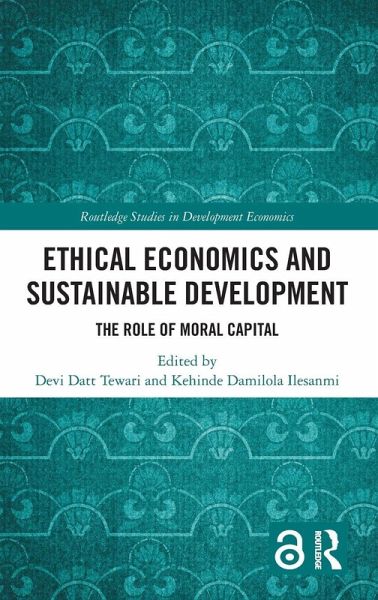
This book explores the role of moral capital and its relationship with economic growth and emphasizes the ways in which investment in moral frameworks can promote social well-being and sustainable development. It argues that firm growth is crucial for the broader economy, underpinning the sustainability of the ecosystem.
This book explores the role of moral capital and its relationship with economic growth and emphasizes the ways in which investment in moral frameworks can promote social well-being and sustainable development. It argues that firm growth is crucial for the broader economy, underpinning the sustainability of the ecosystem.
Devi Datt Tewari is a professor in the Department of Economics, University of Zululand (UNIZULU), South Africa. Kehinde Damilola Ilesanmi is a lecturer in the Department of Economics, University of Zululand (UNIZULU), South Africa.
Inhaltsangabe
Introduction Part I: Theorisation of Moral Capital and African Economic Sustainability Nexus 1. Currency manipulation as a toolkit for Western Hegemony: Is a moral economy ever possible? 2. Rethinking the economy for the greater good: Lessons from Climate Change Mitigation Initiatives 3. Roles of banks in times of crisis: More regulation or moral capital? 4. Moral capital and leadership: A possible solution to the African problem? 5. Moral capital in economic history: A brief survey of ideas and relevance to Africa Part II: Selected Empirical Studies on the Impact of Moral Capital on African Economic Policies 6. Enhancing Moral Capital in South Africa: The Role of Government and its Implication for the Economy 7. The impact of national minimum wage policy on inflation and unemployment in South Africa: A segmented regression analysis 8. Do firms have the responsibility to be morally responsible? Moral capital versus firm growth in selected African countries 9. Moral Capital Threshold in the Effectiveness of Oda for Social Infrastructure 10. Using the Rule of law as an elixir to arrest moral capital bankruptcy and financial collapse of South African state-owned enterprises 11. Can Corruption Be Eradicated and Moral Capital Restored in the DRC? A Comprehensive Analysis of Legal and Regulatory Frameworks from Mobutu to Tshisekedi
Introduction Part I: Theorisation of Moral Capital and African Economic Sustainability Nexus 1. Currency manipulation as a toolkit for Western Hegemony: Is a moral economy ever possible? 2. Rethinking the economy for the greater good: Lessons from Climate Change Mitigation Initiatives 3. Roles of banks in times of crisis: More regulation or moral capital? 4. Moral capital and leadership: A possible solution to the African problem? 5. Moral capital in economic history: A brief survey of ideas and relevance to Africa Part II: Selected Empirical Studies on the Impact of Moral Capital on African Economic Policies 6. Enhancing Moral Capital in South Africa: The Role of Government and its Implication for the Economy 7. The impact of national minimum wage policy on inflation and unemployment in South Africa: A segmented regression analysis 8. Do firms have the responsibility to be morally responsible? Moral capital versus firm growth in selected African countries 9. Moral Capital Threshold in the Effectiveness of Oda for Social Infrastructure 10. Using the Rule of law as an elixir to arrest moral capital bankruptcy and financial collapse of South African state-owned enterprises 11. Can Corruption Be Eradicated and Moral Capital Restored in the DRC? A Comprehensive Analysis of Legal and Regulatory Frameworks from Mobutu to Tshisekedi
Es gelten unsere Allgemeinen Geschäftsbedingungen: www.buecher.de/agb
Impressum
www.buecher.de ist ein Internetauftritt der buecher.de internetstores GmbH
Geschäftsführung: Monica Sawhney | Roland Kölbl | Günter Hilger
Sitz der Gesellschaft: Batheyer Straße 115 - 117, 58099 Hagen
Postanschrift: Bürgermeister-Wegele-Str. 12, 86167 Augsburg
Amtsgericht Hagen HRB 13257
Steuernummer: 321/5800/1497
USt-IdNr: DE450055826