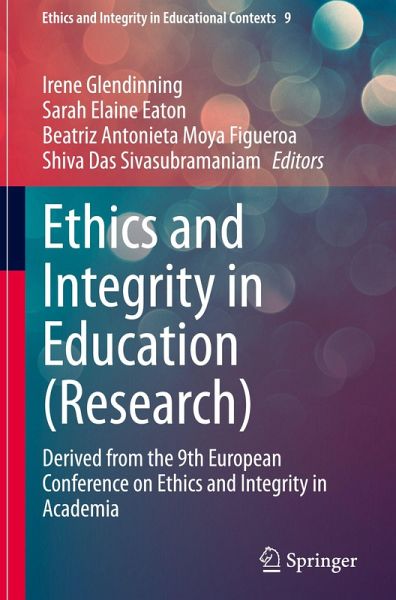
Derived from the 9th European Conference on Ethics and Integrity in Academia Herausgegeben:Glendinning, Irene; Eaton, Sarah Elaine; Moya Figueroa, Beatriz Antoneita; Sivasubramaniam, Shiva Das
Derived from the 9th European Conference on Ethics and Integrity in Academia Herausgegeben:Glendinning, Irene; Eaton, Sarah Elaine; Moya Figueroa, Beatriz Antoneita; Sivasubramaniam, Shiva Das
This book provides insights on approaches for enhancing ethical practice, professionalism and integrity for future development in academia and beyond. It does so by offering a thorough review of the background and processes to enhance academic integrity in the years of artificial intelligence. The book also explores the future of research integrity and ethics by examining lessons from the past. Ideas from research findings on how to incorporate an integrity culture in continuously changing secondary and higher education are addressed. The chapters are written by international authors who have…mehr
This book provides insights on approaches for enhancing ethical practice, professionalism and integrity for future development in academia and beyond. It does so by offering a thorough review of the background and processes to enhance academic integrity in the years of artificial intelligence. The book also explores the future of research integrity and ethics by examining lessons from the past. Ideas from research findings on how to incorporate an integrity culture in continuously changing secondary and higher education are addressed. The chapters are written by international authors who have been working in the fields of integrity sciences, focussing on ways to enhance ethics and integrity amongst students, academics and institutions (including schools). They identify approaches to deter and detect misconduct and discuss the ways to educate academic integrity amongst academic communities. The book addresses best practices from international institutions and how these can be transformed and adopted in different subject areas. Embracing and managing the use of generative artificial intelligence (GenAI) tools in education are key themes throughout. Special attention is given to the ethical use of GenAI, exploring the ways to minimise the misuses via policies and guidelines.
Dr. Irene Glendinning has recently retired from her most recent role as the Academic Integrity Lead for Coventry University Group after a long career over 40 years. Since 2010 she has focused on research into strategies for academic integrity, particularly concerning the design of workable institutional policies that deter misconduct in education and research and encourage a culture of scholarly learning. She continues to be engaged in research and international working groups focusing on improving academic integrity and fighting corruption, as part of the European Network for Academic Integrity. Dr. Sarah Elaine Eaton is Professor and research chair of Education at the University of Calgary, Canada. Eaton’s research focuses on academic ethics in higher education. Her work can be found in the British Educational Research Journal, the Journal of Academic Ethics, the Journal of Educational Thought and Interchange, among other places. She is the Editor-in-Chief of the International Journal for Educational Integrity (Springer Nature) and co-founder and co-editor of Canadian Perspectives on Academic Integrity. Dr. Shiva Das Sivasubramaniam is the Deputy Dean for the School of Life and Health Sciences, at University of Roehampton, UK, after 25 years as an academic with extensive research experience in academic integrity focussing on medical ethics. He is the associate editor of Journal of Academic Ethics, and a member of the editorial board of International Journal of Educational Integrity. He is one of the founding members of the European Network for Academic Integrity in which he is leading the ethics and integrity advisory working group responsible for developing guidelines for academic integrity and research ethics. Dr. Beatriz Antonieta Moya Figueroa has obtained a PhD from the Werklund School of Education at the University of Calgary, Canada, in the Educational Research program, specializing in Leadership, Policy, and Governance. As a current Assistant Professor at the Instituto de Éticas Aplicadas at the Pontificia Universidad Católica de Chile, she aims to explore emerging academic integrity issues and support transformations in higher education institutions committed to emerging academic integrity and social justice across teaching, learning, assessment, and research practices. Building on this motivation, she informs her research with methodologies that explore glocal (i.e., global and local) experiential and situated insights, drawing from the fields of academic integrity, the Scholarship of Teaching and Learning (SoTL), leadership, and generative artificial intelligence (GenAI).
Inhaltsangabe
Chapter 1. A Literature Review on AI Detection: Investigating the Potential of Authorship Attribution Methods- Zander Janse van Rensburg.- Chapter 2. Academic Integrity and Staff Perceptions: Perspectives on Students Understanding of Academic Integrity, and Staff Needs in the Age of Artificial Intelligence - Caroline Campbell.- Chapter 3. An Approach to Evaluate the Impact of Academic Integrity Training for Educators by Analysing Assessment Referrals - Lauren Schrock, Asima Iqbal, Alexa Kirkaldy.- Chapter 4. From Healthcare to Higher Ed: A Five-Level Framework for Fostering Academic Integrity - Jessica Kalra.- Chapter 5. A Detailed Guide to Structural Topic Modelling in Educational Research: Insights from a Study on the Ethical Use of AI in Academia - Michael Weiss, Sabiha Mumtaz, Jamie Carmichael.- Chapter 6. Curriculum Dilemmas: How Can Teachers Foster Pupils Ability to Collaborate and Compete in the Swedish Education System? - Charlotta Ronn.- Chapter 7. University Policies on Academic Ethics and Integrity in Bulgaria.- Chapter 8. Towards an ethical standard: An analysis of perspectives and experiences in complying with basic ethical requirements.- Chapter 9. The Journey to Explicit Ethics Education for Czech Computer Science Teaching Assistants.- Chapter 10. Countering Education Fraud and Essay Mills through Legal Measures.
Chapter 1. A Literature Review on AI Detection: Investigating the Potential of Authorship Attribution Methods- Zander Janse van Rensburg.- Chapter 2. Academic Integrity and Staff Perceptions: Perspectives on Students Understanding of Academic Integrity, and Staff Needs in the Age of Artificial Intelligence - Caroline Campbell.- Chapter 3. An Approach to Evaluate the Impact of Academic Integrity Training for Educators by Analysing Assessment Referrals - Lauren Schrock, Asima Iqbal, Alexa Kirkaldy.- Chapter 4. From Healthcare to Higher Ed: A Five-Level Framework for Fostering Academic Integrity - Jessica Kalra.- Chapter 5. A Detailed Guide to Structural Topic Modelling in Educational Research: Insights from a Study on the Ethical Use of AI in Academia - Michael Weiss, Sabiha Mumtaz, Jamie Carmichael.- Chapter 6. Curriculum Dilemmas: How Can Teachers Foster Pupils Ability to Collaborate and Compete in the Swedish Education System? - Charlotta Ronn.- Chapter 7. University Policies on Academic Ethics and Integrity in Bulgaria.- Chapter 8. Towards an ethical standard: An analysis of perspectives and experiences in complying with basic ethical requirements.- Chapter 9. The Journey to Explicit Ethics Education for Czech Computer Science Teaching Assistants.- Chapter 10. Countering Education Fraud and Essay Mills through Legal Measures.
Es gelten unsere Allgemeinen Geschäftsbedingungen: www.buecher.de/agb
Impressum
www.buecher.de ist ein Internetauftritt der buecher.de internetstores GmbH
Geschäftsführung: Monica Sawhney | Roland Kölbl | Günter Hilger
Sitz der Gesellschaft: Batheyer Straße 115 - 117, 58099 Hagen
Postanschrift: Bürgermeister-Wegele-Str. 12, 86167 Augsburg
Amtsgericht Hagen HRB 13257
Steuernummer: 321/5800/1497
USt-IdNr: DE450055826