
Andere Kunden interessierten sich auch für
 Qualitative Research Methods for the Social Sciences, Global Edition101,99 €
 Designing Qualitative Research79,99 €
 Research and Writing in International Relations46,99 €
 The Evolution of Ethics in America50,99 €
 How to Be Less Stupid about Race12,99 €
 Teaching Criminological Theory44,99 €
 Nice Racism12,99 €






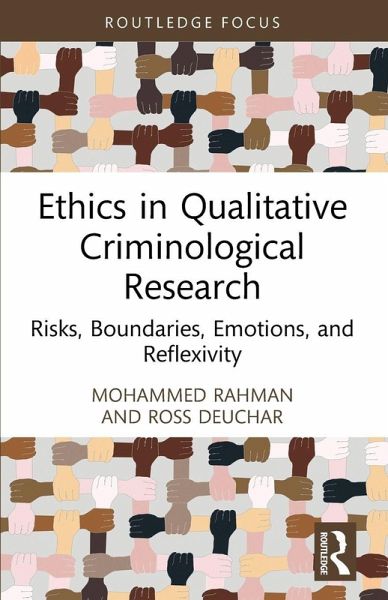
Providing academic insights, reflections, and practical guidance on ethically conducting qualitative criminological research, this book emphasizes real-life examples to navigate research risks, boundaries, and emotions while spotlighting reflexivity as a pivotal tool for qualitative inquiries.
"Considering pertinent issues associated with qualitative criminological research in contemporary settings, Rahman and Deuchar draw upon their own experience of working with hard-to-reach and marginalised populations to raise difficult, yet must have conversations, concerning an ever-evolving field of ethics. In doing so, the authors offer both practical recommendations and direction for the future of ethics. The work is most certainly a must read for anyone seeking to undertake cutting edge criminological research."
Dr Robert McLean, University of the West of Scotland
"Ethics in Criminological Research: Risks, Boundaries, Emotions, and Reflexivity offers unique and invaluable insights into navigating the ethical complexities of qualitative research in criminology - of which there are many. Drawing from rich literature and personal experiences, Rahman and Deuchar provide practical solutions to ethical dilemmas, making it an essential guide for students, researchers, and practitioners alike."
Associate Professor Amin Asfari, Regis University
"Research ethics are probably the most important but most neglected topic in methods training. As such it is fantastic to see research ethics front and centre in this engaging new text by two experienced researchers."
Professor Shadd Maruna, University of Liverpool
"Ethics in Criminological Research: Risks, Boundaries, Emotions, and Reflexivity is an insightful work of many qualities. Rahman and Deuchar have 'walked the walk' before writing such as book and the end product is a rounded and admirably clear account of the often unclear boundaries in the complex landscape of criminological research. This is an essential read especially for early career criminologists and other social scientists, who will also find wise, practical, and ethical solutions."
Professor Georgios A. Antonopoulos, Northumbria University
Dr Robert McLean, University of the West of Scotland
"Ethics in Criminological Research: Risks, Boundaries, Emotions, and Reflexivity offers unique and invaluable insights into navigating the ethical complexities of qualitative research in criminology - of which there are many. Drawing from rich literature and personal experiences, Rahman and Deuchar provide practical solutions to ethical dilemmas, making it an essential guide for students, researchers, and practitioners alike."
Associate Professor Amin Asfari, Regis University
"Research ethics are probably the most important but most neglected topic in methods training. As such it is fantastic to see research ethics front and centre in this engaging new text by two experienced researchers."
Professor Shadd Maruna, University of Liverpool
"Ethics in Criminological Research: Risks, Boundaries, Emotions, and Reflexivity is an insightful work of many qualities. Rahman and Deuchar have 'walked the walk' before writing such as book and the end product is a rounded and admirably clear account of the often unclear boundaries in the complex landscape of criminological research. This is an essential read especially for early career criminologists and other social scientists, who will also find wise, practical, and ethical solutions."
Professor Georgios A. Antonopoulos, Northumbria University