
111,99 €
inkl. MwSt.
Versandkostenfrei*
Versandfertig in 1-2 Wochen
payback
56 °P sammeln
  • Gebundenes Buch

This book addresses why some ethnic minority migrant groups have better economic and political integration outcomes than others. The central claim is that social integration leads to trade-offs with economic and political integration. The logic behind this claim is that socially segregated groups may have difficulties interacting with mainstream society but will have more capacity for group mobilization. That mobilization can improve economic and political integration. In comparison, socially integrated groups may have greater capacity to interact with mainstream society but also less…mehr

Produktbeschreibung
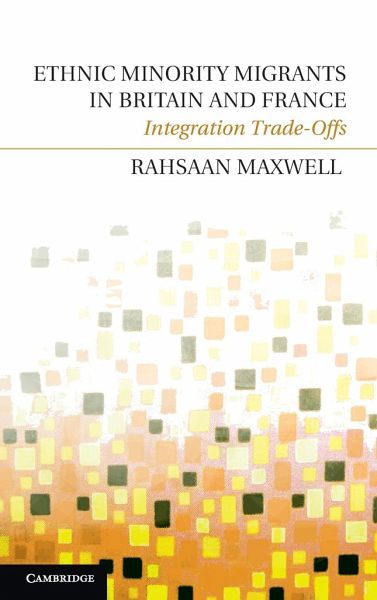
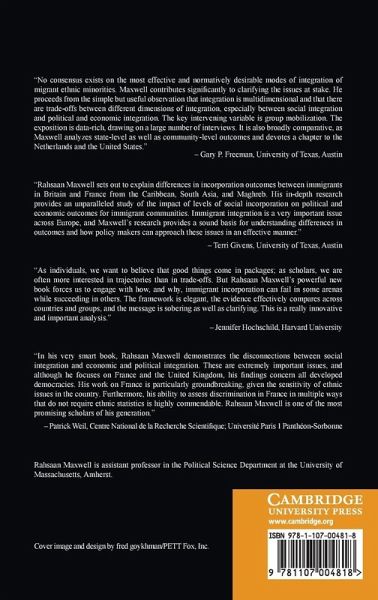
This book addresses why some ethnic minority migrant groups have better economic and political integration outcomes than others. The central claim is that social integration leads to trade-offs with economic and political integration. The logic behind this claim is that socially segregated groups may have difficulties interacting with mainstream society but will have more capacity for group mobilization. That mobilization can improve economic and political integration. In comparison, socially integrated groups may have greater capacity to interact with mainstream society but also less likelihood of developing significant group mobilization resources. As a result, this can limit their economic and political integration outcomes. Rahsaan Maxwell develops this argument with evidence from Britain and France, claiming that similar group-level dynamics exist despite numerous national-level contextual differences, and provides a brief extension of the argument to The Netherlands and the United States.
Autorenporträt
Rahsaan Maxwell is Associate Professor of Political Science at the University of North Carolina, Chapel Hill. His work has previously appeared in Political Behavior, the International Migration Review, West European Politics, Ethnic and Racial Studies, the Journal of Ethnic and Migration Studies and the Dubois Review. He has edited volumes and written commission reports for think tanks and foundations in the United States and Europe. He has received fellowships from the Ford Foundation, the Transatlantic Academy and the French Embassy in the United States.