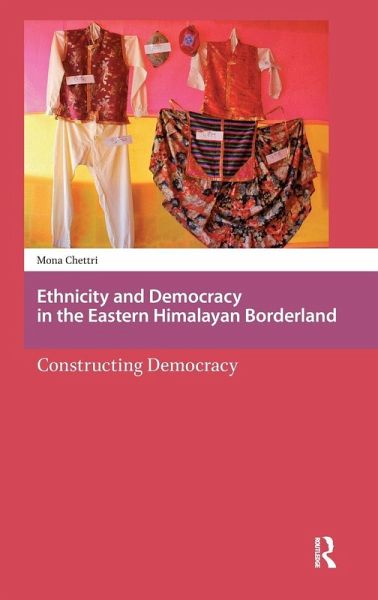
This book presents a close look at the growth, success, and proliferation of ethnic politics on the peripheries of modern South Asia, built around a case study of the Nepal ethnic group that lives in the borderlands of Sikkim, Darjeeling, and east Nepal.
This book presents a close look at the growth, success, and proliferation of ethnic politics on the peripheries of modern South Asia, built around a case study of the Nepal ethnic group that lives in the borderlands of Sikkim, Darjeeling, and east Nepal.
Mona Chettri is a Next Generation Network Scholar at the Australia-India Institute, University of Western Australia. She is the author of Ethnicity and Democracy in the Eastern Himalayan Borderland: Constructing Democracy (Amsterdam University Press, 2017). Her current research focuses on infrastructure, urbanisation, and gender in the Sikkim-Darjeeling Himalaya. Willem van Schendel, Professor of History, University of Amsterdam and International Institute of Social History, the Netherlands. He works with the history, anthropology and sociology of Asia. Recent works include A History of Bangladesh (2020), Embedding Agricultural Commodities (2017, ed.), The Camera as Witness (2015, with J. L. K. Pachuau). See uva.academia.edu/WillemVanSchendel.
Inhaltsangabe
Introduction: Ethnic Identity and Politics in the Eastern Himalaya Why Study the Eastern Himalayan Borderland? Studying the Eastern Himalayan Borderland Facilitating Ethnic Politics 1. Locating the Nepali in the Eastern Himalaya Becoming Nepali: Colonial History and Ethnic Group Formation Going to Muglan: Emigration from the Kingdom of Gorkha to India Language and Ethnic Group Formation Homogenization of the Nepalis and its Impact on Identity Formation 1.1 Identifying the Nepalis of the Eastern Himalaya Gorkhaland: Homeland for the Indian-Nepalis Deconstructing the Nepalis in Sikkim Re-Claiming Limbuwan 2. The Ethnic Worldview: Framing Existential Grievances Limbus of Eastern Nepal and the Politics of 'Jati and Nose' Discriminating Against the Sons of the Soil: The Gorkhas of Darjeeling Fostering Culture of Dependency in Sikkim 3. Ethnic Identity as Political Identity The Political Resilience of the Brave Gorkha Neither Mongol nor Kirat: Asserting the Limbu Identity Claiming Exclusive Identities in Sikkim 4. Manifestations of Ethnic Politics The Dress Code: Looking Like a Gorkha Becoming a Tribe in Sikkim Limbus as the Embodiment of the Indigenous Discourse 5. Constructing Democracy Emergence of a New Patronage Structure The New Elites Expressing Agency Through Ethnic Politics Regional Interpretation of Democracy 6. Being Nepali Across Borders Of Ethnic Politics and democratic Cultures Ethnic Politics as People's Politics.
Introduction: Ethnic Identity and Politics in the Eastern Himalaya Why Study the Eastern Himalayan Borderland? Studying the Eastern Himalayan Borderland Facilitating Ethnic Politics 1. Locating the Nepali in the Eastern Himalaya Becoming Nepali: Colonial History and Ethnic Group Formation Going to Muglan: Emigration from the Kingdom of Gorkha to India Language and Ethnic Group Formation Homogenization of the Nepalis and its Impact on Identity Formation 1.1 Identifying the Nepalis of the Eastern Himalaya Gorkhaland: Homeland for the Indian-Nepalis Deconstructing the Nepalis in Sikkim Re-Claiming Limbuwan 2. The Ethnic Worldview: Framing Existential Grievances Limbus of Eastern Nepal and the Politics of 'Jati and Nose' Discriminating Against the Sons of the Soil: The Gorkhas of Darjeeling Fostering Culture of Dependency in Sikkim 3. Ethnic Identity as Political Identity The Political Resilience of the Brave Gorkha Neither Mongol nor Kirat: Asserting the Limbu Identity Claiming Exclusive Identities in Sikkim 4. Manifestations of Ethnic Politics The Dress Code: Looking Like a Gorkha Becoming a Tribe in Sikkim Limbus as the Embodiment of the Indigenous Discourse 5. Constructing Democracy Emergence of a New Patronage Structure The New Elites Expressing Agency Through Ethnic Politics Regional Interpretation of Democracy 6. Being Nepali Across Borders Of Ethnic Politics and democratic Cultures Ethnic Politics as People's Politics.
Es gelten unsere Allgemeinen Geschäftsbedingungen: www.buecher.de/agb
Impressum
www.buecher.de ist ein Internetauftritt der buecher.de internetstores GmbH
Geschäftsführung: Monica Sawhney | Roland Kölbl | Günter Hilger
Sitz der Gesellschaft: Batheyer Straße 115 - 117, 58099 Hagen
Postanschrift: Bürgermeister-Wegele-Str. 12, 86167 Augsburg
Amtsgericht Hagen HRB 13257
Steuernummer: 321/5800/1497
USt-IdNr: DE450055826