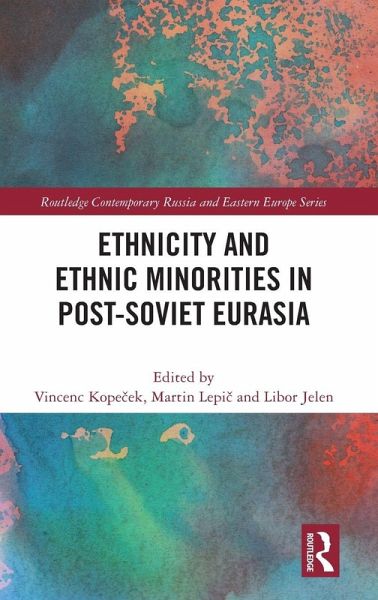
This book focuses on the study of ethnic minorities in post-Soviet Eurasia, their self-perceptions, and their relations with ethnic majorities and dominant state- and nation-building. Contributors to the book examine strategies and networks which minorities create for preserving a group's distinctiveness while at the same time maintaining coexistence with the majority. The chapters also study the effects of different contextual settings of these strategies and networks. Offering a unique systematic comparison of selected cases using ethnicity as the main concept, the book argues it was the…mehr
This book focuses on the study of ethnic minorities in post-Soviet Eurasia, their self-perceptions, and their relations with ethnic majorities and dominant state- and nation-building. Contributors to the book examine strategies and networks which minorities create for preserving a group's distinctiveness while at the same time maintaining coexistence with the majority. The chapters also study the effects of different contextual settings of these strategies and networks. Offering a unique systematic comparison of selected cases using ethnicity as the main concept, the book argues it was the Soviet notion of ethnicity which stood in the centre of the administrative structure of the Soviet Union and that it consequently had a profound impact on how individual ethnic majority and minority groups in the former USSR understood themselves and imagined each other, how political institutions in individual Soviet republics and ethnic autonomies were formed, and how this institutional setting defined the distribution of political power between ethnic majorities and minorities. It also argues that this complex system of relations between ethnic minorities and majorities has significantly changed during the past thirty years and resulted into the formation of a Post-Soviet notion of ethnicity. This book will be of interest to researchers studying Post-Soviet Politics, Political Geography, International Relations, Political Science, History and Area studies.
Libor Jelen is Assistant Professor at Charles University, Prague, Czechia. He focuses on nationalism and geopolitics in post-Soviet Eurasia. He is the author of the monograph Conflict Regions of the World - Europe (in Czech, 2021), and his work has been published in Geopolitics, the Czech Journal of International Relations, and the Bulletin of Geography. Vincenc Kope¿ek is Associate Professor and Deputy Head of the Department of Human Geography and Regional Development, University of Ostrava, Czechia. His research focuses on ethnicity, de facto states, and informal politics in the South Caucasus. He is the co-editor of De Facto States in Eurasia (Routledge, 2020). His recent articles have been published in Europe-Asia Studies, Problems of Post-Communism, and Caucasus Survey. Martin Lepi¿ is Assistant Professor at Charles University, Prague, Czechia. In his research, Martin focuses on centre-periphery tensions and their impact on the geography of secessionist movements, inter-ethnic relations, and the electoral prospects of regionalist parties, particularly in Southern Europe and the Caucasus. His work has been published in Political Geography and Nationalities Papers.
Inhaltsangabe
Introduction. Part 1 Theorizing ethnicity in the Soviet and post-Soviet contexts 1. Ethnicity in Soviet and post-Soviet states in context 2. Situations and strategies of national minorities in post-Soviet Eurasia: a conceptual and theoretical framework Part 2 Case studies 3. Between Kurdish nationalism and Yezidi ethno-religious exceptionalism. Identity split among the Yezidis in Armenia and Georgia 4. Like "plastic"? Ethnic ambiguity as a survival strategy among the Megrelians in the de facto state of Abkhazia 5. Between two states: the Lezgins' struggle for cultural survival in Russia and Azerbaijan 6. The evolution of Azerbaijani Talysh identity: construction, deconstruction, and reconstruction across Soviet and post-Soviet eras 7. We were nomads. The influence of the border on the mobility of Georgian Azerbaijanis after 1991 and 2020 8. What went wrong? Reflections on the Komi ethnic movement 9. Contesting culture: state instrumentalization of Sakha traditions in the post-Soviet Republic of Sakha 10. Latgalians - contested identity through the past and the present 11. Identity narratives of the Rusyns in Transcarpathia since the dissolution of the Soviet Union 12. The Gagauz diaspora in Transnistria: preserving identity in a multi-ethnic environment 13. Koryo-saram - spirals of migration and transformations of identity 14. Kazakhstani Russians in transition: identity formation in times of uncertainty 15. Karakalpaks: entity with and without autonomy. Conclusion
Introduction. Part 1 Theorizing ethnicity in the Soviet and post-Soviet contexts 1. Ethnicity in Soviet and post-Soviet states in context 2. Situations and strategies of national minorities in post-Soviet Eurasia: a conceptual and theoretical framework Part 2 Case studies 3. Between Kurdish nationalism and Yezidi ethno-religious exceptionalism. Identity split among the Yezidis in Armenia and Georgia 4. Like "plastic"? Ethnic ambiguity as a survival strategy among the Megrelians in the de facto state of Abkhazia 5. Between two states: the Lezgins' struggle for cultural survival in Russia and Azerbaijan 6. The evolution of Azerbaijani Talysh identity: construction, deconstruction, and reconstruction across Soviet and post-Soviet eras 7. We were nomads. The influence of the border on the mobility of Georgian Azerbaijanis after 1991 and 2020 8. What went wrong? Reflections on the Komi ethnic movement 9. Contesting culture: state instrumentalization of Sakha traditions in the post-Soviet Republic of Sakha 10. Latgalians - contested identity through the past and the present 11. Identity narratives of the Rusyns in Transcarpathia since the dissolution of the Soviet Union 12. The Gagauz diaspora in Transnistria: preserving identity in a multi-ethnic environment 13. Koryo-saram - spirals of migration and transformations of identity 14. Kazakhstani Russians in transition: identity formation in times of uncertainty 15. Karakalpaks: entity with and without autonomy. Conclusion
Es gelten unsere Allgemeinen Geschäftsbedingungen: www.buecher.de/agb
Impressum
www.buecher.de ist ein Internetauftritt der buecher.de internetstores GmbH
Geschäftsführung: Monica Sawhney | Roland Kölbl | Günter Hilger
Sitz der Gesellschaft: Batheyer Straße 115 - 117, 58099 Hagen
Postanschrift: Bürgermeister-Wegele-Str. 12, 86167 Augsburg
Amtsgericht Hagen HRB 13257
Steuernummer: 321/5800/1497
USt-IdNr: DE450055826