
Andere Kunden interessierten sich auch für
 A History of Political Thought34,99 €
 Victorian Political Thought on France and the French76,99 €
 Victorian Political Thought on France and the French76,99 €
 A History of Political Thought68,99 €
 Political Thought from Machiavelli to Stalin76,99 €
 Peasants, Political Police, and the Early Soviet State38,99 €
 A Handbook to Political Questions of the day and the Arguments on Either Side, With an Introd36,99 €

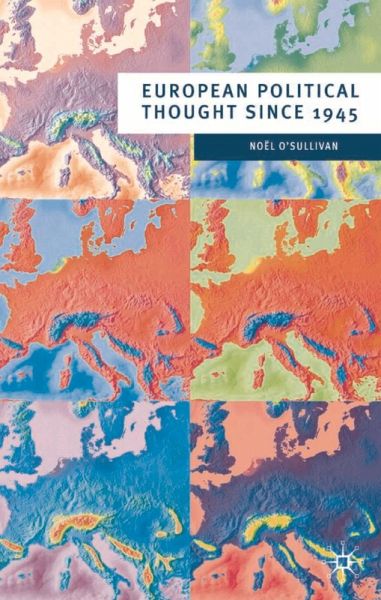
This book offers a critical account of the response of leading European political thinkers to the postwar task of reconstruction, the advent of totalitarianism in the USSR, and the emergence of increasing social diversity and supra-national political trends in the post Cold War era. The unifying concern is with whether the ideal of the limited state has been successfully adapted to the European order of nation-states in the early postwar decades, and subsequently to the European Union and globalization.
This study offers a concise overview of European political thought since 1945. Despite its enormous diversity, Noël O'Sullivan argues that a unifying theme may be found in the need for European political thinkers to respond, either sympathetically or critically, to the following four major requirements posed by the postwar task of democratic reconstruction: - To restate the theory of the limited state in face of the continuing totalitarian challenge represented by postwar Soviet power - To provide social integration by developing a coherent ideal of social justice - To develop a more pluralist theory of the democratic state in response to the claims of feminism, postmodernism and cultural and ethnic minorities - To extend the ideal of civil association from a national into a supranational concept of European political identity in response to developments such as globalisation. The study also considers such issues as environmentalism and the emergence of the so-called 'risk society'. O'Sullivan concludes that, while an uneasy compromise has been achieved between the limited state, welfare provision and pluralism, the attempt to resituate this compromise within a supra-national European 'civil' identity may finally subvert the modern ideal of democratic and accountable government. Clear and accessible, this thematic survey is essential reading for all those interested in political thought in Europe from 1945 to the present.
This study offers a concise overview of European political thought since 1945. Despite its enormous diversity, Noël O'Sullivan argues that a unifying theme may be found in the need for European political thinkers to respond, either sympathetically or critically, to the following four major requirements posed by the postwar task of democratic reconstruction: - To restate the theory of the limited state in face of the continuing totalitarian challenge represented by postwar Soviet power - To provide social integration by developing a coherent ideal of social justice - To develop a more pluralist theory of the democratic state in response to the claims of feminism, postmodernism and cultural and ethnic minorities - To extend the ideal of civil association from a national into a supranational concept of European political identity in response to developments such as globalisation. The study also considers such issues as environmentalism and the emergence of the so-called 'risk society'. O'Sullivan concludes that, while an uneasy compromise has been achieved between the limited state, welfare provision and pluralism, the attempt to resituate this compromise within a supra-national European 'civil' identity may finally subvert the modern ideal of democratic and accountable government. Clear and accessible, this thematic survey is essential reading for all those interested in political thought in Europe from 1945 to the present.