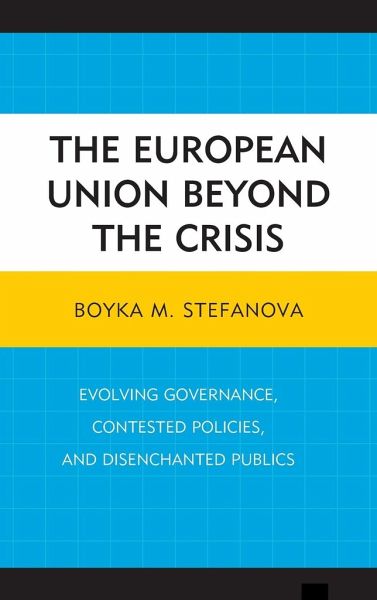
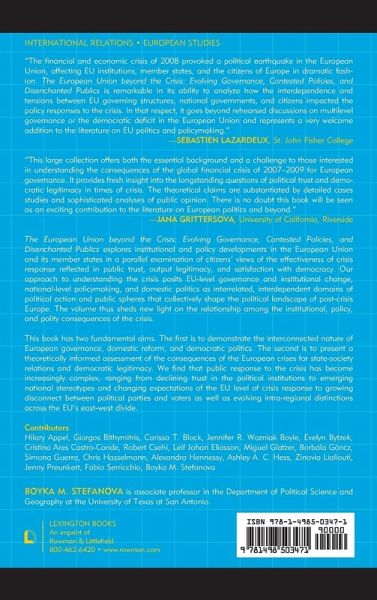
This book provides a post-crisis perspective on European politics by studying interactions within and among related domestic and EU political spheres. The contributors focus on political dynamics associated with the policy decisions and outcomes of crisis response in all three domains: EU institutions, public policy, and democratic politics.
This book provides a post-crisis perspective on European politics by studying interactions within and among related domestic and EU political spheres. The contributors focus on political dynamics associated with the policy decisions and outcomes of crisis response in all three domains: EU institutions, public policy, and democratic politics.
Boyka Stefanova is associate professor in the Department of Political Science and Geography at the University of Texas at San Antonio.
Inhaltsangabe
Chapter 1: Beyond the Crisis: Governance and Politics in the European Union between Crisis and Opportunity (Editor's Introduction) Boyka Stefanova Part I: European Governance in a Time of Crisis: Limitations and Prospects of The EU's Economic and Monetary Union Chapter 2: Collaborative Federalism in the European Union: Intergovernmental Relations and the Allocation of Powers in the Economic and Monetary Union Robert Csehi Chapter 3: Trust and Currency: Functional Preconditions and Problems of the Euro Jenny Preunkert Chapter 4: European Monetary Union versus European Clearing Union: An Application of Keynes to Regional Monetary Systems Ashley A.C. Hess Chapter 5: Why the Euro Will Survive: The Institutionalization of Accepted Policies through Key Actors Leif Johan Eliasson Part II: The Politics of Crisis Response: European Governance Meets Public Policy Chapter 6: The Sovereign Debt Crisis, Bailout Politics, and Fiscal Coordination in the European Union Hilary Appel and Carissa Tudor Block Chapter 7: A Discernible Impact? The Influence of Public Opinion on EU Policy-Making Jennifer Boyle and Chris Hasselmann Chapter 8: Informal Governance and the Eurozone Crisis Alexandra Hennessy Chapter 9: Coping with Financial Crisis: Crisis Response, Institutional Innovation, and the Variety of Finance Capitalism in Italy and Spain Boyka Stefanova Chapter 10: EU Affairs in Spanish Electoral Competition at the Height of the Euro Crisis Cristina Ares Castro-Conde Chapter 11: Testing the Resilience of Civil Society: The Euro Crisis, Portugal's Welfare State and the Third Sector Miguel Glatzer Part III: Democratic Politics in the Context of Crisis: a Citizens' Perspective Chapter 12: Public Attitudes and Support for the EU in the Wake of the Financial Crisis Jennifer Boyle and Chris Hasselmann Chapter 13: Implications of the Greek Crisis: Nationalism, Enemy Stereotypes, and the European Union Zinovia Lialiouti and Giorgos Bithymitris Chapter 14: Identity and Economic Rationality: Explaining Attitudes towards the EU in a Time of Crisis Simona Guerra and Fabio Serricchio Chapter 15: Public Perceptions of the European Union and the Effect of the Crisis: A Persistent East-West Divide? Borbala Göncz Chapter 16: Satisfaction with Democracy in Times of Economic Crises Evelyn Bytzek
Chapter 1: Beyond the Crisis: Governance and Politics in the European Union between Crisis and Opportunity (Editor's Introduction) Boyka Stefanova Part I: European Governance in a Time of Crisis: Limitations and Prospects of The EU's Economic and Monetary Union Chapter 2: Collaborative Federalism in the European Union: Intergovernmental Relations and the Allocation of Powers in the Economic and Monetary Union Robert Csehi Chapter 3: Trust and Currency: Functional Preconditions and Problems of the Euro Jenny Preunkert Chapter 4: European Monetary Union versus European Clearing Union: An Application of Keynes to Regional Monetary Systems Ashley A.C. Hess Chapter 5: Why the Euro Will Survive: The Institutionalization of Accepted Policies through Key Actors Leif Johan Eliasson Part II: The Politics of Crisis Response: European Governance Meets Public Policy Chapter 6: The Sovereign Debt Crisis, Bailout Politics, and Fiscal Coordination in the European Union Hilary Appel and Carissa Tudor Block Chapter 7: A Discernible Impact? The Influence of Public Opinion on EU Policy-Making Jennifer Boyle and Chris Hasselmann Chapter 8: Informal Governance and the Eurozone Crisis Alexandra Hennessy Chapter 9: Coping with Financial Crisis: Crisis Response, Institutional Innovation, and the Variety of Finance Capitalism in Italy and Spain Boyka Stefanova Chapter 10: EU Affairs in Spanish Electoral Competition at the Height of the Euro Crisis Cristina Ares Castro-Conde Chapter 11: Testing the Resilience of Civil Society: The Euro Crisis, Portugal's Welfare State and the Third Sector Miguel Glatzer Part III: Democratic Politics in the Context of Crisis: a Citizens' Perspective Chapter 12: Public Attitudes and Support for the EU in the Wake of the Financial Crisis Jennifer Boyle and Chris Hasselmann Chapter 13: Implications of the Greek Crisis: Nationalism, Enemy Stereotypes, and the European Union Zinovia Lialiouti and Giorgos Bithymitris Chapter 14: Identity and Economic Rationality: Explaining Attitudes towards the EU in a Time of Crisis Simona Guerra and Fabio Serricchio Chapter 15: Public Perceptions of the European Union and the Effect of the Crisis: A Persistent East-West Divide? Borbala Göncz Chapter 16: Satisfaction with Democracy in Times of Economic Crises Evelyn Bytzek
Es gelten unsere Allgemeinen Geschäftsbedingungen: www.buecher.de/agb
Impressum
www.buecher.de ist ein Internetauftritt der buecher.de internetstores GmbH
Geschäftsführung: Monica Sawhney | Roland Kölbl | Günter Hilger
Sitz der Gesellschaft: Batheyer Straße 115 - 117, 58099 Hagen
Postanschrift: Bürgermeister-Wegele-Str. 12, 86167 Augsburg
Amtsgericht Hagen HRB 13257
Steuernummer: 321/5800/1497
USt-IdNr: DE450055826