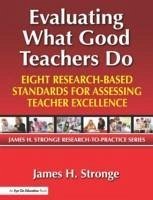
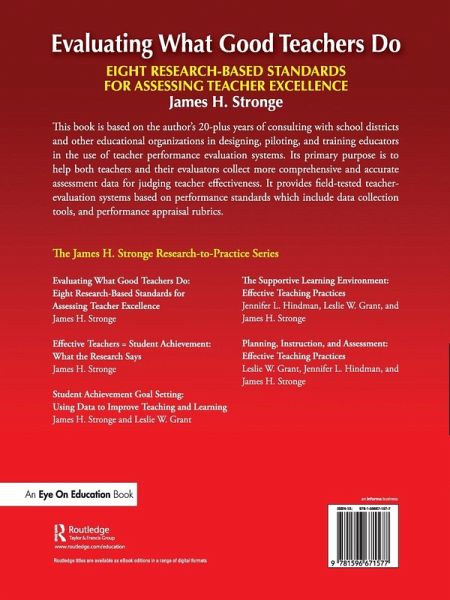
This book is based on author James H. Stronge's 20-plus years of consulting with school districts and other educational organizations in designing, piloting, and training educators in the use of teacher-performance evaluation systems. Its primary purpose is to help both teachers and their evaluators collect more comprehensive and accurate assessment data for judging teacher effectiveness. The author provides field-tested teacher-evaluation systems based on performance standards which include data collection tools and performance appraisal rubrics.
This book is based on author James H. Stronge's 20-plus years of consulting with school districts and other educational organizations in designing, piloting, and training educators in the use of teacher-performance evaluation systems. Its primary purpose is to help both teachers and their evaluators collect more comprehensive and accurate assessment data for judging teacher effectiveness. The author provides field-tested teacher-evaluation systems based on performance standards which include data collection tools and performance appraisal rubrics.
James H. Stronge is the Heritage Professor in the Educational Policy, Planning, and Leadership Area at the College of William and Mary, Williamsburg, Virginia. His research interests include policy and practice related to teacher quality, and teacher and administrator evaluation. His work on teacher quality focuses on how to identify effective teachers and how to enhance teacher effectiveness. Dr. Stronge has presented his research at state, national, and international conferences such as the American Educational Research Association, American Association of School Administrators, Asia-Pacific Conference on Gifted, Association for Supervision and Curriculum Development, European Council of International Schools. National Evaluation Institute, and University Council for Educational Administration. Additionally, he has worked extensively with local school districts and other educational organizations on issues related to teacher effectiveness, teacher selection, and teacher and administrator evaluation. Dr. Stronge has authored, coauthored, or edited twenty-two books and more than 100 articles, chapters, and technical reports. Selected books have been translated and published in Arabic, Mandarin, Italian, Korean, Portuguese, and Vietnamese. Some of his recent books include: Student Achievement Goal Setting: Using Data to Improve Teaching and Learning> (Eye On Education, 2009) Qualities of Effective Principals> (Association for Supervision and Curriculum Development, 2008) Qualities of Effective Teaching,> 2nd Ed. (Association for Supervision and Curriculum Development, 2007) The Teacher Quality Index: A Protocol for Teacher Selection> (Association for Supervision and Curriculum Development, 2006) Teacher Pay and Teacher Quality: Attracting, Developing, and Retaining the Best Teachers> (Corwin Press, 2006) Linking Teacher Evaluation and Student Achievement> (Association for Supervision and Curriculum Development, 2005) Evaluating Teaching,> 2nd Ed. (Corwin Press, 2005). Dr. Stronge has been a teacher, counselor, and district-level administrator. His doctorate is in the area of Educational Administration and Planning from the University of Alabama. He may be contacted at: The College of William and Mary, School of Education, P.O. Box 8795, Williamsburg, VA 23187-8795; 757-221-2339; or http://wmpeople.wm.edu/jhstro.
Inhaltsangabe
Part I Performance Standards for Teachers; Chapter 1 How to Assess Teacher Quality; Chapter 2 Professional Knowledge4A standard format and common language are used throughout Chapters 2 to 9 so as to provide comparability and ease-of-use for the eight teacher performance standards presented in the Chapters. Consequently, there is purposeful overlap in Introduction language used in the Chapters. The intent is that this selective use of repetitive language will serve to reinforce the concepts and practices discussed throughout the book.; Chapter 3 Data-Driven Planning; Chapter 4 Instructional Delivery; Chapter 5 Assessment for Learning; Chapter 6 Learning Environment; Chapter 7 Communication and Advocacy; Chapter 8 Professionalism; Chapter 9 Student Progress; Chapter 10 Concluding Thoughts on Evaluating Teacher EffectivenessPart II Tools You Can Use;
Part I Performance Standards for Teachers; Chapter 1 How to Assess Teacher Quality; Chapter 2 Professional Knowledge4A standard format and common language are used throughout Chapters 2 to 9 so as to provide comparability and ease-of-use for the eight teacher performance standards presented in the Chapters. Consequently, there is purposeful overlap in Introduction language used in the Chapters. The intent is that this selective use of repetitive language will serve to reinforce the concepts and practices discussed throughout the book.; Chapter 3 Data-Driven Planning; Chapter 4 Instructional Delivery; Chapter 5 Assessment for Learning; Chapter 6 Learning Environment; Chapter 7 Communication and Advocacy; Chapter 8 Professionalism; Chapter 9 Student Progress; Chapter 10 Concluding Thoughts on Evaluating Teacher EffectivenessPart II Tools You Can Use;
Es gelten unsere Allgemeinen Geschäftsbedingungen: www.buecher.de/agb
Impressum
www.buecher.de ist ein Internetauftritt der buecher.de internetstores GmbH
Geschäftsführung: Monica Sawhney | Roland Kölbl | Günter Hilger
Sitz der Gesellschaft: Batheyer Straße 115 - 117, 58099 Hagen
Postanschrift: Bürgermeister-Wegele-Str. 12, 86167 Augsburg
Amtsgericht Hagen HRB 13257
Steuernummer: 321/5800/1497
USt-IdNr: DE450055826