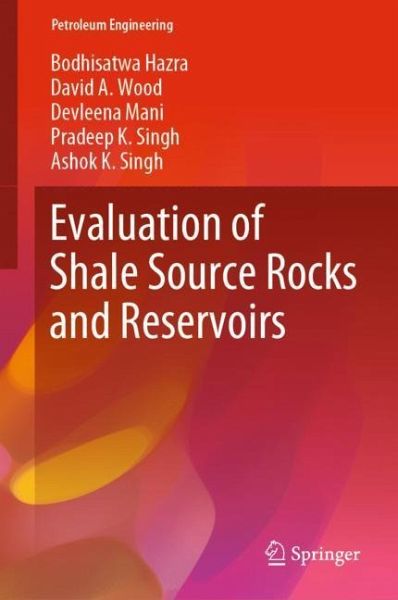
This book details the analytical processes, and interpretation of the resulting data, needed in order to achieve a comprehensive source-rock evaluation of organic-rich shales. The authors employ case studies on Permian and Cretaceous shales from various Indian basins and other petroleum-bearing basins around the world to illustrate the key features of their organic-rich shale characterization methodology. These case studies may also help to identify potential zones within shale formations that could be exploited for commercial gas and/or oil production. Given its scope, the book will be of…mehr
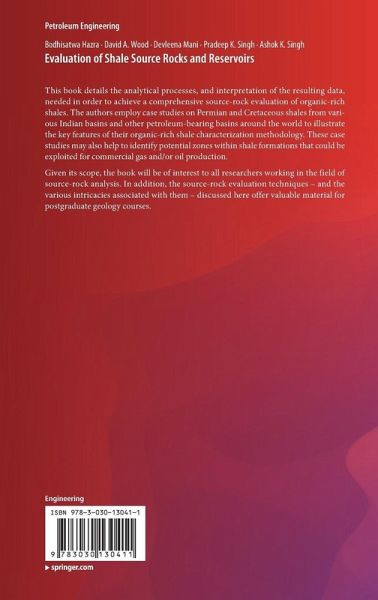
This book details the analytical processes, and interpretation of the resulting data, needed in order to achieve a comprehensive source-rock evaluation of organic-rich shales. The authors employ case studies on Permian and Cretaceous shales from various Indian basins and other petroleum-bearing basins around the world to illustrate the key features of their organic-rich shale characterization methodology. These case studies may also help to identify potential zones within shale formations that could be exploited for commercial gas and/or oil production.
Given its scope, the book will be of interest to all researchers working in the field of source-rock analysis. In addition, the source-rock evaluation techniques - and the various intricacies associated with them - discussed here offer valuable material for postgraduate geology courses.
Dr. Bodhisatwa Hazra, a Senior Scientist at CSIR-Central Institute of Mining and Fuel Research, Dhanbad, India, is currently working as a Visiting Scientist at the University of Kiel, Germany. He specializes in Petroleum Geochemistry, Organic Petrology and is currently focusing on unconventional reservoir geochemistry-petrophysics, and CO2 sequestration. Dr. Hazra obtained his PhD degree from Indian School of Mines, Dhanbad, on the shale-gas assessment of Raniganj basin, India. Dr. Hazra is a recipient of DST Inspire Faculty award, 2015 and CSIR Young Scientist Award, 2019. Currently, he serves as an Associate Editor of the Journal of Geological Society of India, and the Arabian Journal of Geosciences. Dr. Debanjan Chandra, is a Postdoctoral Fellow at TU Delft. He received his PhD degree from Indian Institute of Technology Bombay on resolving the gas storage and migration behavior in shale and coal for enhanced gas recovery and CO2 storage applications. By combining reservoir permeability with rock mechanical properties, he attempted to quantify reservoir stability during enhanced hydrocarbon recovery. Dr. Chandra also used gas adsorption as well as X-ray and neutron scattering to assess the gas storage capacity of shale and coal reservoirs which were validated using 3D X-ray CT and 2D electron microscopic imaging. Dr. Vikram Vishal is an Associate Professor at Indian Institute of Technology (IIT) Bombay, India, and holds a PhD degree jointly from IIT Bombay and Monash University, Australia. He has had brief professional stints at IIT Roorkee, Stanford University, Massachusetts Institute of Technology, Shell and Tata Steel Limited. Dr. Vishal specializes in reservoir geomechanics, unconventional petrophysics and geologic carbon sequestration. A two-time Fulbright Fellow and a two-time national awardee, Dr. Vishal is a recipient of several notable recognitions. He has received 2 patents, and authored over 100 research publications, five national roadmaps and four international reports in his domains of expertise.
Inhaltsangabe
Fundamentals of Shale Rock and Shale Gas: Inorganic Perspective.- Source Rock Assessment.- Perspectives and Conclusions.