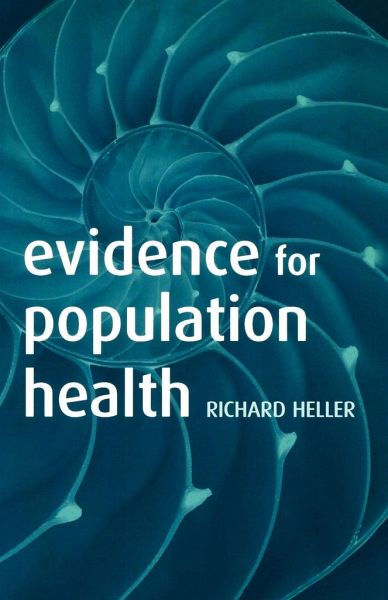
Evidence based medicine has had a major impact on clinical practice. There is an urgent need for the Public Health community to further develop its own evidence base as many interventions are introduced, unchallenged with no hope of evaluation as the tools for this do not exist. This well structured text aims to provide the tools to achieve this aim. Mindful of the varying needs of students, practitioners and policy makers, the author highlights key take home messages for each and provides practical methods, and their theoretical basis, for applying evidence to the field of Public Health. Some…mehr
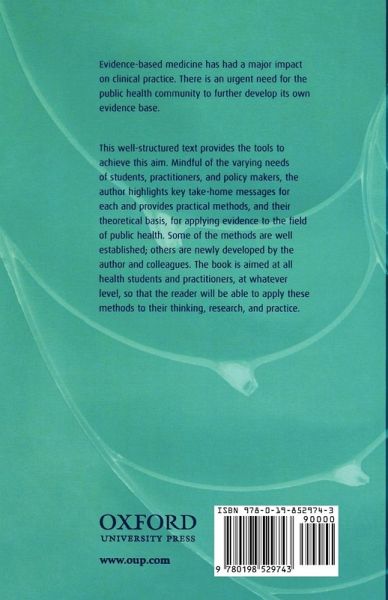
Evidence based medicine has had a major impact on clinical practice. There is an urgent need for the Public Health community to further develop its own evidence base as many interventions are introduced, unchallenged with no hope of evaluation as the tools for this do not exist. This well structured text aims to provide the tools to achieve this aim. Mindful of the varying needs of students, practitioners and policy makers, the author highlights key take home messages for each and provides practical methods, and their theoretical basis, for applying evidence to the field of Public Health. Some of the methods are well established, others are newly developed by the author and colleagues. The book is aimed at all health students and practitioners, at whatever level, with the hope that the reader will apply these methods to their thinking, research and practice.
Richard Heller, Emeritus Professor of Medicine, University of Newcastle, Australia and of Public Health, University of Manchester, UK, has a medical degree and doctorate from the University of London, United Kingdom. He was Professor of Clinical Epidemiology and Community Medicine at the University of Newcastle, Australia and Professor of Public Health at the University of Manchester, United Kingdom. Richard was also the founder and coordinator of the People's Open Access Education Initiative (Peoples-uni, https://www.peoples-uni.org/), which aimed to provide Public Health capacity building in developing countries at low cost, through e-learning using open-access resources on the Internet and leading to an MPH degree. He is author of The Distributed University for Sustainable Higher Education (2022, https://link.springer.com/book/10.1007/978-981-16-6506-6).
Inhaltsangabe
* Preface * Part 1: Ask the question - what is the need for evidence for population health? * 1: What is evidence for population health? * 2: The population or the individual in public health * 3: Shifting the distribution * Part 2: Collect the evidence - what measures should we make? * 4: Measuring the population impact * 5: Evaluating population-based risks and interventions * 6: Getting the outcome measure right * 7: Public health informatics: the role of e-science in building the evidence base * Part 3: Understand and use the evidence - how can professionals and the public understand and use evidence to improve population health? * 8: Perceptions of risk among policy-makers and the public * 9: Managing knowledge for population health * 10: Applying evidence to inform public health practice and health policy decision-making * 11: Individual or population priorities for population health: involving the public * 12: Evidence into action: population impact assessment and the population health decision support
* Preface * Part 1: Ask the question - what is the need for evidence for population health? * 1: What is evidence for population health? * 2: The population or the individual in public health * 3: Shifting the distribution * Part 2: Collect the evidence - what measures should we make? * 4: Measuring the population impact * 5: Evaluating population-based risks and interventions * 6: Getting the outcome measure right * 7: Public health informatics: the role of e-science in building the evidence base * Part 3: Understand and use the evidence - how can professionals and the public understand and use evidence to improve population health? * 8: Perceptions of risk among policy-makers and the public * 9: Managing knowledge for population health * 10: Applying evidence to inform public health practice and health policy decision-making * 11: Individual or population priorities for population health: involving the public * 12: Evidence into action: population impact assessment and the population health decision support
Es gelten unsere Allgemeinen Geschäftsbedingungen: www.buecher.de/agb
Impressum
www.buecher.de ist ein Internetauftritt der buecher.de internetstores GmbH
Geschäftsführung: Monica Sawhney | Roland Kölbl | Günter Hilger
Sitz der Gesellschaft: Batheyer Straße 115 - 117, 58099 Hagen
Postanschrift: Bürgermeister-Wegele-Str. 12, 86167 Augsburg
Amtsgericht Hagen HRB 13257
Steuernummer: 321/5800/1497
USt-IdNr: DE450055826