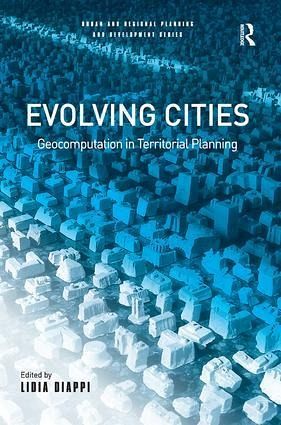
Bringing together the leading researchers into 'geocomputation', this edited volume provides an up-to-date overview of the development of new artificial intelligence principles and technologies used for the analysis, development and evaluation of urban planning policies and programmes.
Bringing together the leading researchers into 'geocomputation', this edited volume provides an up-to-date overview of the development of new artificial intelligence principles and technologies used for the analysis, development and evaluation of urban planning policies and programmes.
Lidia Diappi is a Professor in the Department of Architecture and Planning at the Polytechnic of Milan, Italy.
Inhaltsangabe
Contents: Introduction, Lidia Diappi. The Spatial Investigation Capabilities of Neural Networks: Neural classifiers for land cover recognition: merging radiometric and ancillary information, Silvio Griguolo; Spatial interaction modelling: neural network methods and global optimization, Manfred Fischer and Katerina Hlavackova-Schindler; Complexity in sustainability: an investigation of the Italian urban system through self reflexive neural networks, Lidia Diappi, Massimo Buscema and Michela Ottanà . Land Use Dynamics Through Artificial Intelligence Tools: Knowledge discovery and data mining to investigate urban and territorial evolution: tools and methodologies, Francesco Bonchi, Silvana Lombardo and Serena Pecori; Learning about land use change in Rome and Pisa urban areas, Francesco Bonchi, Silvana Lombardo, Serena Pecori and Alessandro Santucci; The identification and simulation of the urban spatio-temporal dynamic: the case study of Rome, Ferdinando Semboloni; Appendix: an overview of the SSI handbook, Robert Gianassi; Land use dynamics: a stochastic forecasting model based on SOM neural nets knowledge, Lidia Diappi and Paola Bolchi. Multi Agent Systems: Interactions Among Actors and Their Behaviours: Multi agent simulations for traffic in regional planning, Kai Nagel and Bryan Raney; Traffic-related air pollution in an urban environment: a KBDSS for improving the decisional context, Emilia Conte and Grazia Concilio; The chaotic nature of urban neighbourhood evolution, Chris Webster; Index.
Contents: Introduction, Lidia Diappi. The Spatial Investigation Capabilities of Neural Networks: Neural classifiers for land cover recognition: merging radiometric and ancillary information, Silvio Griguolo; Spatial interaction modelling: neural network methods and global optimization, Manfred Fischer and Katerina Hlavackova-Schindler; Complexity in sustainability: an investigation of the Italian urban system through self reflexive neural networks, Lidia Diappi, Massimo Buscema and Michela Ottanà . Land Use Dynamics Through Artificial Intelligence Tools: Knowledge discovery and data mining to investigate urban and territorial evolution: tools and methodologies, Francesco Bonchi, Silvana Lombardo and Serena Pecori; Learning about land use change in Rome and Pisa urban areas, Francesco Bonchi, Silvana Lombardo, Serena Pecori and Alessandro Santucci; The identification and simulation of the urban spatio-temporal dynamic: the case study of Rome, Ferdinando Semboloni; Appendix: an overview of the SSI handbook, Robert Gianassi; Land use dynamics: a stochastic forecasting model based on SOM neural nets knowledge, Lidia Diappi and Paola Bolchi. Multi Agent Systems: Interactions Among Actors and Their Behaviours: Multi agent simulations for traffic in regional planning, Kai Nagel and Bryan Raney; Traffic-related air pollution in an urban environment: a KBDSS for improving the decisional context, Emilia Conte and Grazia Concilio; The chaotic nature of urban neighbourhood evolution, Chris Webster; Index.
Es gelten unsere Allgemeinen Geschäftsbedingungen: www.buecher.de/agb
Impressum
www.buecher.de ist ein Internetauftritt der buecher.de internetstores GmbH
Geschäftsführung: Monica Sawhney | Roland Kölbl | Günter Hilger
Sitz der Gesellschaft: Batheyer Straße 115 - 117, 58099 Hagen
Postanschrift: Bürgermeister-Wegele-Str. 12, 86167 Augsburg
Amtsgericht Hagen HRB 13257
Steuernummer: 321/5800/1497
USt-IdNr: DE450055826