
Andere Kunden interessierten sich auch für
 The Handbook of Critical Theoretical Research Methods in Education78,99 €
 Doing Good Social Science42,99 €
 Doing Good Social Science137,99 €
 Writing as Inquiry Towards Being and Becoming38,99 €
 Writing as Inquiry Towards Being and Becoming137,99 €
 Educational Research Practice in Southern Contexts40,99 €
 Qualitative Forschung auf dem Prüfstand65,00 €


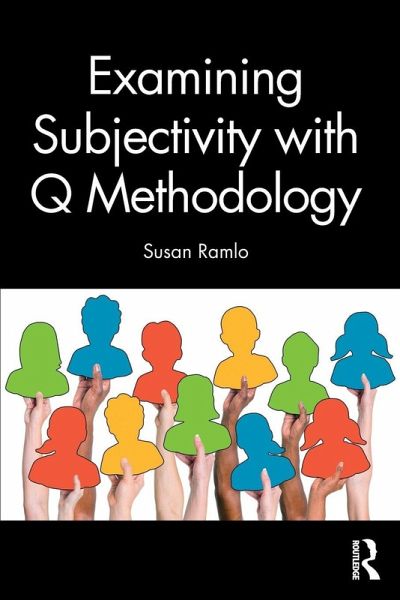
This innovative book explores how Q methodology offers a unique way to examine subjectivity, meaning people's viewpoints, in that it both differentiates and describes viewpoints, by blending qualitative and quantitative research methods.
The book provides accurate terminology and consistent practices, with examples of using Q to study subjectivity in a variety of contexts and disciplines. The book also frames Q with its unique blending of qualitative and quantitative research aspects, from data collection to analysis and interpretation. The author aims to help readers to understand the basics of Q methodology as well as delving deeper into Q as explicated by William Stephenson in an easy to read yet accurate text in terms of processes and theoretical frameworks of Q.
This is an essential text for those interested in using Q methodology in qualitative research and mixed methods research across a range of disciplines.
The book provides accurate terminology and consistent practices, with examples of using Q to study subjectivity in a variety of contexts and disciplines. The book also frames Q with its unique blending of qualitative and quantitative research aspects, from data collection to analysis and interpretation. The author aims to help readers to understand the basics of Q methodology as well as delving deeper into Q as explicated by William Stephenson in an easy to read yet accurate text in terms of processes and theoretical frameworks of Q.
This is an essential text for those interested in using Q methodology in qualitative research and mixed methods research across a range of disciplines.
Dr. Ramlo's introductory text on Q methodology will be a ready resource for students using the methodology in their undergraduate or graduate work. She has covered the foundational elements of the methodology as well as the required steps to conduct a study in a clear and concise manner. Additionally, Dr. Ramlo also touches on some of the deeper theoretical ideas in Q that will be of appeal to more veteran methodologists. I will use this book with my undergraduate students. Dr. Ramlo's book should be on the bookshelf of anyone interested in Q methodology.
James C. Rhoads, Professor of Political Science, Westminster College, Pennsylvania
Dr. Ramlo's book is extremely timely for the field of psychology in that more researchers are seeking information on how to use Q methodology to describe and understand thinking that underpins choices and decision-making. Her book is well structured and provides clear, concise information that informs the novice and experienced researcher of the Q technique and Q methodology. Ramlo has incorporated a rich array of significant and historical references throughout each chapter, a wealth of examples, and a summary of the expected learning. This book is a significant addition to the scientific research community for the study of human subjectivity. It addresses the need for a deeper understanding and appreciation of this unique methodology. It certainly has a place in my research toolbox.
Vivian C. Hardison, Doctor of Human & Organizational Psychology, School of Psychology Touro University Worldwide, Los Alamitos, California
As a preeminent researcher and author in Q-methodology, this author clearly and carefully organizes the process and background in the subject for a wide range of learners, readers, and researchers.
Carrie R. Salmon, Academic Lab Manager, Department of Physics, Kent State University; Affiliated Scholar, College of Wooster, Wooster, Ohio.
James C. Rhoads, Professor of Political Science, Westminster College, Pennsylvania
Dr. Ramlo's book is extremely timely for the field of psychology in that more researchers are seeking information on how to use Q methodology to describe and understand thinking that underpins choices and decision-making. Her book is well structured and provides clear, concise information that informs the novice and experienced researcher of the Q technique and Q methodology. Ramlo has incorporated a rich array of significant and historical references throughout each chapter, a wealth of examples, and a summary of the expected learning. This book is a significant addition to the scientific research community for the study of human subjectivity. It addresses the need for a deeper understanding and appreciation of this unique methodology. It certainly has a place in my research toolbox.
Vivian C. Hardison, Doctor of Human & Organizational Psychology, School of Psychology Touro University Worldwide, Los Alamitos, California
As a preeminent researcher and author in Q-methodology, this author clearly and carefully organizes the process and background in the subject for a wide range of learners, readers, and researchers.
Carrie R. Salmon, Academic Lab Manager, Department of Physics, Kent State University; Affiliated Scholar, College of Wooster, Wooster, Ohio.