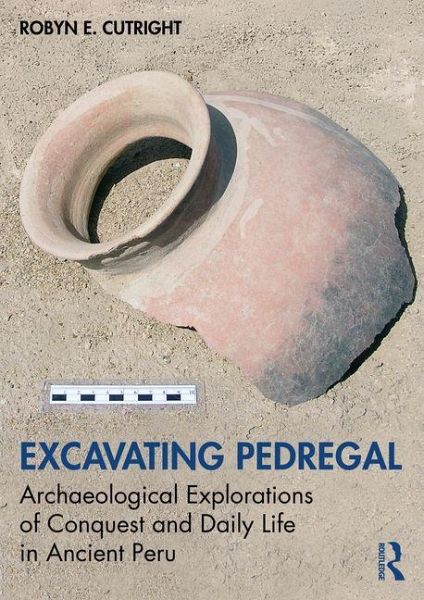
Excavating Pedregal offers a new synthesis of household-level experiences of imperial conquest on the north coast of Perú, using excavations at the Late Intermediate Period farming community of Pedregal as an engaging case study of archaeological research in action.
Excavating Pedregal offers a new synthesis of household-level experiences of imperial conquest on the north coast of Perú, using excavations at the Late Intermediate Period farming community of Pedregal as an engaging case study of archaeological research in action.
Robyn E. Cutright is W. George Matton Professor of Anthropology and Latin American Studies at Centre College, Danville, Kentucky. Her research focuses on the local experiences of Chimú conquest on the north coast of Perú, using daily culinary practice as a window onto broader regional processes of change. This research has been supported by the Wenner-Gren Foundation for Anthropological Research, the Social Science Research Council, a Fulbright Fellowship, the Curtiss T. and Mary G. Brennan Foundation, and the Rust Family Foundation. She is co-editor of Ancient Households on the North Coast of Perú, and author of The Story of Food in the Human Past: How What We Ate Made Us Who We Are. She is also editor of Ñawpa Pacha: The Journal of the Institute of Andean Studies. Cutright received her Ph.D. in Anthropology from the University of Pittsburgh and her B.A. in Anthropology and Spanish from Lawrence University.
Inhaltsangabe
Introduction: What Is an Archaeologist and How Did I Become One? 1 What Do Archaeologists Want to Know about the Past? 2 Reasoning like an Archaeologist: Connecting Questions to Evidence 3 Who Cares about Archaeology and Why? Archaeology's Stakeholders 4 How Do You Know Where to Dig? Surveying Regions Landscapes and Sites 5 Brushing Dirt Off of Other Dirt: Excavating Archaeological Sites 6 Making Sense of Time Space and Artifacts 7 Corn Fish and Conquest: Analyzing Plant and Animal Remains 8 Tools of the Trade: Ceramic Pots and Stone Implements as Culinary Technologies9 Reading the Bones: Bioarchaeology of Cuisine Identity and Experience under Chimú Rule 10 Conclusions Conversations and New Directions
Introduction: What Is an Archaeologist and How Did I Become One? 1 What Do Archaeologists Want to Know about the Past? 2 Reasoning like an Archaeologist: Connecting Questions to Evidence 3 Who Cares about Archaeology and Why? Archaeology's Stakeholders 4 How Do You Know Where to Dig? Surveying Regions Landscapes and Sites 5 Brushing Dirt Off of Other Dirt: Excavating Archaeological Sites 6 Making Sense of Time Space and Artifacts 7 Corn Fish and Conquest: Analyzing Plant and Animal Remains 8 Tools of the Trade: Ceramic Pots and Stone Implements as Culinary Technologies9 Reading the Bones: Bioarchaeology of Cuisine Identity and Experience under Chimú Rule 10 Conclusions Conversations and New Directions
Es gelten unsere Allgemeinen Geschäftsbedingungen: www.buecher.de/agb
Impressum
www.buecher.de ist ein Internetauftritt der buecher.de internetstores GmbH
Geschäftsführung: Monica Sawhney | Roland Kölbl | Günter Hilger
Sitz der Gesellschaft: Batheyer Straße 115 - 117, 58099 Hagen
Postanschrift: Bürgermeister-Wegele-Str. 12, 86167 Augsburg
Amtsgericht Hagen HRB 13257
Steuernummer: 321/5800/1497
USt-IdNr: DE450055826