

Andere Kunden interessierten sich auch für
 Excel 2013 for Educational and Psychological Statistics53,49 €
 Excel 2019 for Educational and Psychological Statistics49,99 €
 Surveying Human Vulnerabilities across the Life Course38,99 €
 Human Rights Issues and Muslim Community in Kenya, after 9/11/201341,99 €
 Discrete Choice Experiments Using R91,99 €
 The Social Sciences of Quantification91,99 €
 Creating and Verifying Data Sets with Excel44,99 €


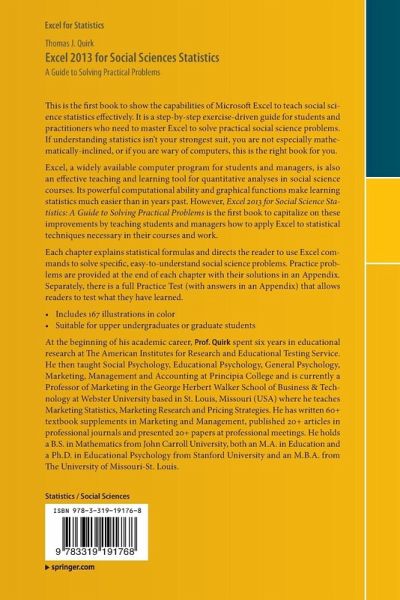
This is the first book to show the capabilities of Microsoft Excel to teach social science statistics effectively. It is a step-by-step exercise-driven guide for students and practitioners who need to master Excel to solve practical social science problems. If understanding statistics isn't your strongest suit, you are not especially mathematically-inclined, or if you are wary of computers, this is the right book for you.
Excel, a widely available computer program for students and managers, is also an effective teaching and learning tool for quantitative analyses in social science courses. Its powerful computational ability and graphical functions make learning statistics much easier than in years past. However, Excel 2013 for Social Science Statistics: A Guide to Solving Practical Problems is the first book to capitalize on these improvements by teaching students and managers how to apply Excel to statistical techniques necessary in their courses and work.
Each chapter explains statistical formulas and directs the reader to use Excel commands to solve specific, easy-to-understand social science problems. Practice problems are provided at the end of each chapter with their solutions in an Appendix. Separately, there is a full Practice Test (with answers in an Appendix) that allows readers to test what they have learned.
Includes 167 illustrations in color
Suitable for upper undergraduates or graduate students
Excel, a widely available computer program for students and managers, is also an effective teaching and learning tool for quantitative analyses in social science courses. Its powerful computational ability and graphical functions make learning statistics much easier than in years past. However, Excel 2013 for Social Science Statistics: A Guide to Solving Practical Problems is the first book to capitalize on these improvements by teaching students and managers how to apply Excel to statistical techniques necessary in their courses and work.
Each chapter explains statistical formulas and directs the reader to use Excel commands to solve specific, easy-to-understand social science problems. Practice problems are provided at the end of each chapter with their solutions in an Appendix. Separately, there is a full Practice Test (with answers in an Appendix) that allows readers to test what they have learned.
Includes 167 illustrations in color
Suitable for upper undergraduates or graduate students
"This book presents some important features of a powerful software known for its interesting features along with several statistical topics. ... The target audience is primarily students majoring in disciplines other than statistics. ... Each chapter is followed by a good number of exercises very helpful to the students. ... the book would be an excellent reference on the subject." (Morteza Marzjarani, Technometrics, Vol. 58 (2), 2016)