
Andere Kunden interessierten sich auch für
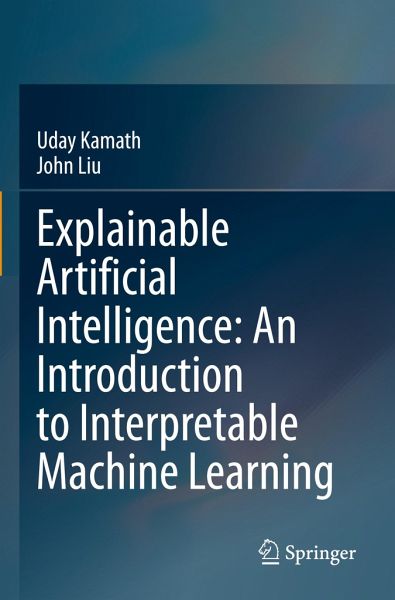
 Explainable Artificial Intelligence: An Introduction to Interpretable Machine Learning106,99 €
 Explainable and Interpretable Reinforcement Learning for Robotics42,99 €
 Explainable and Interpretable Reinforcement Learning for Robotics42,99 €
 Explainable Artificial Intelligence98,99 €
 Explainable Artificial Intelligence61,99 €
 Explainable Artificial Intelligence65,99 €
 Explainable Artificial Intelligence61,99 €
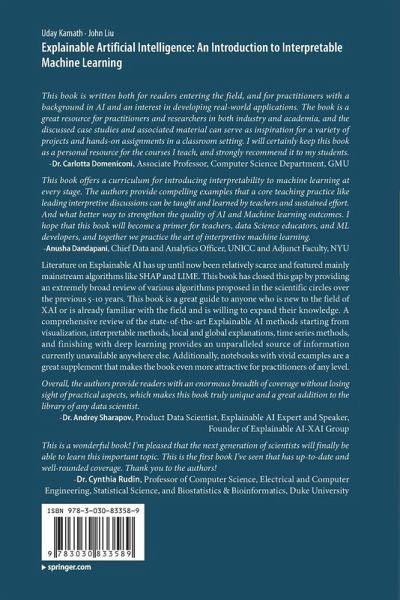
This book is written both for readers entering the field, and for practitioners with a background in AI and an interest in developing real-world applications. The book is a great resource for practitioners and researchers in both industry and academia, and the discussed case studies and associated material can serve as inspiration for a variety of projects and hands-on assignments in a classroom setting. I will certainly keep this book as a personal resource for the courses I teach, and strongly recommend it to my students.
--Dr. Carlotta Domeniconi, Associate Professor, Computer Science Department, GMU
This book offers a curriculum for introducing interpretability to machine learning at every stage. The authors provide compelling examples that a core teaching practice like leading interpretive discussions can be taught and learned by teachers and sustained effort. And what better way to strengthen the quality of AI and Machine learning outcomes. I hope that this book will become a primer for teachers, data Science educators, and ML developers, and together we practice the art of interpretive machine learning.
--Anusha Dandapani, Chief Data and Analytics Officer, UNICC and Adjunct Faculty, NYU
This is a wonderful book! I'm pleased that the next generation of scientists will finally be able to learn this important topic. This is the first book I've seen that has up-to-date and well-rounded coverage. Thank you to the authors!
--Dr. Cynthia Rudin, Professor of Computer Science, Electrical and Computer Engineering, Statistical Science, and Biostatistics & Bioinformatics
Literature on Explainable AI has up until now been relatively scarce and featured mainly mainstream algorithms like SHAP and LIME. This book has closed this gap by providing an extremely broad review of various algorithms proposed in the scientific circles over the previous 5-10 years. This book is a great guide to anyone who isnew to the field of XAI or is already familiar with the field and is willing to expand their knowledge. A comprehensive review of the state-of-the-art Explainable AI methods starting from visualization, interpretable methods, local and global explanations, time series methods, and finishing with deep learning provides an unparalleled source of information currently unavailable anywhere else. Additionally, notebooks with vivid examples are a great supplement that makes the book even more attractive for practitioners of any level.
Overall, the authors provide readers with an enormous breadth of coverage without losing sight of practical aspects, which makes this book truly unique and a great addition to the library of any data scientist.
Dr. Andrey Sharapov, Product Data Scientist, Explainable AI Expert and Speaker, Founder ofExplainable AI-XAI Group
--Dr. Carlotta Domeniconi, Associate Professor, Computer Science Department, GMU
This book offers a curriculum for introducing interpretability to machine learning at every stage. The authors provide compelling examples that a core teaching practice like leading interpretive discussions can be taught and learned by teachers and sustained effort. And what better way to strengthen the quality of AI and Machine learning outcomes. I hope that this book will become a primer for teachers, data Science educators, and ML developers, and together we practice the art of interpretive machine learning.
--Anusha Dandapani, Chief Data and Analytics Officer, UNICC and Adjunct Faculty, NYU
This is a wonderful book! I'm pleased that the next generation of scientists will finally be able to learn this important topic. This is the first book I've seen that has up-to-date and well-rounded coverage. Thank you to the authors!
--Dr. Cynthia Rudin, Professor of Computer Science, Electrical and Computer Engineering, Statistical Science, and Biostatistics & Bioinformatics
Literature on Explainable AI has up until now been relatively scarce and featured mainly mainstream algorithms like SHAP and LIME. This book has closed this gap by providing an extremely broad review of various algorithms proposed in the scientific circles over the previous 5-10 years. This book is a great guide to anyone who isnew to the field of XAI or is already familiar with the field and is willing to expand their knowledge. A comprehensive review of the state-of-the-art Explainable AI methods starting from visualization, interpretable methods, local and global explanations, time series methods, and finishing with deep learning provides an unparalleled source of information currently unavailable anywhere else. Additionally, notebooks with vivid examples are a great supplement that makes the book even more attractive for practitioners of any level.
Overall, the authors provide readers with an enormous breadth of coverage without losing sight of practical aspects, which makes this book truly unique and a great addition to the library of any data scientist.
Dr. Andrey Sharapov, Product Data Scientist, Explainable AI Expert and Speaker, Founder ofExplainable AI-XAI Group
This book is written both for readers entering the field, and for practitioners with a background in AI and an interest in developing real-world applications. The book is a great resource for practitioners and researchers in both industry and academia, and the discussed case studies and associated material can serve as inspiration for a variety of projects and hands-on assignments in a classroom setting. I will certainly keep this book as a personal resource for the courses I teach, and strongly recommend it to my students.
--Dr. Carlotta Domeniconi, Associate Professor, Computer Science Department, GMU
This book offers a curriculum for introducing interpretability to machine learning at every stage. The authors provide compelling examples that a core teaching practice like leading interpretive discussions can be taught and learned by teachers and sustained effort. And what better way to strengthen the quality of AIand Machine learning outcomes. I hope that this book will become a primer for teachers, data Science educators, and ML developers, and together we practice the art of interpretive machine learning.
--Anusha Dandapani, Chief Data and Analytics Officer, UNICC and Adjunct Faculty, NYU
Literature on Explainable AI has up until now been relatively scarce and featured mainly mainstream algorithms like SHAP and LIME. This book has closed this gap by providing an extremely broad review of various algorithms proposed in the scientific circles over the previous 5-10 years. This book is a great guide to anyone who is new to the field of XAI or is already familiar with the field and is willing to expand their knowledge. A comprehensive review of the state-of-the-art Explainable AI methods starting from visualization, interpretable methods, local and global explanations, time series methods, and finishing with deep learning provides an unparalleled source ofinformation currently unavailable anywhere else. Additionally, notebooks with vivid examples are a great supplement that makes the book even more attractive for practitioners of any level.
Overall, the authors provide readers with an enormous breadth of coverage without losing sight of practical aspects, which makes this book truly unique and a great addition to the library of any data scientist.
Dr. Andrey Sharapov, Product Data Scientist, Explainable AI Expert and Speaker, Founder of Explainable AI-XAI Group
This is a wonderful book! I'm pleased that the next generation of scientists will finally be able to learn this important topic. This is the first book I've seen that has up-to-date and well-rounded coverage. Thank you to the authors!"
--Dr. Cynthia Rudin, Professor of Computer Science, Electrical and Computer Engineering, Statistical Science, and Biostatistics & Bioinformatics
--Dr. Carlotta Domeniconi, Associate Professor, Computer Science Department, GMU
This book offers a curriculum for introducing interpretability to machine learning at every stage. The authors provide compelling examples that a core teaching practice like leading interpretive discussions can be taught and learned by teachers and sustained effort. And what better way to strengthen the quality of AIand Machine learning outcomes. I hope that this book will become a primer for teachers, data Science educators, and ML developers, and together we practice the art of interpretive machine learning.
--Anusha Dandapani, Chief Data and Analytics Officer, UNICC and Adjunct Faculty, NYU
Literature on Explainable AI has up until now been relatively scarce and featured mainly mainstream algorithms like SHAP and LIME. This book has closed this gap by providing an extremely broad review of various algorithms proposed in the scientific circles over the previous 5-10 years. This book is a great guide to anyone who is new to the field of XAI or is already familiar with the field and is willing to expand their knowledge. A comprehensive review of the state-of-the-art Explainable AI methods starting from visualization, interpretable methods, local and global explanations, time series methods, and finishing with deep learning provides an unparalleled source ofinformation currently unavailable anywhere else. Additionally, notebooks with vivid examples are a great supplement that makes the book even more attractive for practitioners of any level.
Overall, the authors provide readers with an enormous breadth of coverage without losing sight of practical aspects, which makes this book truly unique and a great addition to the library of any data scientist.
Dr. Andrey Sharapov, Product Data Scientist, Explainable AI Expert and Speaker, Founder of Explainable AI-XAI Group
This is a wonderful book! I'm pleased that the next generation of scientists will finally be able to learn this important topic. This is the first book I've seen that has up-to-date and well-rounded coverage. Thank you to the authors!"
--Dr. Cynthia Rudin, Professor of Computer Science, Electrical and Computer Engineering, Statistical Science, and Biostatistics & Bioinformatics