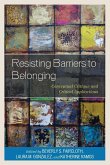
This groundbreaking book explores the interactions of three powerful concepts in early childhood education: early childhood settings as sites for democracy, belonging as a human need and basis for participation, and relationships with land. Through exemplars of pioneering practice, it renews thinking about democracy and broadens understanding of belonging in culturally diverse societies. Drawing from three research projects undertaken with teachers as collaborators in eleven early childhood settings, the book showcases examples grounded in Aotearoa New Zealand's renowned bicultural curriculum,…mehr
This groundbreaking book explores the interactions of three powerful concepts in early childhood education: early childhood settings as sites for democracy, belonging as a human need and basis for participation, and relationships with land. Through exemplars of pioneering practice, it renews thinking about democracy and broadens understanding of belonging in culturally diverse societies. Drawing from three research projects undertaken with teachers as collaborators in eleven early childhood settings, the book showcases examples grounded in Aotearoa New Zealand's renowned bicultural curriculum, Te Wh¿riki. It demonstrates how participatory design methodologies can reimagine the theory-practice nexus and privilege diverse voices often marginalized in traditional research settings. Woven throughout are "glimpses of hope" that illustrate new possibilities for pedagogical practice in the country's bicultural context. In a time marked by significant societal shifts and neoliberal pressures, the authors argue that layering and interweaving these three concepts enables the creation of innovative approaches to policy thinking and practice that challenge existing frameworks and advocate for public, democratic early childhood education systems. This essential resource will interest postgraduate students, researchers, teachers, student teachers, early childhood managers and policy makers. It offers valuable insights for advanced students and practitioners of early childhood education seeking to understand democratic practice and belonging in diverse cultural contexts around the globe.
Linda Mitchell Linda Mitchell is Retired Professor and Honorary Fellow, at Te Whare W¿nanga o Waikato, University of Waikato, in Aotearoa New Zealand. Raella Kahuroa Raella Kahuroa (Ng¿ti Kahungungu) is a lecturer and researcher in early childhood education at Te Whare W¿nanga o Waikato, University of Waikato, in Aotearoa New Zealand. Amanda Bateman Amanda Bateman is a Professor of Early Years at Birmingham City University, England, having worked at Te Whare W¿nanga o Waikato, University of Waikato. Bronwen Cowie Bronwen Cowie is an Emeritus Professor at Te Whare W¿nanga o Waikato, University of Waikato, in Aotearoa New Zealand. Olivera Kamenarac Olivera Kamenarac is a Senior Lecturer in Education at Southern Cross University, Australia after working at Te Whare W¿nanga, University of Waikato. Elaine Khoo Elaine Khoo is an Associate Professor at the Institute of Education at Massey University, New Zealand after working at Te Whare W¿nanga, University of Waikato. Hoana McMillan Hoana McMillan (Ng¿i Te Rangi, Ng¿ti Porou, Ng¿ti Kahungunu) is a lecturer and kaupapa M¿ori researcher at Te Whare W¿nanga o Waikato, University of Waikato, in Aotearoa New Zealand. Lesley Kay Rameka Lesley Rameka (Ng¿ti Raukawa, Ng¿ti Tukorehe) has recently retired from her roles as a Senior Research Fellow and Kaupapa M¿ori researcher at Te Whare W¿nanga o Waikato, University of Waikato, in Aotearoa New Zealand.
Inhaltsangabe
List of figures Acknowledgements Author biographies Chapter 1: Introduction. Setting the scene Background Conceptual framing Definitions Outline/structure of the book Theme 1: Democracy in education Chapter 2: Democracy as a value and purpose for a public education system Chapter 3: Early childhood education creating a world Chapter 4: Creating a democratic living philosophy (a new chapter with Berhampore Kgtn) Chapter 5: K hanga reo and transformational directions for education Chapter 6: Teachers as democratic professionals and the child as citizen Theme 2: Belonging, connections to others and the environment Chapter 7: A human rights analysis of early childhood policy Chapter 8: P whiri - the traditional m ori ceremony of welcome as a process for supporting belonging Chapter 9: Participation in cultural processes of food preparation and belonging Chapter 10: Connecting homeland with EC settings Theme 3: Relationships with land Chapter 11: Ko au te whenua, ko te whenua ko au - I am the land and the land is me Chapter 12: Walking with young children to story and read the land Chapter 13: Maunganui Kindergarten: Developing connectedness with land and with people Theme 4: Renewing the thinking and practice of democracy in researching early childhood education. Research as a palimpsest Chapter 14. Research partnerships for exploring pedagogical practice in Aotearoa New Zealand Chapter 15. Research as a palimpsest. Possibilities for research, pedagogy and policy Glossary References for all chapters
List of figures Acknowledgements Author biographies Chapter 1: Introduction. Setting the scene Background Conceptual framing Definitions Outline/structure of the book Theme 1: Democracy in education Chapter 2: Democracy as a value and purpose for a public education system Chapter 3: Early childhood education creating a world Chapter 4: Creating a democratic living philosophy (a new chapter with Berhampore Kgtn) Chapter 5: K hanga reo and transformational directions for education Chapter 6: Teachers as democratic professionals and the child as citizen Theme 2: Belonging, connections to others and the environment Chapter 7: A human rights analysis of early childhood policy Chapter 8: P whiri - the traditional m ori ceremony of welcome as a process for supporting belonging Chapter 9: Participation in cultural processes of food preparation and belonging Chapter 10: Connecting homeland with EC settings Theme 3: Relationships with land Chapter 11: Ko au te whenua, ko te whenua ko au - I am the land and the land is me Chapter 12: Walking with young children to story and read the land Chapter 13: Maunganui Kindergarten: Developing connectedness with land and with people Theme 4: Renewing the thinking and practice of democracy in researching early childhood education. Research as a palimpsest Chapter 14. Research partnerships for exploring pedagogical practice in Aotearoa New Zealand Chapter 15. Research as a palimpsest. Possibilities for research, pedagogy and policy Glossary References for all chapters
Es gelten unsere Allgemeinen Geschäftsbedingungen: www.buecher.de/agb
Impressum
www.buecher.de ist ein Internetauftritt der buecher.de internetstores GmbH
Geschäftsführung: Monica Sawhney | Roland Kölbl | Günter Hilger
Sitz der Gesellschaft: Batheyer Straße 115 - 117, 58099 Hagen
Postanschrift: Bürgermeister-Wegele-Str. 12, 86167 Augsburg
Amtsgericht Hagen HRB 13257
Steuernummer: 321/5800/1497
USt-IdNr: DE450055826