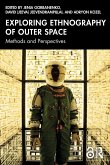
This book explores new methods and perspectives in the anthropology of outer space. For the past ten years, scholarship of outer space has grown significantly in the social sciences. Now, an international community of anthropologists is starting to produce significant contributions to this work. This is pushing the conversations around the future of humanity, technology, and outer space beyond the realm of speculative theory into concrete challenges to established norms within anthropology. Each chapter in this volume introduces a unique take on what constitutes an ethnographic field in…mehr
This book explores new methods and perspectives in the anthropology of outer space. For the past ten years, scholarship of outer space has grown significantly in the social sciences. Now, an international community of anthropologists is starting to produce significant contributions to this work. This is pushing the conversations around the future of humanity, technology, and outer space beyond the realm of speculative theory into concrete challenges to established norms within anthropology. Each chapter in this volume introduces a unique take on what constitutes an ethnographic field in anthropology. They signal a re-imagination of the central concept for the discipline and offer a timely meditation on the shift in anthropology's understanding of fieldwork from its inception until now. The volume consists of eleven ethnographic chapters, plus an introduction by the editors, and two invited responses. Each of the main body chapters presents a distinct approach to situating outer space empirically on Earth. By bringing together emerging and established scholars, this book ultimately posits that an anthropological approach to outer space requires creative approaches to ethnography that are no longer exclusively premised on a co-presence with the people under study. A primer of innovative ethnographies and an ideal companion to courses on methods, this volume will provide students with a body of accessible, contemporary work on futurisms and outer space. In addition, this book will serve as a snapshot of a moment in ethnographically innovative anthropology that will be relevant to a wider academic audience through its exegesis of new methods for the study of distributed communities.
The Open Access version of this book, available at http://www.taylorfrancis.com, has been made available under a Creative Commons Attribution-Non Commercial-No Derivatives-ShareAlike (CC-BY-NC-SA) 4.0 license.
Jenia Gorbanenko is a PhD candidate in Anthropology at University College London specialising in the anthropology of religion in outer space. David (Jeeva) Jeevendrampillai is a Lecturer at The University of Manchester. He researches planetary belonging and community building in outer space. Adryon Kozel is a PhD candidate in Anthropology at University College London. They research how space enthusiasts construct potential futures in space, and narratives of what it means for humans to go to space. All three editors are members of the ERC Advanced Grant ETHNO-ISS, an anthropological study of the International Space Station based at University College London.
Inhaltsangabe
1. Introduction 2. Transcendence bodies and estranged labour in outer space: The astronaut's contribution to a general theory of hierarchy 3. Anthropologists in outer space: Science fiction infrastructure comparison 4. Imaginaries of Outer Space from Africa. Astronomy Infrastructure in South Africa and Madagascar 5. Museums Meteorites and Portals: tracing the imperial logics of trans-planetary resource extractivism 6. Of Stars and Wheat: Making Sense of the Cosmos in a Regional Museum of Cosmonautics 7. From Mexico to the Moon: (Outer)Spatializing Ethnography 8. Are we still anthropologists if we go to space using only our imaginations? 9. Terraforming a field site: Reflections on crafting knowledge on Mars 10. Composing the cosmos: Tuning into multiplicities with Thai Buddhist concepts 11. Divining South Korea's Space Age through Korean Shamanism and Astrology (My¿ngni) 12. Space intentionally left blank 13. Methodological Sensibilities in Outer Spaces 14. ...a response
1. Introduction 2. Transcendence bodies and estranged labour in outer space: The astronaut's contribution to a general theory of hierarchy 3. Anthropologists in outer space: Science fiction infrastructure comparison 4. Imaginaries of Outer Space from Africa. Astronomy Infrastructure in South Africa and Madagascar 5. Museums Meteorites and Portals: tracing the imperial logics of trans-planetary resource extractivism 6. Of Stars and Wheat: Making Sense of the Cosmos in a Regional Museum of Cosmonautics 7. From Mexico to the Moon: (Outer)Spatializing Ethnography 8. Are we still anthropologists if we go to space using only our imaginations? 9. Terraforming a field site: Reflections on crafting knowledge on Mars 10. Composing the cosmos: Tuning into multiplicities with Thai Buddhist concepts 11. Divining South Korea's Space Age through Korean Shamanism and Astrology (My¿ngni) 12. Space intentionally left blank 13. Methodological Sensibilities in Outer Spaces 14. ...a response
Es gelten unsere Allgemeinen Geschäftsbedingungen: www.buecher.de/agb
Impressum
www.buecher.de ist ein Internetauftritt der buecher.de internetstores GmbH
Geschäftsführung: Monica Sawhney | Roland Kölbl | Günter Hilger
Sitz der Gesellschaft: Batheyer Straße 115 - 117, 58099 Hagen
Postanschrift: Bürgermeister-Wegele-Str. 12, 86167 Augsburg
Amtsgericht Hagen HRB 13257
Steuernummer: 321/5800/1497
USt-IdNr: DE450055826