
Andere Kunden interessierten sich auch für
 Exploring the dual roles of mother and student teacher32,99 €
 Collected Papers VI. Literary Reality and Relationships113,99 €
 Educator-learner relationships in South African public schools45,99 €
 Effectiveness of Teacher-student Ratio Policy on Classroom Learning39,99 €
 Exploring Beliefs and Practices of Teachers of Secondary Mathematics52,99 €
 TEACHER-STUDENT INTERACTIONS52,99 €
 Exploring Best Practices of Literacy Instruction32,99 €
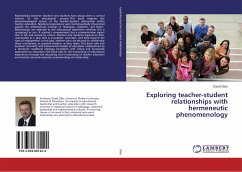
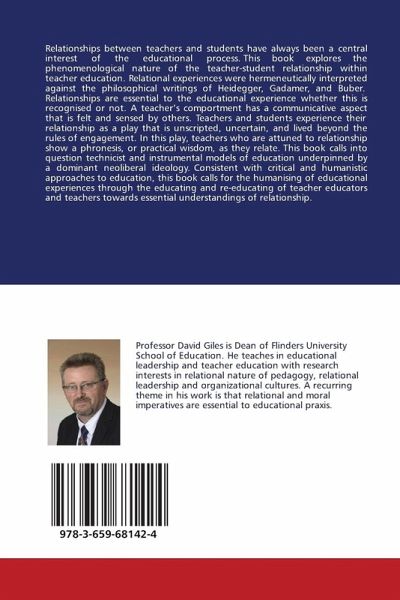
Relationships between teachers and students have always been a central interest of the educational process. This book explores the phenomenological nature of the teacher-student relationship within teacher education. Relational experiences were hermeneutically interpreted against the philosophical writings of Heidegger, Gadamer, and Buber. Relationships are essential to the educational experience whether this is recognised or not. A teacher's comportment has a communicative aspect that is felt and sensed by others. Teachers and students experience their relationship as a play that is unscripted, uncertain, and lived beyond the rules of engagement. In this play, teachers who are attuned to relationship show a phronesis, or practical wisdom, as they relate. This book calls into question technicist and instrumental models of education underpinned by a dominant neoliberal ideology. Consistent with critical and humanistic approaches to education, this book calls for the humanising of educational experiences through the educating and re-educating of teacher educators and teachers towards essential understandings of relationship.