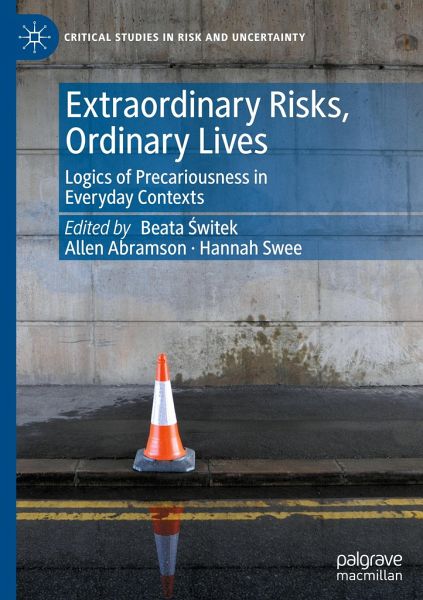
This book untangles the relationship between expert categorisations of risk and the on-the-ground experiences of untrained 'ordinary' people who may be routinely subjected to significant danger in a variety of extraordinary contexts. It considers political, ethical and moral dimensions of risk and calls for more targeted ethnographic research, designed to reveal how grass-roots risk dispositions and practice intersect with official discourses, individual agency and community resilience.
This book untangles the relationship between expert categorisations of risk and the on-the-ground experiences of untrained 'ordinary' people who may be routinely subjected to significant danger in a variety of extraordinary contexts. It considers political, ethical and moral dimensions of risk and calls for more targeted ethnographic research, designed to reveal how grass-roots risk dispositions and practice intersect with official discourses, individual agency and community resilience.
Beata ¿witek is Assistant Professor at the Department of Cross-Cultural and Regional Studies, University of Copenhagen, Denmark. Allen Abramson is a Senior Lecturer in Social Anthropology at University College London, UK. Hannah Swee is a climate and capacity building specialist for the United Nations.
Inhaltsangabe
Chapter 1. Introduction: Ordinary life, extraordinary risk: On the normalisation of significant risk-taking in precarious contexts.- Part I. Self-Constitution: Defiance, endurance and choice.- Chapter 2. 'Knowing how to walk': Risk, violence and practices of endurance in urban Brazil.- Chapter 3. Risk negotiations in the mines of Potosí: Implications for rethinking current Health and Safety approaches.- Chapter 4. Regenerative medicine, unproven therapies and the framing of clinical risk.- Chapter 5. Commentary: Clear and present danger: Dodging and dealing with risk and uncertainty in everyday life.- Part II. Shifting dangers: Macro and micro politics of risk.- Chapter 6. 'Keeping the conversation going': Understanding risk in a context of escalating conflict in Syria.- Chapter 7. The Edgeworker's Habitus: Climbing and Ordinary Risks.- Chapter 8. Commentary: Action, edgework, and the situated logics of risk.- Part III. Environmental threat and cultural possibility: Risk and the contemporary city.- Chapter 9. 'Asilmak tehlikeli ve yasaktir': Unintelligible mobility and uncertain manhood in Istanbul's Old City.- Chapter 10. Ordinary life in the shadow of Vesuvius: Surviving the announced catastrophe.- Chapter 11. Keeping disasters under control: Anticipation, cyclones and responses to uncertainty.- Chapter 12. Commentary: Interpretive risk ethnography as a means of understanding risk problems: Encounters with the ordinary-extraordinary and what comes after?
Chapter 1. Introduction: Ordinary life, extraordinary risk: On the normalisation of significant risk-taking in precarious contexts.- Part I. Self-Constitution: Defiance, endurance and choice.- Chapter 2. 'Knowing how to walk': Risk, violence and practices of endurance in urban Brazil.- Chapter 3. Risk negotiations in the mines of Potosí: Implications for rethinking current Health and Safety approaches.- Chapter 4. Regenerative medicine, unproven therapies and the framing of clinical risk.- Chapter 5. Commentary: Clear and present danger: Dodging and dealing with risk and uncertainty in everyday life.- Part II. Shifting dangers: Macro and micro politics of risk.- Chapter 6. 'Keeping the conversation going': Understanding risk in a context of escalating conflict in Syria.- Chapter 7. The Edgeworker's Habitus: Climbing and Ordinary Risks.- Chapter 8. Commentary: Action, edgework, and the situated logics of risk.- Part III. Environmental threat and cultural possibility: Risk and the contemporary city.- Chapter 9. 'Asilmak tehlikeli ve yasaktir': Unintelligible mobility and uncertain manhood in Istanbul's Old City.- Chapter 10. Ordinary life in the shadow of Vesuvius: Surviving the announced catastrophe.- Chapter 11. Keeping disasters under control: Anticipation, cyclones and responses to uncertainty.- Chapter 12. Commentary: Interpretive risk ethnography as a means of understanding risk problems: Encounters with the ordinary-extraordinary and what comes after?
Es gelten unsere Allgemeinen Geschäftsbedingungen: www.buecher.de/agb
Impressum
www.buecher.de ist ein Internetauftritt der buecher.de internetstores GmbH
Geschäftsführung: Monica Sawhney | Roland Kölbl | Günter Hilger
Sitz der Gesellschaft: Batheyer Straße 115 - 117, 58099 Hagen
Postanschrift: Bürgermeister-Wegele-Str. 12, 86167 Augsburg
Amtsgericht Hagen HRB 13257
Steuernummer: 321/5800/1497
USt-IdNr: DE450055826