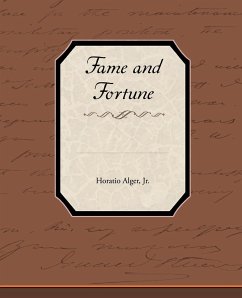
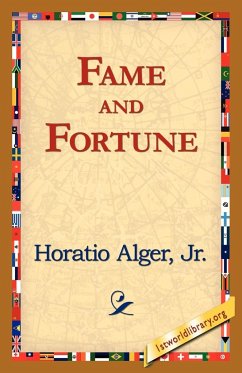
The room which yielded so much satisfaction to the two boys was on the fourth floor of a boarding-house in Bleecker Street. No doubt many of my young readers, who are accustomed to elegant homes, would think it very plain; but neither Richard nor his friend had been used to anything as good. They had been thrown upon their own exertions at an early age, and had a hard battle to fight with poverty and ignorance. Those of my readers who are familiar with Richard Hunter's experiences when he was "Ragged Dick," will easily understand what a great rise in the world it was for him to have a really…mehr
The room which yielded so much satisfaction to the two boys was on the fourth floor of a boarding-house in Bleecker Street. No doubt many of my young readers, who are accustomed to elegant homes, would think it very plain; but neither Richard nor his friend had been used to anything as good. They had been thrown upon their own exertions at an early age, and had a hard battle to fight with poverty and ignorance. Those of my readers who are familiar with Richard Hunter's experiences when he was "Ragged Dick," will easily understand what a great rise in the world it was for him to have a really respectable home. For years he had led a vagabond life about the streets, as a boot-black, sleeping in old wagons, or boxes, or wherever he could find a lodging gratis. It was only twelve months since a chance meeting with an intelligent boy caused him to form the resolution to grow up respectable. By diligent evening study with Henry Fosdick, whose advantages had been much greater than his own, assisted by a natural quickness and an unusual aptitude for learning, he had, in a year, learned to read and write well, and had, besides, made considerable progress in arithmetic. Still he would have found it difficult to obtain a situation if he had not been the means of saving from drowning the young child of Mr. James Rockwell, a wealthy merchant in business on Pearl Street, who at once, out of gratitude for the service rendered, engaged our hero in his employ at the unusual compensation, for a beginner, of ten dollars a week. His friend, Henry Fosdick, was in a hat store on Broadway, but thus far only received six dollars a week.
Horatio Alger, an American novelist who lived from January 13, 1832, to July 18, 1899, authored books for young adults about poor lads who, through their good deeds, climb from impoverished roots to lives of stability and comfort in the middle class. His works are known for their "rags-to-riches" narrative, which had a formative influence on the Gilded Age United States. All of Alger's young adult books revolve around the idea that a young man can change his situation for the better by acting morally. The "Horatio Alger myth" holds that the young man achieves success via toil, however, this is untrue. The youngster behaves according to classic characteristics like honesty, generosity, and altruism in the actual stories, and success is invariably the result of an accident that works to the boy's advantage. The youngster might recover a sizable sum of money that was misplaced or save a passenger from a derailed carriage. A wealthy person notices the youngster and his predicament as a result of this. For instance, in one tale, a little child narrowly avoids being hit by a streetcar before being snatched away to safety by a homeless orphan youth.
Es gelten unsere Allgemeinen Geschäftsbedingungen: www.buecher.de/agb
Impressum
www.buecher.de ist ein Internetauftritt der buecher.de internetstores GmbH
Geschäftsführung: Monica Sawhney | Roland Kölbl | Günter Hilger
Sitz der Gesellschaft: Batheyer Straße 115 - 117, 58099 Hagen
Postanschrift: Bürgermeister-Wegele-Str. 12, 86167 Augsburg
Amtsgericht Hagen HRB 13257
Steuernummer: 321/5800/1497
USt-IdNr: DE450055826